
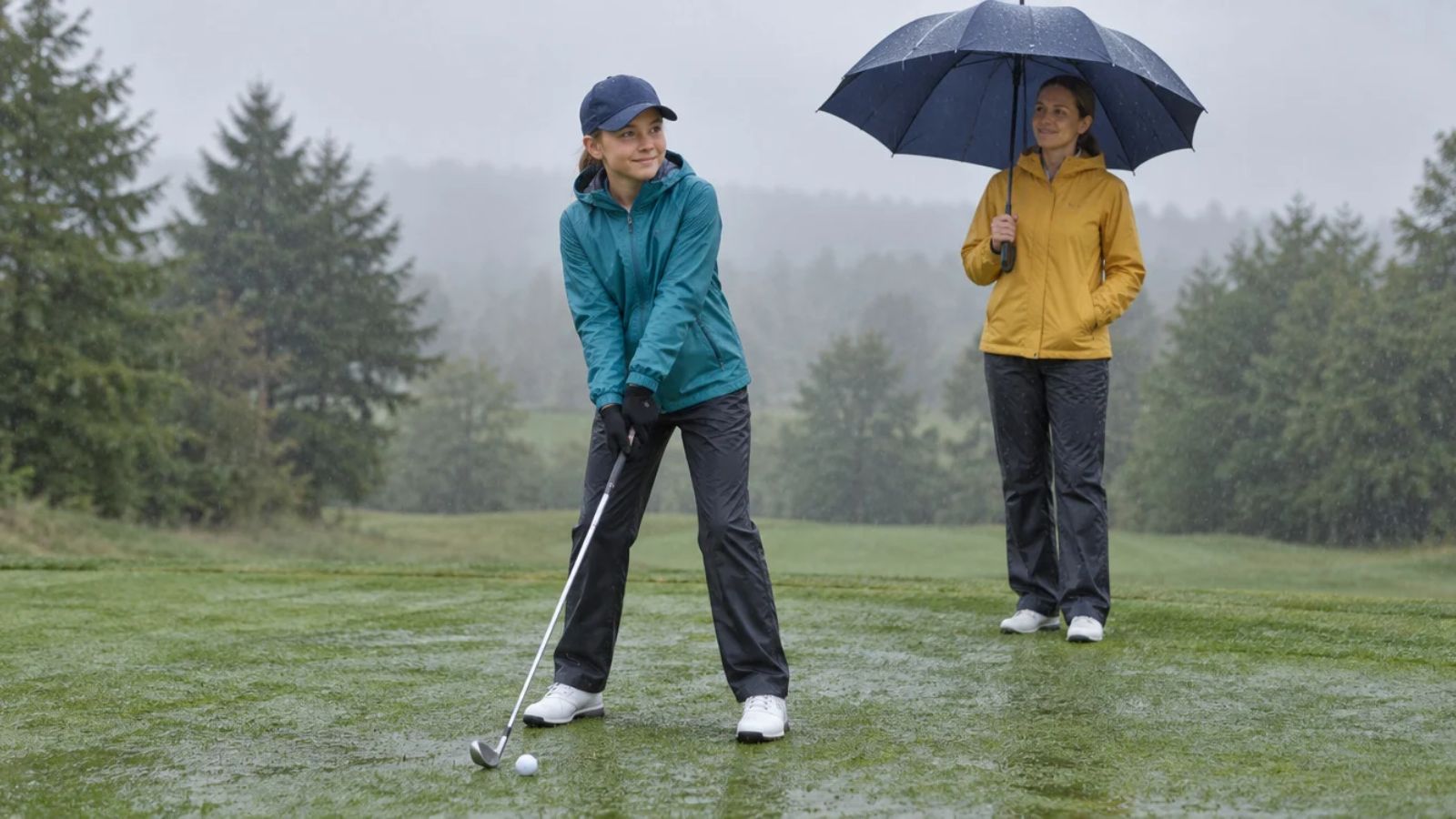

The first properly wet rounds of fall are when most families go looking for the best rain gloves for junior golf, usually the night before a soggy event. It’s a smaller search than you’d expect. Walk the glove wall at a golf shop and you’ll find plenty of junior gloves and plenty of rain gloves, but almost nothing that is both. This review looks hard at the one pair most junior golf families end up with anyway, FootJoy’s RainGrip, and at what to do when your child’s hands are still too small for it. If you’re reading this from the southern hemisphere, as I am, swap fall for spring and the advice holds.
I’m Al. I trained and taught high school mathematics and science, and these days I’m at home with two boys, five years apart, who have worked through a good deal of golf gear between them. I’m not a club fitter or a golf professional, and I don’t name the gear we own on this site, so nothing here comes from strapping these gloves onto my own kids. What I bring is a science teacher’s habit of asking who measured what, and a parent’s sense of which specs matter in the rain. Stay with me and you’ll see who this pair suits, who it doesn’t, and what to buy instead.

🌧️🧤 Quick Verdict
FootJoy RainGrip Golf Gloves (Pair)
★★★★☆ | ~$27.95 USD | Mid-range
Best for: Juniors about 11 and up whose hands have outgrown junior X-Large gloves
Rated on FootJoy's specifications and more than 400 owner reviews rather than my own children's hands: it's the best rain grip a junior can realistically wear, once their hands reach adult Small.
- Sold as a pair, so both hands grip in the wet
- An Autosuede knit palm built for wet and humid rounds
- Women's, men's and Cadet cuts give small hands three chances to fit
- Worth knowing: No junior sizes, so it's too big for most children under about 11
👉 Shop FootJoy RainGrip (opens in a new tab)
Photo 13
What You're Getting
FootJoy traces its roots to a Brockton, Massachusetts shoe company founded in 1857, which first used the FootJoy name in 1923, and Acushnet has owned the brand since 1985, according to FootJoy's company history (opens in a new tab). It calls RainGrip the world's #1 men's (opens in a new tab) rain golf glove. That's the maker's own claim, not an independent ranking, but it was the one rain pair carried by every US, UK and Australian retailer I checked.
What arrives is two gloves, one for each hand, because FootJoy sells RainGrip only in pairs (opens in a new tab). There's no junior version. The cuts that matter for a child are the smallest adult ones, and here's what FootJoy and the retailers publish about them.
RainGrip at a glance
| Detail | What's published |
|---|---|
| Sold as | A pair, one glove for each hand |
| Palm | Autosuede knit, made for grip in wet or humid conditions |
| Back of fingers | Quick-dry knit for breathability |
| Closure | Angled ComforTab hook-and-loop tab |
| Extras | Removable ball marker |
| Women's pair | Sizes S, M, M/L, L |
| Men's pair | Regular S to 2XL, plus a Cadet pair with shorter fingers |
| Junior sizes | None |
| Weight, warranty, care | Not published on FootJoy's product page |
| Price tier | Mid-range |
Checked November 2026 on FootJoy US and Worldwide Golf Shops.
Price and availability: In the US, the women's pair is $27.95 USD (opens in a new tab) at Worldwide Golf Shops in Small to Large, though that store ships FootJoy to US addresses only (opens in a new tab). FootJoy sells the men's pair, in Regular and Cadet cuts, for $28.00 USD (opens in a new tab). In the UK, the same glove is sold as the HydroSeries RainGrip, at £21.95 GBP (opens in a new tab) at The Golf Shop Online in sizes S to XL, though that listing doesn't ship outside the EU. In Australia, FootJoy lists the RainGrip Pair at $32 AUD (opens in a new tab) in S to XL, but it was out of stock when I checked, while the women's RainGrip is sold there as single gloves (opens in a new tab) at $26.95 AUD.
That's the pair on paper. The more useful question is which of those details actually help a junior keep hold of a wet club, and how well this pair delivers on each.
Key Features
Two gloves, because two hands get wet: A normal golf glove covers one hand, and in steady rain the bare hand is where the trouble starts. RainGrip comes as a pair (opens in a new tab), so both hands meet the grip through the same fabric, and a child doesn't have to think about which hand is slipping. At $28.00 USD (opens in a new tab) for the pair from FootJoy, that's two gloves at a mid-range price, which matters when the pair is likely to be outgrown before it's worn out.
A palm made to get wet: There's a reason ordinary gloves and bare hands give up in a downpour. A University of Sheffield study found that the friction between a finger and a surface rises with moisture (opens in a new tab) up to a point and then falls, with water absorption the main reason for the early rise. Past that point, more water means less grip. FootJoy's answer is an Autosuede knit palm that it says gives grip in wet (opens in a new tab) or humid conditions, which retailers describe as water-absorbent. Golf Monthly puts the trade-off plainly: wet-weather gloves are more about protection (opens in a new tab) than feel. For a junior still building a sound grip, a club that stays put matters more than touch.
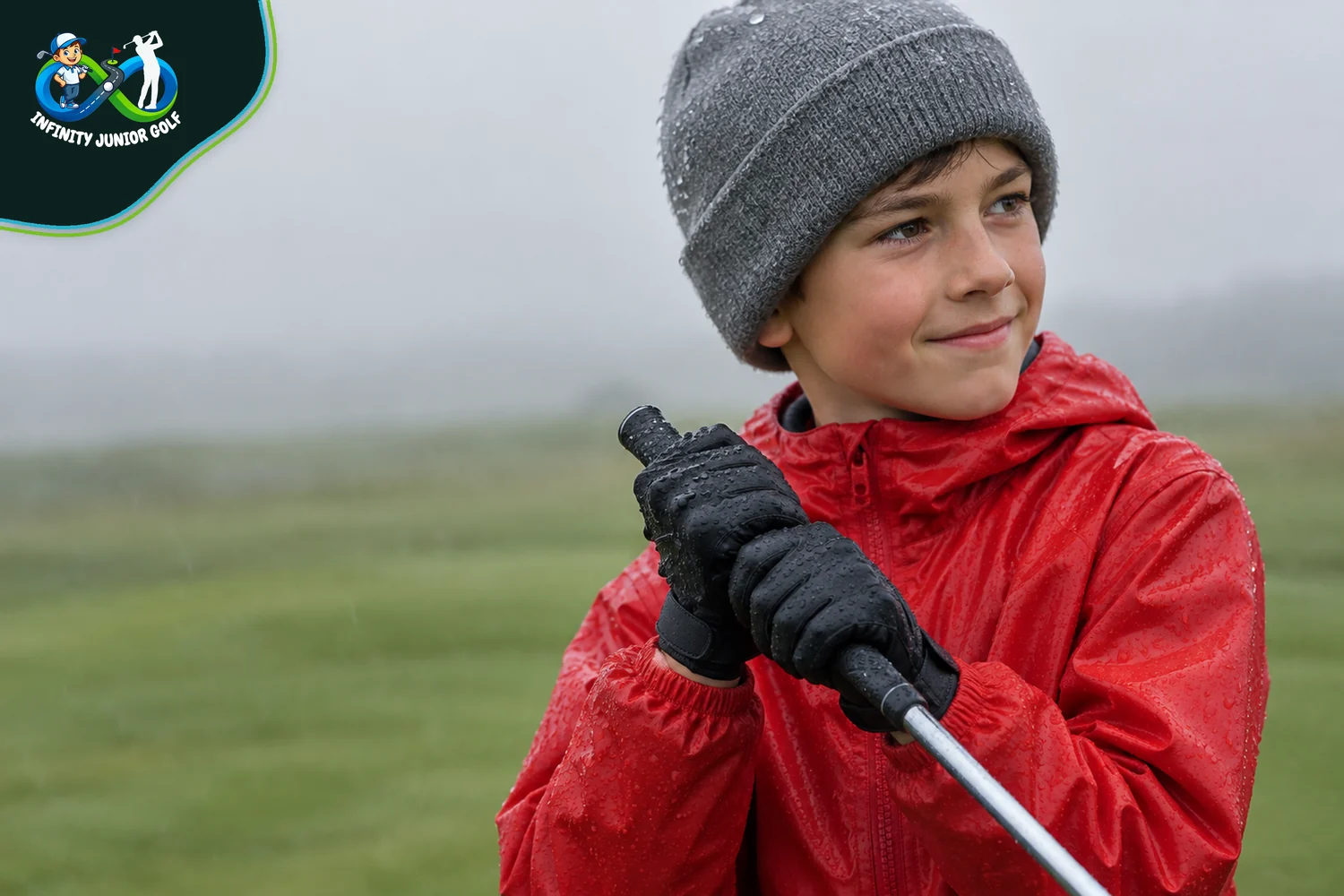
Three cuts give a small hand more chances: This is the feature that decides whether RainGrip works for your child at all. FootJoy sizes adult gloves by middle-finger length and palm width, and its fitting guide says that if the finger number is smaller than the palm number, you should try a Cadet glove (opens in a new tab), which has shorter fingers. The same guide notes that for some men, a women's glove (opens in a new tab) may be the best option, and that several Tour players wear one. So between the women's pair, the men's Regular and the men's Cadet, a boy or girl at the bottom of the adult range has three shapes to try. Hands keep changing, and FootJoy suggests checking glove size at the start of every season (opens in a new tab), which for a growing junior is the same rule as everything else: measure before buying.
No junior sizes is the catch: The smallest RainGrip is an adult Small, and nothing in FootJoy's range goes below it. The U.S. Kids Golf junior chart runs up to X-Large at 17.5 cm (opens in a new tab) from the bottom of the palm to the tip of the middle finger, with ages 11 to 12 given as a rough guide. As a rule of thumb, adult sizing picks up roughly where junior sizing stops, so most children under about 11 are likely to find even the women's Small too long in the fingers. A rain glove that's loose slips inside itself, which is the one thing it exists to prevent. It's one more line on the list of junior golf costs that comes from growth rather than wear.
It's well within the rules: The R&A and USGA Equipment Rules allow gloves provided they are plain (opens in a new tab): a fitted covering with a separate sheath for each finger and thumb, smooth material across the palm, and no padding, straps or material that sticks to the grip. The rules specifically allow material added for moisture absorption (opens in a new tab) as long as it doesn't count as padding, and the USGA's version (opens in a new tab) reads the same. An ordinary rain glove such as RainGrip raises no question at a junior event.
Specifications describe what a glove is built to do. What matters for a family is how that plays out on a cold, wet morning with a child who'd rather be indoors.
How It Performs in Real Life
Whose evidence this is: None of what follows comes from my own boys wearing RainGrip; it rests on FootJoy's details, the sizing charts and what owners report, the approach set out in how we assess gear. The owner base is large. Golf Galaxy's current listing shows about 100 reviews (opens in a new tab) averaging 4.8 out of 5, with 98 percent recommending it, and a second listing shows more than 300 reviews (opens in a new tab) averaging 4.7. A few of those are from parents who bought a pair for a junior. Many reviews on both listings are marked as receiving an incentive, so weigh them that way.
Grip holds when the rain is steady: Keeping hold of the club in the wet is the whole job here. The palm is built to absorb water rather than shed it, and The Golf Shop Online's rain glove guide explains that rain gloves of this kind grip better the wetter (opens in a new tab) they get, which is the opposite of a leather glove.

☔⛳ Recommended
FootJoy RainGrip Golf Gloves (Pair)
A water-absorbent palm on both hands is what keeps a junior's club where it should be when the rain doesn't stop.
- Sold as a pair
- Women's, men's and Cadet cuts
👉 Shop FootJoy RainGrip (opens in a new tab)
Photo 14
Size first, here as everywhere: What I got wrong with my eldest was sizing. I bought his first set of clubs too big because I'd been told he'd grow into it, which makes sense for school shoes and none for golf clubs. I couldn't tell you the brand now. What I remember is him working harder than he should have needed to, and enjoying it less. The second time round I measured properly and bought for the child in front of me. A glove is that lesson in miniature. If you've done the same with any piece of kit, you're in good company.
Order two sizes if you're unsure: When you're buying for a growing child at a distance, the returns policy matters more than the price. FootJoy US offers free returns (opens in a new tab) within 30 days and suggests ordering two sizes and sending one back.
U.S. Kids Golf junior glove sizes, a guide to where junior sizing ends
| Junior size | Palm to middle fingertip | Rough age guide |
|---|---|---|
| X-Small | 14 cm | 2 to 4 |
| Small | 14.5 cm | 4 to 6 |
| Medium | 15.5 cm | 7 to 9 |
| Large | 16.5 cm | 10 to 11 |
| X-Large | 17.5 cm | 11 to 12 |
Source: U.S. Kids Golf chart (opens in a new tab), checked November 2026. Measure your child rather than going by age.
Humid days count too: FootJoy pitches RainGrip for wet or humid (opens in a new tab) conditions, and owners back that up: one Golf Galaxy reviewer bought a pair for a junior golfer (opens in a new tab) for summer practice to keep wetness away, and several others say it's the glove they reach for when their hands sweat. For a child who soaks a leather glove by the ninth hole in summer, that gives the pair a second job beyond the rain.
Two rounds in the wet is where spares earn their place: Tournament weekends are physically hard on kids in a way a casual round isn't: consecutive rounds, early starts and a lot of walking. My eldest has played club, state and national championships here in Australia, and the gear list for those weekends only gets longer. A wet pair that never dried overnight starts the next round already soaked, so a second pair sealed in a zip bag belongs on any tournament packing list. The Golf Shop Online's rain glove guide suggests keeping a budget pair sealed in the bag (opens in a new tab) as an emergency kit, and drying gloves at room temperature rather than on a radiator or in a tumble dryer. FootJoy's product page publishes no care instructions of its own.
The rest of the rain kit matters as much: A good grip doesn't help much if everything else is soaked. A junior bag with a rain hood keeps grips and spare gloves dry between shots.
Feet and storms come next: Wet feet make a long round longer, so waterproof golf shoes belong alongside the gloves. And rain gloves are for rain, not storms. The CDC's rule is when thunder roars (opens in a new tab), go indoors, to an enclosed shelter rather than a golf cart, and wait at least 30 minutes after the storm before going back out.
Put the specifications and the wet-weather picture side by side, and a clear list of strengths and weaknesses falls out.
Pros and Cons

Pros
- Sold as a pair (opens in a new tab), so both hands grip through the same wet-weather fabric
- A water-absorbent palm (opens in a new tab) that FootJoy says grips better in wet conditions
- Women's, men's Regular and men's Cadet cuts give a small adult-sized hand three chances to fit
- Strong owner ratings: 4.8 out of 5 (opens in a new tab) from about 100 reviews on Golf Galaxy's current listing
- Also useful on hot, humid days for juniors with sweaty hands
Cons
- No junior sizes; the smallest is an adult Small, so most children under about 11 won't get a snug fit
- FootJoy publishes no weight, warranty term or care instructions on the product page
- Availability varies: Worldwide Golf Shops ships FootJoy to US addresses only (opens in a new tab), the Australian pair was out of stock, and the UK listing ships within the EU only when I checked
The design is right for rain; the only real question is whether your child's hands are big enough yet.
Photo 15
Our Verdict
RainGrip does the one thing a rain glove has to do, keep a wet club in a junior's hands, and it covers both hands at a mid-range price. The water-absorbent palm, the choice of three cuts and a large, consistent body of owner reviews are why it gets four stars.
The fifth star goes missing on fit, and it's a big one for this site's readers: there's no junior size, so the pair only works once a child's hands reach the bottom of the adult range. FootJoy also publishes less than it could, with no weight, warranty or care guidance on the product page.
For a junior of about 11 and older, whose hands have outgrown junior X-Large, it's the rain glove I'd point you to first, especially for a child who plays events that go ahead in the wet. Measure first, order two sizes if you're unsure, and keep a dry spare in the bag. For younger children, one of the alternatives below is the better buy.

💧🏌️ The Bottom Line
FootJoy RainGrip Golf Gloves (Pair)
★★★★☆ | ~$27.95 USD | Mid-range
Best for: Juniors about 11 and up whose hands have outgrown junior X-Large gloves
The rain glove to beat for older juniors: two water-absorbent palms that grip when it pours, held back only by the absence of a junior size.
👉 Shop FootJoy RainGrip (opens in a new tab)
Photo 16
How It Compares
Not every junior fits an adult Small yet, and not every family wants FootJoy. Two alternatives cover the gaps RainGrip leaves.

🌦️🔄 Alternative
MacWet Micromesh Original Golf Rain Gloves (Pair)
Price tier: Mid-range
MacWet's pair starts at size XS (6.5) (opens in a new tab), the smallest true rain-glove size I found, is sized by measuring across the hand just below the fingers, and is machine washable at 30°C. In the UK, The Golf Shop Online sells it for £24.50 GBP, a little more than RainGrip there. Glenmuir, which makes it, showed it out of stock (opens in a new tab) when I checked, and its reviewers say sizing can be inconsistent, so measure carefully. It suits a junior whose hands sit just below FootJoy's Small, or one who plays in the wet often enough that washing matters, especially in the UK.
👉 Shop MacWet Micromesh (opens in a new tab)
Photo 17
🧒☁️ Alternative
Callaway Junior's Weather SPANN Golf Glove
Price tier: Budget
The Weather SPANN is a genuine junior glove in Junior Small to Large (opens in a new tab), made of Callaway's Fusetech synthetic with micro-ventilation, at $12.99 USD. It's an all-weather glove sold singly rather than a rain pair, so it won't grip the way RainGrip does in a downpour. For a child under about 11, buy two and keep the spare dry in a zip bag; it's the better choice until their hands reach adult sizes.
👉 Shop Callaway Weather SPANN (opens in a new tab)
Photo 18
Outside the US, the picture changes. Worldwide Golf Shops ships the Callaway glove abroad at its $100 USD flat rate (opens in a new tab), far more than the glove costs, so look locally: in New Zealand, for example, Golf360 lists it at $25.90 NZD (opens in a new tab) in left-hand only. For a junior whose hands have reached adult Small and who plays through wet weather, RainGrip is still the one to beat: a proper rain pair, easy to find, at a mid-range price.
FAQs
Five questions parents ask when the forecast turns wet.
Do junior golfers really need rain gloves?
For an occasional rainy round, a spare dry glove or two will do. Once a child plays events that go ahead in the rain, rain gloves help, because ordinary skin and gloves lose grip once moisture builds up (opens in a new tab), and rain gloves are built to keep gripping when wet.
What size rain glove will fit my child?
Measure from the bottom of the palm to the tip of the middle finger. If your child is at or past the top of the junior size chart (opens in a new tab), try an adult Small, and if their fingers are short for their palm, FootJoy suggests a Cadet cut (opens in a new tab). Golf Monthly says a glove should feel as snug as a second skin (opens in a new tab), with no spare material at the fingertips.
Are rain gloves allowed in junior tournaments?
Yes. The Equipment Rules allow any plain glove (opens in a new tab), and they specifically permit material added for moisture absorption as long as it isn't padding. Standard rain gloves are made to meet that.
Can my child wear rain gloves on hot, humid days?
Yes, and many golfers do. FootJoy designs RainGrip for wet or humid (opens in a new tab) conditions, and a number of owner reviews come from golfers with sweaty hands (opens in a new tab).
How should I dry rain gloves after a round?
Let them dry at room temperature, away from a radiator or tumble dryer, as The Golf Shop Online (opens in a new tab) advises. MacWet's pair is machine washable (opens in a new tab) at 30°C; FootJoy publishes no care instructions on its RainGrip page.
Our Related Articles
Showing up to a junior golf tournament well-prepared can make all the difference between a round filled with frustration and one brimming with confidence.
Read article
Most of what parents want to know about junior golf shoes, comfort and durability above all, only shows up after a season of wear.
Read article

Golf has a reputation for being expensive, and I won’t pretend that reputation came from nowhere. By the time you factor in clubs, green
Read article
Conclusion
FootJoy's RainGrip gets the essentials right for wet-weather junior golf: two gloves, a palm built to grip when soaked, and three cuts that give a small hand a fair chance of a fit, all at a mid-range price. What holds it back is that no junior size exists, so it only works once a child's hands reach adult Small. For a junior of about 11 or older who plays through the rain, it's the pair to start with; for younger children, a junior all-weather glove and a dry spare will serve them better until they grow into it.
When the rain arrives at your junior's next event, what's in the bag to keep their hands dry?
