

Showing up to a junior golf tournament well-prepared can make all the difference between a round filled with frustration and one brimming with confidence. When a young golfer steps onto the first tee knowing they have everything they need — the right clubs, the right gear, the right snacks — something clicks mentally. That readiness translates directly into better focus, calmer nerves, and ultimately, better golf.
Hi, I’m Al. I’m not a golf coach or a touring professional — I’m just a parent and golf enthusiast who fell completely in love with junior golf and everything that surrounds it. Watching young players compete, prepare, and grow through the game is something I genuinely find inspiring, and this site is my way of sharing what I’ve picked up along the way. Whether your child is playing in their very first tournament or their fifteenth, I hope what follows gives you something practical and useful to take away — so keep reading, because there’s a lot of good stuff ahead.
⛳ Our Top Pick — Best Junior Tournament Rangefinder
Bushnell Tour V7 Shift Rangefinder
I chose the Bushnell Tour V7 Shift over other rangefinders because Bushnell is the Official Rangefinder of the Hurricane Junior Golf Tour (HJGT) (opens in a new tab) — the largest multi-day junior golf event operator in the world — which says everything about how trusted this brand is among serious junior competitors. One round with this device on an unfamiliar course and the yardage confidence it delivers is immediately obvious; there's no squinting at sprinkler heads or guessing to the flag.
The Tour V7 Shift provides slope-adjusted distances with Slope First Technology — displaying slope yardage prominently in green on a dual-color OLED display — alongside PinSeeker with Visual JOLT, giving junior golfers the precise yardage data they need to make confident club selections in competition, and the flexibility to dial in slope during every practice round.
- ✅ PinSeeker with Visual JOLT Technology | Slope-Switch certified legal for tournament use
- ✅ Accurate to within 1 yard | Up to 1,300-yard range
- ✅ LINK-enabled club recommendations (practice use) | Yardage Range Recall
- ✅ Ships globally | Compact, tournament-bag ready
| Mid-range to Premium
👉 Shop Bushnell Tour V7 Shift Rangefinder (opens in a new tab)Building the Perfect Junior Golf Bag Setup
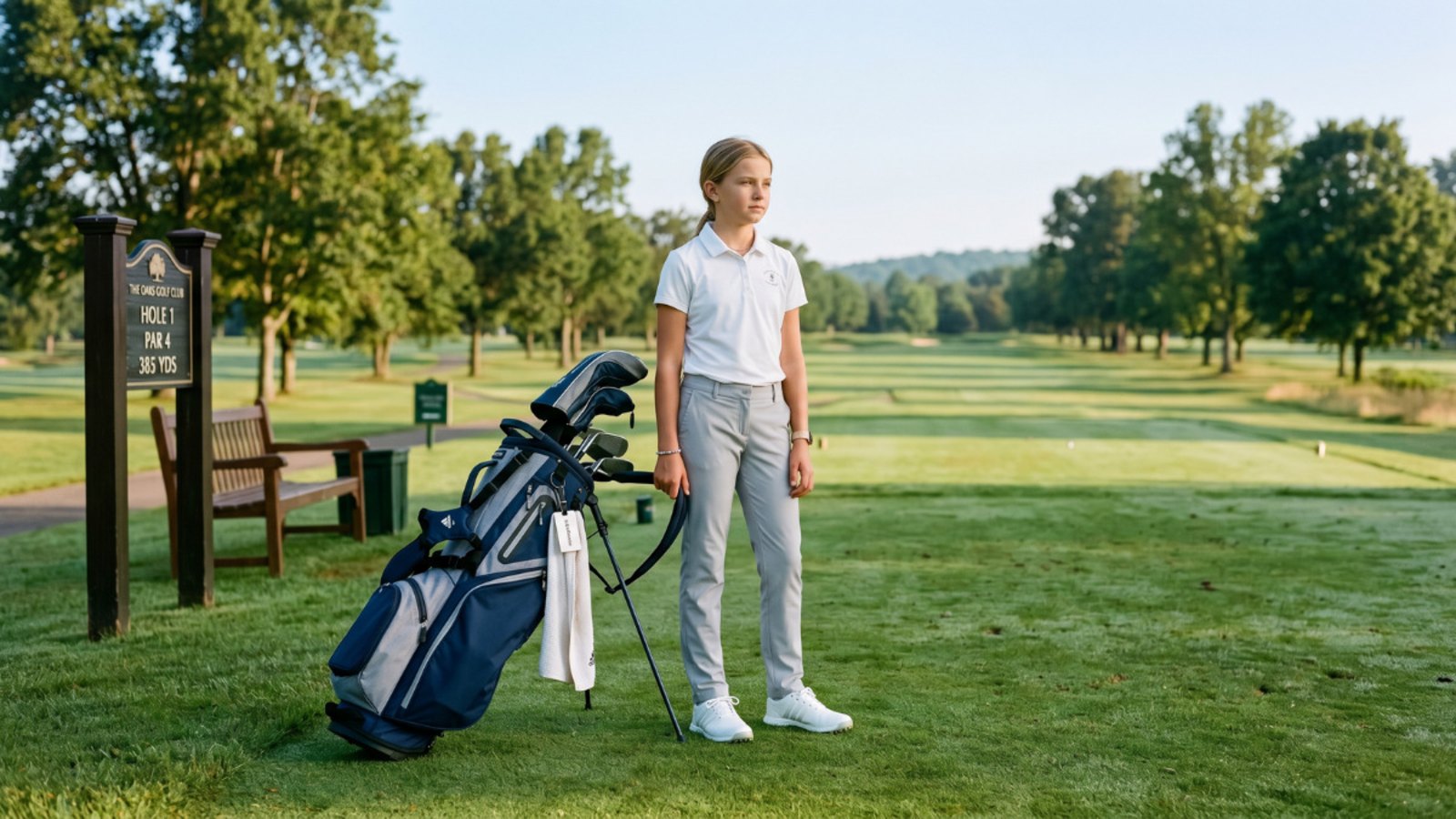
The bag itself sets the foundation: Every piece of equipment a junior golfer carries to a tournament lives inside one place — the golf bag. For tournament play, a lightweight stand bag (opens in a new tab) with dual carry straps is the gold standard. It lets young players carry their own bag comfortably for 18 holes without burning unnecessary energy, while dual straps distribute the weight evenly across the shoulders, protecting growing bodies from strain. Look for a bag with at least six pockets, a built-in rain hood, and a sturdy leg stand mechanism that deploys reliably even on uneven terrain.
The 14-club rule is non-negotiable: Under the Rules of Golf (opens in a new tab) — the same rules that apply to junior tournaments at every level from local club events to national events like those run by the American Junior Golf Association (AJGA) (opens in a new tab) — a player is permitted a maximum of 14 clubs in their bag during any competitive round. Carrying more than 14 is a penalty offense: two penalty strokes per hole in stroke play, up to a maximum of four strokes per round, with disqualification possible if a player continues to use an excess club after becoming aware of the breach. Before the bag is zipped up on tournament morning, a quick count is essential. A well-fitted junior set for a competitive player will typically include a driver, a fairway wood or hybrid, a set of irons (usually 5 or 6 through 9), a pitching wedge, a sand wedge or lob wedge, and a putter. Some players also carry a gap wedge for those tricky mid-distance shots around the green.
Golf balls deserve more thought than they get: Bringing enough golf balls is one of those things that feels obvious until it isn’t. For a competitive junior round, packing a minimum of six to nine balls is a smart baseline — conditions on an unfamiliar course, water hazards, and early nerves can all eat into your supply faster than expected. It’s also worth knowing that the USGA and R&A publish a Conforming Ball list (opens in a new tab), and the AJGA directs all players to check it before competition; playing a non-conforming ball results in disqualification. Most premium brands like Titleist, Callaway, and Vice Golf produce conforming balls that are well-suited to junior play.

Getting the bag and club setup right is really only half the picture. Once the equipment side is sorted, the next thing any junior tournament golfer needs to think carefully about is what they’re actually going to wear on the day — and it matters more than many families expect.
Tournament-Ready Apparel and Footwear
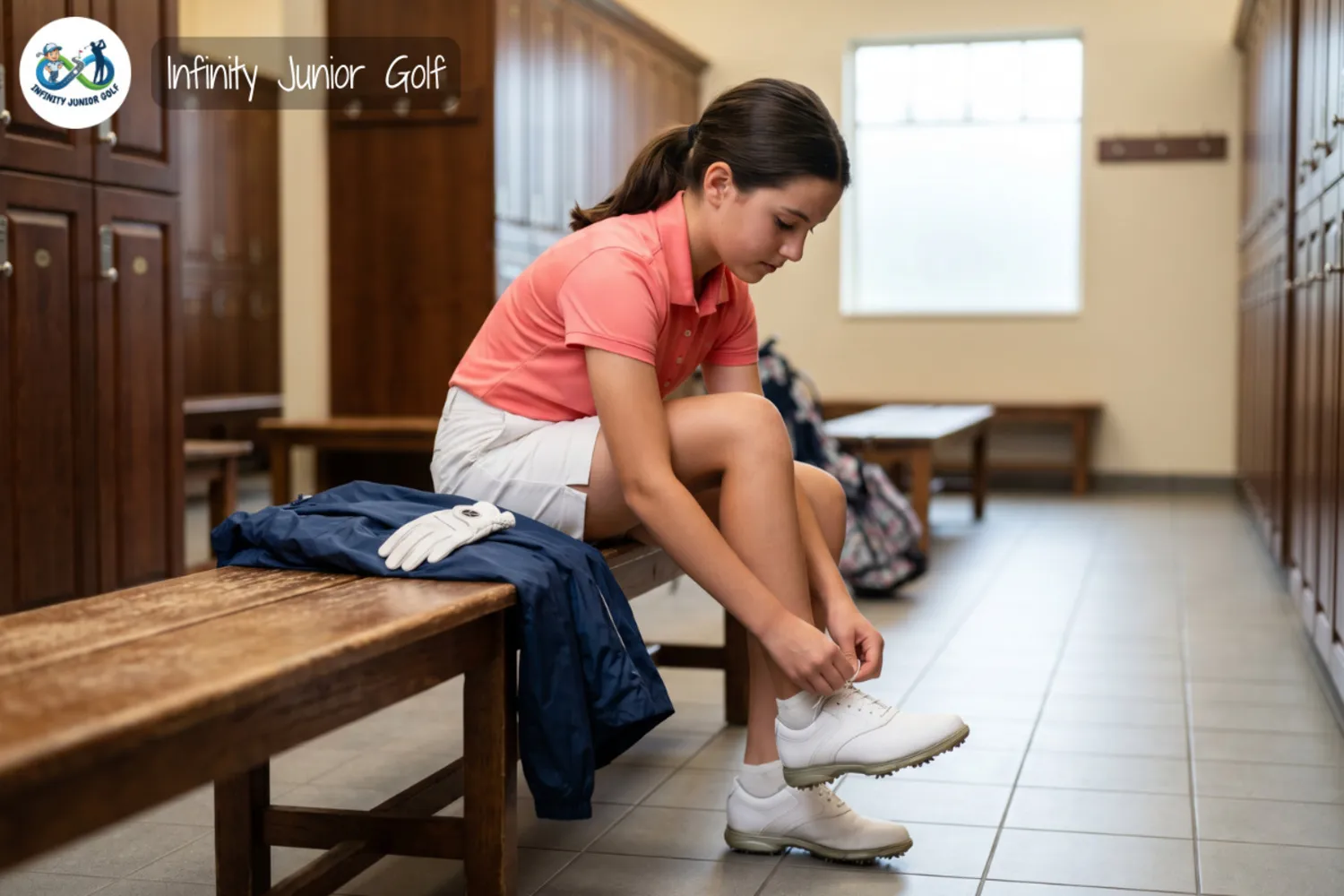
Golf shoes are the most important wardrobe decision: On tournament day, a junior golfer will spend four or more hours on their feet, walking several miles across varying terrain. The right golf shoes — lightweight, supportive, and correctly fitted — can mean the difference between energy and fatigue by the back nine. Soft-spike shoes are recommended for junior players as they provide excellent grip without damaging greens, and are widely accepted at courses across the world. FootJoy is consistently the #1 shoe brand on Tour for good reason — their junior shoe range (opens in a new tab) is engineered for comfort, durability, and performance for growing feet.
Dress code compliance protects the round: Most junior golf tournaments (opens in a new tab), from local club competitions to national events, enforce a dress code. The standard across the majority of competitions worldwide requires a collared polo shirt (no round-neck T-shirts), tailored shorts or trousers (no denim, cargo shorts, or athletic shorts), and appropriate golf footwear. Packing a backup polo shirt and spare socks is a wise move — weather changes, spills, or wet conditions can make a change of clothes genuinely useful. Always check the specific tournament’s dress code requirements when registering, as some events have stricter guidelines than others.
Layering is the junior golfer’s best friend: Temperatures on a golf course can shift significantly from the first tee to the 18th green, particularly in the morning when conditions tend to be cooler. A lightweight, zip-up golf wind jacket or pullover that fits neatly into a bag pocket is essential. For tournaments played in regions prone to rain — the UK, Ireland, parts of Asia, and significant areas of North America — a waterproof jacket and waterproof trousers are non-negotiable items. Packing these items every time, regardless of the forecast, is a habit that saves rounds from being derailed by unexpected showers.
A good glove completes the hand: A well-fitted golf glove gives a junior golfer a more secure grip, reduces the chance of the club twisting at impact, and protects against blisters during long competitive rounds. Carrying two gloves is ideal — if one becomes wet from sweat or rain, having a dry backup ready is a small but significant advantage. FootJoy’s junior glove range (opens in a new tab), designed specifically for growing hands with spandex stretch panels and a MicroTac grip palm, is among the most trusted choices in the junior game.
Now that the bag is packed and the outfit is sorted, the accessories and tools that separate a well-prepared junior tournament player from one who’s just winging it deserve close attention — and believe me, these details genuinely matter out on the course.
Essential Accessories and Tournament Tools
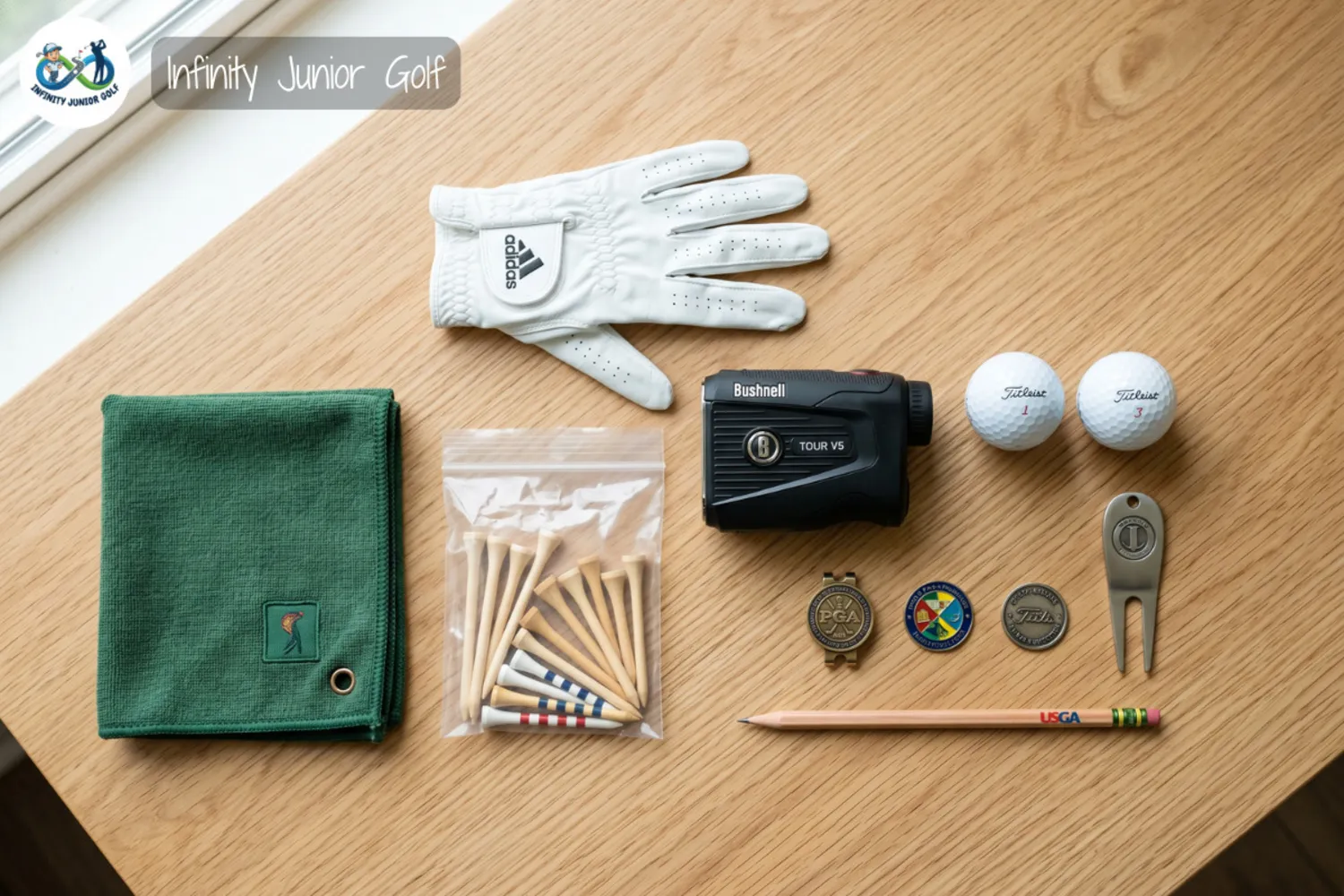
Tees, ball markers, and divot tools are small but critical: These are the items that get forgotten most often and cause the most unnecessary stress at the first tee. Pack a full bag of tees in varying heights — shorter tees for irons and longer tees for the driver. Bring at least three ball markers (coins work perfectly in a pinch), and always carry a divot repair tool; repairing pitch marks is both a rule of etiquette and a requirement in many junior tournament formats. Many junior golfers keep a small ziplock bag with these essentials pre-packed so they can be dropped straight into the bag on tournament morning without thinking.
A rangefinder is a genuine game-changer for serious juniors: In competitive junior golf, knowing the exact distance to the flag — or to a hazard — can directly influence club selection and scoring. Laser rangefinders are permitted in most amateur and junior golf competitions under Rule 4.3 (opens in a new tab) of the Rules of Golf, and the investment pays off quickly in terms of course management confidence. Bushnell Golf (opens in a new tab), the Official Rangefinder of the American Junior Golf Association (AJGA), is the benchmark brand in junior competitive golf technology.
🏌️
Bushnell’s partnership with the HJGT — the largest multi-day junior golf event operator in the world — makes the Tour V7 Shift the most credible rangefinder choice for junior tournament play specifically.
- ✅ Slope-Switch technology legal for tournament use (opens in a new tab)
- ✅ Dual-color OLED display with Slope First Technology for crystal-clear yardages in any lighting (opens in a new tab)
- ✅ PinSeeker with Visual JOLT for precise flag acquisition (opens in a new tab)
- ✅ Compact and lightweight — fits in any bag side pocket (opens in a new tab)
A towel (or two) does more than people think: Keeping clubs clean and dry throughout a round has a direct impact on ball flight and spin control. A small, microfiber golf towel clipped to the bag is a standard piece of tournament kit for players at every level. Many experienced junior tournament players carry a second towel for wiping down their hands and face — particularly useful in hot, humid conditions or when nerves produce moisture on the grip hand.
Carry a scorecard wallet and pencil: Most tournaments provide scorecards, but having a dedicated scorecard wallet keeps the card protected from weather and damage, and prevents the all-too-common mid-round scramble for a working pencil. Pack two or three pencils. These are tiny details that, collectively, communicate a level of preparation and seriousness that genuinely helps a young competitor feel settled and ready.
With all the physical gear accounted for — clubs, apparel, and accessories — the natural next question is where to actually source it all. Not every golf retailer serves junior tournament players equally well, so the six recommendations below have been chosen specifically because they stock exactly the kinds of products covered in this article, ship to customers worldwide, and offer something distinct across price points and specialties.
Brands and Tools That Help Juniors Thrive — Our Recommendations
Getting equipped for a junior golf tournament doesn’t need to be complicated, but knowing which retailers genuinely cater to young competitive players — rather than just stocking a few junior items on the side — makes the process significantly easier. Each of the retailers below has been selected because their products map directly onto the packing checklist covered in this article, from tournament-ready stand bags and conforming golf balls to tournament shoes, gloves, rangefinders, and accessories. All six ship internationally or offer global access.
U.S. Kids Golf
U.S. Kids Golf is the world’s leading junior-specific golf brand, and their full range of junior club sets (opens in a new tab) is available through Worldwide Golf Shops — covering every height range from beginners through to competitive teenagers. Their UL7 series — available in sets such as the UL7 7 Club Stand Set (opens in a new tab) for developing players and the TS3 10-Piece Package Set (opens in a new tab) for more advanced juniors — features lighter shafts and optimized head weights designed to help young golfers get the ball airborne more easily and build better swing mechanics from the start. Worldwide Golf Shops carries the full U.S. Kids Golf lineup alongside a broad range of junior golf gear (opens in a new tab) to round out the full packing list in one place.
FootJoy
FootJoy is the #1 shoe and glove brand on the PGA Tour, and their junior-specific lines bring that same performance engineering to developing players. Their junior golf shoes (opens in a new tab) — including the cleated Traditions Junior and the spikeless FJ Fuel Junior, both available for boys and girls — are lightweight, supportive, and built for four-plus hours on their feet across tournament conditions, while their junior golf gloves (opens in a new tab) feature flexible stretch panels and a soft microfiber back designed specifically for growing hands. Carrying one of each in the bag is one of the simplest performance upgrades a junior tournament golfer can make.
Titleist
Titleist is the most played golf ball brand at competitive events worldwide, and for juniors stepping into tournament play, ball conformity matters. Their full range of golf balls (opens in a new tab) — from the tour-level Pro V1 to the more accessible TruFeel — are all USGA-conforming, removing any risk of disqualification from using a non-approved ball. Titleist also offers tournament-ready golf bags (opens in a new tab) and golf gloves (opens in a new tab) for juniors who want to consolidate their gear from a single trusted brand.
Bushnell Golf
As the Official Rangefinder of the Hurricane Junior Golf Tour, Bushnell Golf is the most credible name in junior tournament technology. Their laser rangefinder collection (opens in a new tab) includes tournament-legal, slope-switch models — such as the Tour V7 Shift (opens in a new tab) with its locking Slope-Switch feature — compact enough to slip into any bag side pocket and accurate to within a yard of the target on every approach shot. For any junior playing on an unfamiliar course, a Bushnell rangefinder removes the guesswork and replaces it with the kind of yardage confidence that directly improves club selection and scoring.
Golf Galaxy
Golf Galaxy is one of North America’s most comprehensive golf retailers, stocking a wide range of junior-specific gear directly relevant to tournament preparation. Their youth golf shop (opens in a new tab) covers clubs, apparel, and shoes for boys and girls across all age groups, their youth stand bags (opens in a new tab) include well-reviewed options like the Sun Mountain Phenom junior stand bag, and their kids’ accessories section (opens in a new tab) stocks tees, markers, towels, and other small tournament essentials. With a Best Price Guarantee and broad brand selection, Golf Galaxy is a strong one-stop option for North American families.
GlobalGolf
GlobalGolf is one of the most well-stocked online destinations for golf accessories worldwide, shipping to over 100 countries and making it a practical choice for tournament packing essentials no matter where families are located. Their golf accessories section (opens in a new tab) includes rangefinders, GPS units, towels, tees, gloves, and tools — everything from the small-but-critical items on this packing list to larger gear like bags from all the major brands — with free shipping on new orders over $99 within the continental U.S. (or $179 for pre-owned orders), and a flat rate of $8.99 below those thresholds. For budget-conscious families, GlobalGolf’s pre-owned junior clubs (opens in a new tab) also offer access to quality gear at a significantly reduced price point, with brands like TaylorMade, Ping, and U.S. Kids Golf regularly in stock.
With the gear sourced and the bag packed, the final — and often most underestimated — element of tournament preparation comes down to what your junior golfer eats, drinks, and carries in their mind from the first tee to the last putt.
Fueling the Round — Nutrition, Hydration, and Mental Game Prep
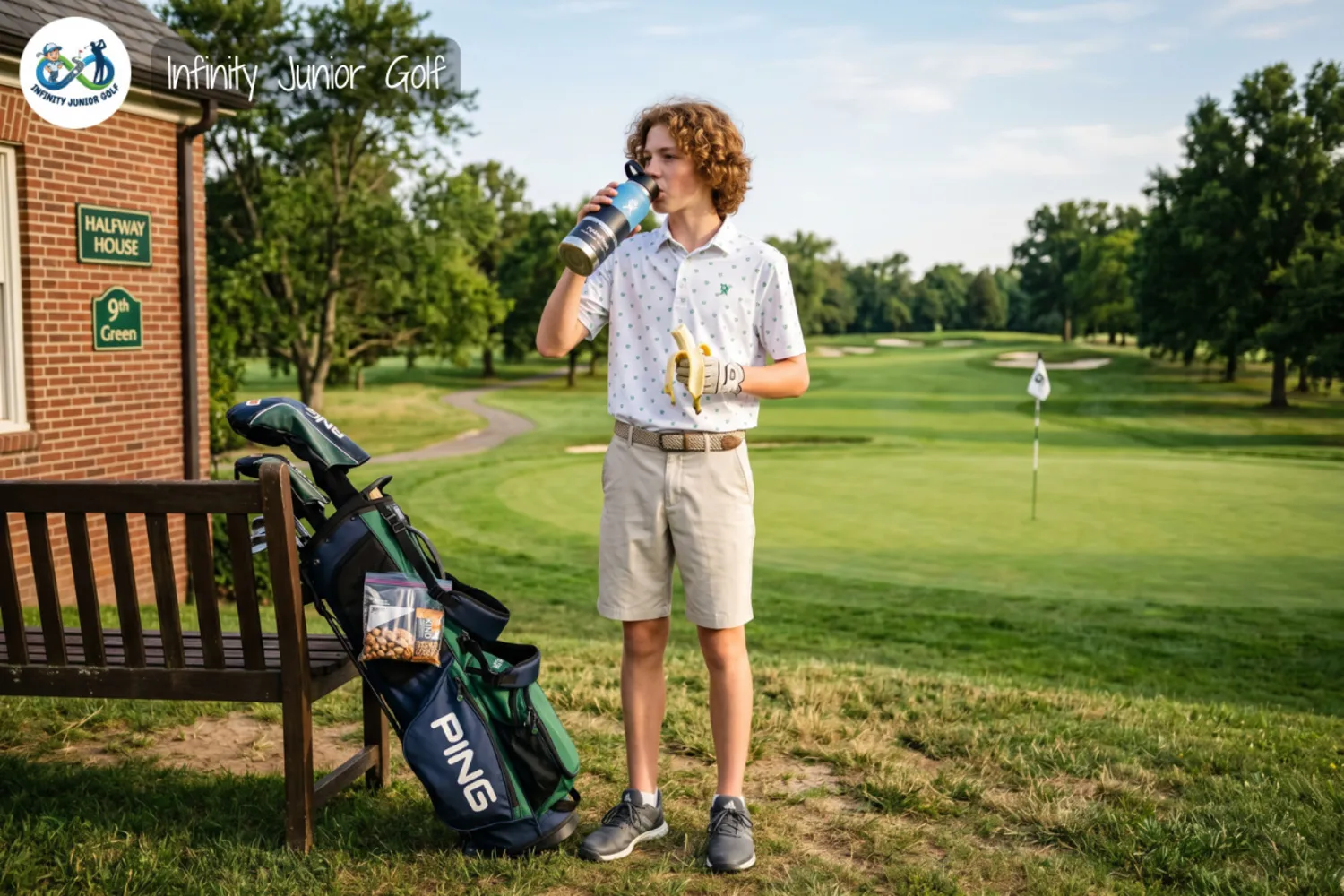
Hydration starts the night before: By the time a junior golfer feels thirsty on the course, they are already slightly dehydrated — and even mild dehydration (opens in a new tab) noticeably impairs focus, coordination, and decision-making. The recommendation from sports performance professionals is to begin hydrating at least 24 to 48 hours before a tournament, and to pack a large, reusable water bottle that can be refilled at the course. Many junior golf bags have dedicated water bottle pockets precisely for this reason — use them. In hot or humid climates, electrolyte tablets or sports drinks can also help maintain energy levels across a long competitive round.
The right tournament snacks are purposeful, not accidental: Golfers burn more calories walking 18 holes than most people realize — often in the range of 1,000 to 1,500 calories (opens in a new tab) across a full round. For junior players, whose growing bodies have higher metabolic demands, a thoughtful snack selection can sustain energy and prevent the concentration dips that tend to derail scoring on the back nine. The best tournament snacks are easy to eat on the go, not messy, and provide a combination of slow-release carbohydrates and protein. Reliable choices include bananas, trail mix with nuts and dried fruit, protein bars, rice cakes, and peanut butter sandwiches cut into manageable pieces. Avoid heavy, greasy foods or anything high in refined sugar — the short-term spike is invariably followed by a crash that shows up right around the 14th hole.
Sunscreen and insect repellent are non-negotiables: A junior golfer can be outside on an exposed golf course for four or more hours during a tournament, often in direct sunlight with limited shade. Broad-spectrum sunscreen (opens in a new tab) at SPF 30 or higher should be applied before leaving home and reapplied at the turn. In tropical, subtropical, or heavily wooded course environments, insect repellent also deserves a spot in the bag’s accessories pocket. These items aren’t glamorous, but they are essential — nothing derails a junior’s focus faster than sunburn discomfort or insect distractions by the sixth hole.
Mental preparation is something you can literally pack: Experienced junior golfers and their coaches often use physical anchors to help manage pre-round nerves and maintain focus throughout competition. Some players keep a small journal or notes card with their pre-shot routine written out, key swing thoughts (opens in a new tab), or a motivational phrase they’ve personally chosen. Others carry earbuds for a calming or energizing music playlist during the walk between shots or on the range beforehand. These aren’t frills — they are legitimate mental performance tools, and junior golfers who develop pre-tournament rituals consistently report feeling more settled and confident when they arrive at the first tee.
The packing picture is now complete — clubs, apparel, accessories, nutrition, and mindset all accounted for. What follows are ten practical, tournament-tested tips to help you put all of it into action, so that tournament morning runs as smoothly as possible for both you and your junior golfer.
Our Practical Tips For You
Whether you’re packing for a tournament for the first time or refining a system you’ve used before, these tips will help make sure nothing gets left behind — and that your junior golfer arrives focused, comfortable, and ready to compete.
| Tip | How to Implement It | Why It Helps |
|---|---|---|
| Pack the bag the night before | Set aside 20 minutes the evening before the tournament to check every pocket of the golf bag. | Going through the checklist the night before removes the rushed, high-stress packing that leads to forgotten items. |
| Count your clubs before leaving home | Physically count each club and confirm the total is 14 or fewer. | Carrying more than 14 clubs in competition results in a penalty stroke or disqualification under the Rules of Golf. |
| Carry a backup glove | Place a second golf glove in a sealed zip-lock bag in a side pocket. | A wet or sweaty glove significantly reduces grip security, especially in warm or humid conditions. |
| Pre-pack an accessories zip-lock | Put tees, ball markers, divot tool, and pencils in one dedicated small bag inside the golf bag. | This means the key small accessories are always together and never left behind. |
| Check the tournament dress code in advance | Visit the tournament organizer’s website or email them directly before packing. | Arriving in non-compliant clothing risks a disqualification or embarrassing wardrobe change at the course. |
| Apply sunscreen before you leave home | Apply SPF 50+ sunscreen 20 minutes before departure and pack the bottle for reapplication at the turn. | Sunscreen needs time to absorb and be effective — putting it on in the parking lot is too late. |
| Prepare snacks the night before | Place snacks in a dedicated bag pocket or small lunch bag the evening before. | Having snacks pre-packed means they won’t be forgotten in the morning rush and the golfer has consistent energy throughout the round. |
| Pack a rain jacket regardless of the forecast | Always put a waterproof jacket (and ideally waterproof trousers) in the bag, even on clear days. | Weather on a golf course changes quickly, and a wet, cold junior golfer loses concentration fast. |
| Bring a charged rangefinder | Charge the rangefinder device the night before and check it functions correctly. | A dead rangefinder on tournament day is a significant disadvantage on an unfamiliar course with unknown yardages. |
| Arrive at least one hour before tee time | Plan the route and departure time to allow a minimum of 60 minutes of warm-up time before the round. | A proper warm-up — stretching, range practice, putting — settles nerves and significantly improves scoring on the early holes. |
With those tips locked in, let’s answer a few of the most common questions that come up around packing for junior golf tournaments.
FAQs
Here are quick answers to some of the questions families ask most often about preparing for junior golf tournaments.
How many golf balls should a junior bring to a tournament?
A minimum of six to nine balls is a sensible amount for an 18-hole junior tournament round. It’s always better to carry more than you think you need — water hazards, rough, and out-of-bounds can be unpredictable, especially on unfamiliar courses.
Are rangefinders allowed in junior golf tournaments?
In most junior golf competitions, rangefinders are permitted under the USGA Local Rule allowing distance-measuring devices. However, this varies by tournament — always confirm with the specific event organizers before the round, as some events do not adopt this Local Rule.
What should a junior golfer eat before and during a tournament?
A balanced pre-round meal with complex carbohydrates, lean protein, and some healthy fat — eaten two to three hours before tee time — provides a solid energy foundation. During the round, easy-to-carry snacks like bananas, nuts, protein bars, and sandwiches maintain energy levels without causing digestive discomfort.
What is the dress code for most junior golf tournaments?
Most junior tournaments require a collared polo shirt, tailored golf shorts or trousers (no denim or cargo shorts), and appropriate golf shoes. The specific requirements vary by organization and event, so checking the tournament’s official guidelines when registering is always the right move.
Our Related Articles

Step-by-Step Guide To A Perfect Golf Swing
Golf is one of those rare sports where the fundamentals you build as a beginner — or as a young junior golfer — stay with…
Read More (opens in a new tab)
The Best Lightweight Golf Bags For Junior Players
Getting a young golfer excited about the game is a wonderful thing. But something that doesn’t always get the attention it deserves is the equipment…
Read More (opens in a new tab)
Top Junior Golf Tournaments In The US
Junior golf tournaments play an essential role in developing young golfers’ skills, competitive mindset, and passion for the game. Across the United States, numerous tournaments…
Read More (opens in a new tab)Conclusion
Packing well for a junior golf tournament is about more than just remembering the golf clubs. It’s about giving a young player the confidence that comes from knowing they are fully prepared — the right bag and club setup, tournament-compliant apparel, essential accessories, proper nutrition, and a charged rangefinder ready to deliver precise yardages on every approach shot. When every item on the list is accounted for, the only thing a junior golfer needs to think about on the first tee is playing golf.
Start with the night-before habit: pack the bag, count the clubs, charge the rangefinder, prepare the snacks, and lay out the outfit. Do it once and you’ll realize how much calmer and more focused tournament morning becomes for everyone. The small preparation steps described in this article are the same ones that competitive junior golfers at every level — from local club events to national junior tours — use to set themselves up for success.
We’d love to hear from you: what’s the one item you or your junior golfer always makes sure to pack for a tournament — and have you ever had a moment where you wished you hadn’t forgotten something? Drop your answer in the comments below!
