


Golf is one of those rare sports where the fundamentals you build as a beginner — or as a young junior golfer — stay with you for life. Getting the golf swing right from the start isn’t just about hitting the ball farther or straighter; it’s about building habits that feel natural, repeatable, and genuinely fun. Whether you’re a parent watching your child take their first swing on the practice range, or a young golfer yourself just discovering the game, this guide is designed to walk you through every key step of a solid golf swing — from grip to follow-through — in plain, practical language.
Hi, I’m Al — just a regular golf dad who somehow tumbled headfirst into the world of junior golf and never quite found my way out. I started this journey standing on a practice range watching my kid swing a club that was clearly three sizes too big, thinking there has to be a better way. Years later, I’ve spent more time than I care to admit learning everything I can about helping young golfers build real, lasting skills — not just the ability to occasionally make contact. I genuinely love this stuff, and more importantly, I love seeing kids light up when something finally clicks. If you’ve got a junior golfer in your life — or you are one — I’m glad you’re here. Keep reading, because what follows might just be the clearest, most practical swing guide you’ll find anywhere.
⭐ Our Top Pick — Best Junior Golf Club Set
PING PRODi G Junior Golf Club Set
I chose the PING PRODi G over every other junior set on the market because of one thing no competitor offers at this level: the "Get Golf Growing" program (opens in a new tab), which provides a one-time, no-cost club adjustment when you purchase five or more clubs in a single transaction — something that genuinely changes the value equation for parents. When your child is learning a proper swing, being fit to the right equipment matters enormously, and the PRODi G's configurable build means you can tailor the set to exactly where your junior is in their development, with wedge add-on options available as they progress.
The single most compelling benefit is that these clubs are engineered using the same design philosophy and R&D behind PING's adult G series — so juniors aren't hitting with toy-grade gear, they're hitting with properly engineered clubs that reward a developing swing.
- ✅ Lightweight graphite shafts sized for junior swing speeds | Fits heights approx. 3’5″–5’4″ (multiple size tiers, roughly ages 5–13) (opens in a new tab)
- ✅ Available in 5 and 7-club configurations, with optional wedge add-ons as your junior develops (opens in a new tab)
- ✅ Ships through PING’s international retailer network (opens in a new tab)
| Mid-range to Premium
👉 Shop PING PRODi G Junior Set (opens in a new tab)Why Grip and Setup Are Everything
The foundation nobody skips: Before a junior golfer takes a single swing, two things determine whether that swing has any chance of success — how they hold the club, and how they stand over the ball. These aren’t the exciting parts of the game, but they are unquestionably the most important. A poor grip is like building a house on sand; every other part of the swing will compensate for it in ways that become harder and harder to fix.
Choosing the right grip: There are three main grip styles taught in junior programs: the overlapping grip (also called the Vardon grip), the interlocking grip, and the ten-finger or “baseball” grip. For younger juniors or children with smaller hands, the ten-finger grip is often the most comfortable starting point because it keeps all fingers in contact with the club, making it easier to control. As their hands grow stronger, many golfers naturally transition to the interlocking or overlapping grip. What matters most is that the grip feels secure without being tense — the club should sit in the fingers, not the palm, and grip pressure should be firm enough to control the club without tightening the forearms. The PGA of America (opens in a new tab) explains how all three grip styles work and how hand placement affects the clubface throughout the swing.
Getting the stance right: A proper stance is simple to describe and well worth practicing repeatedly. Feet should be approximately shoulder-width apart, knees slightly bent, and weight distributed evenly across both feet. The spine tilts forward from the hips — not the waist — so that the arms hang naturally and the club rests on the ground without forcing. Shoulders should be square to the target line, and the head should be up enough to allow a full shoulder turn. For junior golfers, keeping a relaxed posture is absolutely key; tension at address translates directly into a restricted, jerky swing.
Ball position and alignment: Ball position changes depending on which club you’re using — generally, it plays slightly forward of center for mid-irons and closer to the lead foot for longer clubs like drivers. Alignment is something beginners often overlook entirely. A simple drill is to lay two alignment sticks on the ground — one pointing at the target, one parallel to it for the feet — so the body learns what “square” actually feels like before it becomes instinctive. This kind of deliberate setup work, recommended by PGA coaches (opens in a new tab), is what separates golfers who improve quickly from those who plateau.

Now that we’ve nailed the foundation, let’s talk about what happens next — because the moment the club starts moving is where most beginners make their first critical mistake, and the takeaway is where every good swing is either born or quietly derailed.
The Takeaway and Backswing
Starting the swing correctly: The takeaway — the first movement of the club away from the ball — sets the entire shape and rhythm of the swing that follows. The most common mistake beginners make here is starting with the hands and wrists, which instantly throws the club off its ideal path. Instead, the takeaway should be driven by the rotation of the shoulders, with the arms simply going along for the ride. A connected, coordinated shoulder turn keeps the club on the correct arc from the very first inch.
Low and slow wins the race: The club should move back low to the ground and in a smooth arc along the target line for the first foot or so of the takeaway. Many junior golfers have a tendency to pick the club up sharply with their hands, which creates an overly steep swing plane that leads to thin shots and weak contact. A useful practice move is to make the takeaway in slow motion without a ball, taking the club back to about waist height and returning to the start — repeat this 20 times and the body starts to learn what a connected takeaway really feels like.
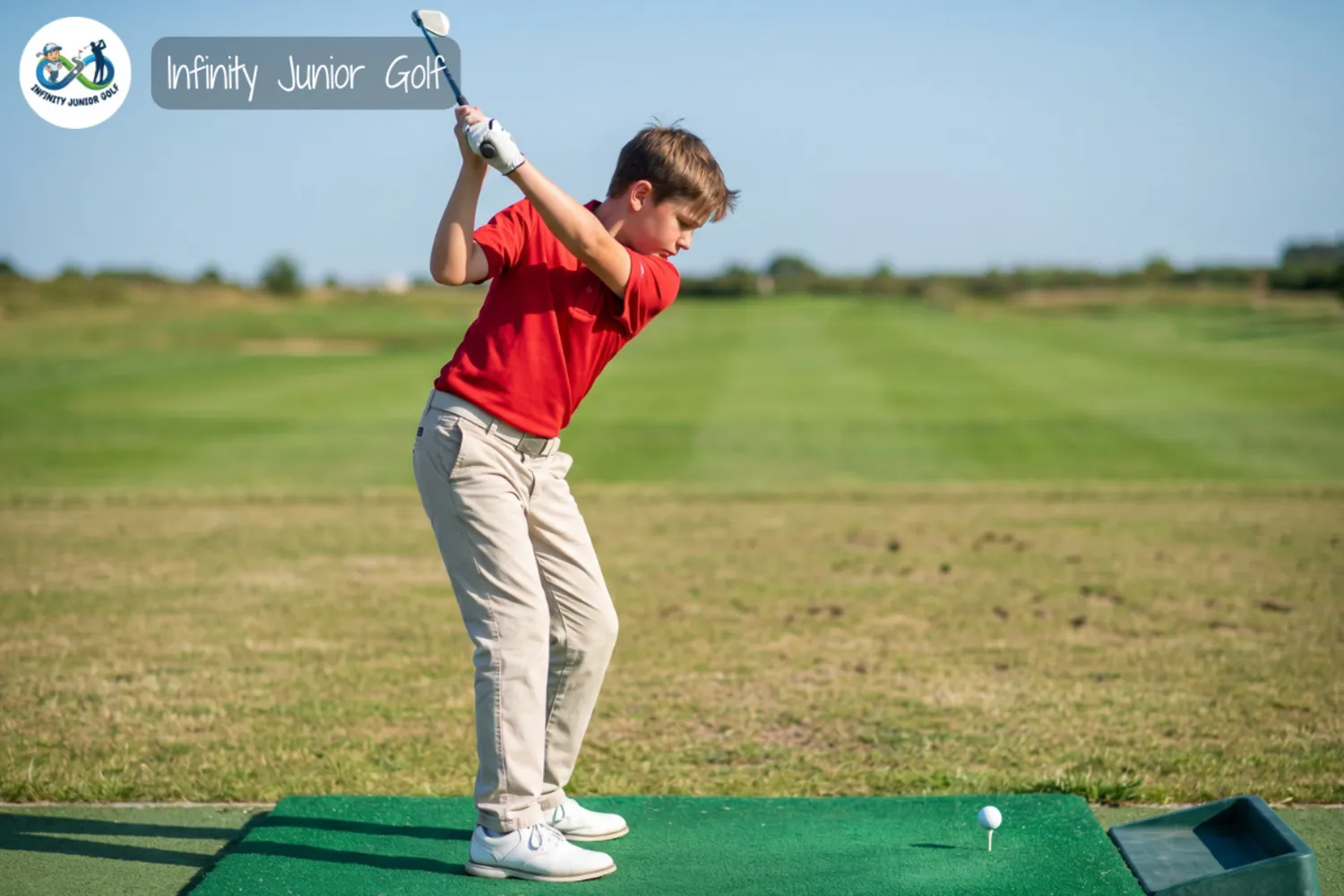
Building the backswing: Once the takeaway is working, the backswing is about continuing that shoulder turn while keeping the lead arm reasonably straight. The lead arm doesn’t need to be rigid like a board — firm, not stiff, is the right mental image. As the shoulders rotate, the hips will naturally follow to a lesser degree, creating a coil between the upper and lower body that stores energy for the downswing. At the top of the backswing, there should be a sense of weight having shifted slightly to the trail foot, and the body should feel loaded — ready to unwind. Golf Distillery’s illustrated backswing guide (opens in a new tab) is a useful visual reference for understanding how these positions connect.
Keeping it in sequence: For junior golfers especially, the single biggest backswing error is over-rotation — trying to swing the club so far back that the arms disconnect from the body and control is lost. The goal isn’t to get the club parallel to the ground; it’s to make a good, controlled shoulder turn and stop when it feels natural. A 3-to-1 tempo (opens in a new tab) — where the backswing takes roughly three times as long as the downswing — is a widely used guideline that helps juniors develop rhythm rather than rushing the transition.
With a solid backswing locked in, the next phase is where power, timing, and accuracy all converge — and where the golf swing either comes together beautifully or falls apart completely. The downswing and impact are the moments that every element of your setup has been building toward.
Downswing, Impact, and the Moment of Truth
Starting the downswing correctly: The single most common mistake beginners make at the top of the swing is trying to hit the ball hard with their arms and hands — a move known as “casting,” which is an early release of the wrists and club from the top of the swing that results in a loss of power and weak, glancing contact. The correct way to initiate the downswing is to shift weight back to the lead foot first, then let the arms drop naturally as the body begins to rotate. This sequence — weight shift, then body rotation, then arms, then club — is the engine behind every powerful, accurate shot.
The role of the hips: As the weight shifts forward, the hips begin to rotate toward the target, pulling the arms and club through on a shallow, powerful path. For junior golfers, a helpful image is imagining the hips as a gate swinging open toward the target. When the hips lead the downswing, the arms automatically find a better angle of attack, the club shallows out naturally, and the dreaded “over the top” move — which produces weak slices — is avoided.
Impact — the moment everything matters: At impact, the body should look similar to the address position, but with important differences: the hips have rotated open toward the target, the weight has transferred forward, and the hands are slightly ahead of the clubhead. This “forward shaft lean” at impact is a hallmark of consistent ball-strikers and is what creates that satisfying, compressed contact sound. The club face should be square to the target at the moment of contact, which is directly influenced by the grip, takeaway, and swing path established in the earlier stages. This impact position guide (opens in a new tab) from a GOLF Top 100 Teacher offers a clear, instructor-verified look at how these positions interact.
🏌️
The PRODi G’s perimeter-weighted iron design is specifically engineered to maximize forgiveness at impact — heel-toe weighting and a lower center of gravity directly reward junior golfers who are still learning to find the sweet spot consistently, and PING’s WebFit Junior tool (opens in a new tab) makes it easy to configure the right set for each child’s size and skill level.
- ✅ Perimeter-weighted design for maximum forgiveness at impact
- ✅ Club fitting program ensures correct shaft length and weight for each junior
- ✅ Available globally through PING’s international retailer network
Don’t try to steer the ball: One of the most important mental cues at impact is to trust the swing and let the club do the work. Trying to guide or steer the ball at impact causes the body to slow down, the hands to flip, and the shot to go sideways. The swing should accelerate through the ball, not at it — impact is a point along the arc, not a destination.

The ball has been struck — but the swing isn’t over yet. What happens after impact tells you everything about whether the swing was truly complete, and the follow-through is one of the most revealing and improvable parts of the whole motion.
The Follow-Through and Finish
Why the follow-through matters: Many beginners treat the follow-through as an afterthought — something that just happens after the ball is gone. In reality, your follow-through is the direct result of everything that came before it in the swing. A poor finish almost always points back to a flaw earlier in the motion, which is exactly why coaches use it as a diagnostic tool (opens in a new tab). If you consistently fall back onto your trail foot, or the club stops abruptly near waist height, the swing has broken down somewhere before impact — not after. (opens in a new tab)
What a correct finish looks like: In a complete, balanced finish, the body’s weight should be almost entirely transferred to the lead foot, the trail heel will have lifted naturally off the ground, and the hips and chest face the target. The club should have continued its arc smoothly over the lead shoulder, with the elbows remaining relatively soft and the grip end of the club pointing roughly toward the target line. The release and extension phase — where both arms extend fully through the ball — is what allows the swing to reach this position naturally, without forcing.
The balance test: A simple but powerful self-check is to hold your finish position for a full three seconds after every shot. If you can’t stay balanced for three seconds with your weight on your lead foot and your chest facing the target, the swing was not fully controlled. This drill is used by coaches working with junior golfers at all levels and is one of the fastest ways to identify whether body rotation and weight transfer (opens in a new tab) are happening correctly. Making this a habit on the driving range means it starts to show up on the course without conscious effort. (opens in a new tab)
Tempo connects everything: The follow-through can’t be forced into a good position in isolation — it arrives naturally when the tempo of the whole swing is correct. The 3-to-1 ratio (opens in a new tab) discussed in the backswing section applies just as much here: a backswing that takes three counts and a through-swing that takes one creates a rhythm that naturally carries the club into a full, balanced finish. Junior golfers who rush the transition almost always produce a short, unbalanced finish because there simply isn’t enough momentum carrying the swing through. (opens in a new tab)

Now that you have a clear picture of all four phases of the swing, let’s look at the equipment and learning tools that will genuinely accelerate your junior’s development — because the right gear and resources make learning a correct swing significantly faster and more enjoyable.
Brands and Tools That Help Juniors Thrive — Our Recommendations
Having the right equipment and training tools in your corner makes a real difference when you’re learning to build a proper golf swing. From perfectly sized club sets that encourage correct mechanics from day one, to swing trainers that teach tempo and sequencing through feel, the products below have been handpicked specifically for junior golfers and beginners working on the fundamentals covered in this guide. Every retailer ships internationally, covers different price points, and offers something genuinely relevant to the skills we’ve been talking about.
Equipment and Training Tools We Recommend
PING Golf
PING’s PRODi G is the benchmark junior club set for developing players. It’s a fully modular system — you select exactly the clubs your junior needs and add more as their game grows — and the “Get Golf Growing” program provides one free club adjustment as your child grows taller, a feature no other major manufacturer matches at this level. The perimeter-weighted iron design mirrors PING’s adult range, meaning juniors are swinging properly engineered clubs that reward a good swing path and correct impact position from the very first round. I chose PING over other premium options here because that free fitting adjustment genuinely changes the long-term value for families who don’t want to replace an entire set every season. Browse individual clubs including the PRODi G irons (opens in a new tab), PRODi G driver (opens in a new tab), and PRODi G fairway wood (opens in a new tab).
U.S. Kids Golf
U.S. Kids Golf is the world’s most dedicated junior golf equipment brand, offering height-based junior club sets fitted by your child’s inches rather than age — a smarter approach that ensures the shaft length and weight are right for how they actually move. Their UltraLight series is specifically engineered for beginner to intermediate players who are building swing fundamentals, with lighter overall weight that makes it far easier to maintain tempo and a full follow-through. With fitting guides, complete sets, and individual clubs available for players from age 3 through to 17, U.S. Kids Golf is the first place I’d send any parent who wants to get the equipment decision right from the very beginning. Shop the full U.S. Kids Golf range at Global Golf (opens in a new tab), which offers $6.99 flat-rate US shipping, free shipping on orders over $149, and international delivery to most countries worldwide.
Lag Shot Golf
The Lag Shot training club is one of the most effective swing training tools available for beginners and juniors learning proper tempo, sequencing, and lag — the three elements that separate a controlled swing from an all-arms hack. Its ultra-flexible shaft physically prevents casting and forces the golfer to use body rotation to drive the downswing, building the correct movement patterns with every repetition. Unlike many training aids that you can only swing at air, the Lag Shot lets you hit real golf balls, which means the feedback is immediate and meaningful. Three junior versions are sized specifically for younger players: the Junior 7 Iron (ages 6–8) (opens in a new tab), the Junior 7 Iron (ages 9–11) (opens in a new tab), and the Junior 7 Iron (ages 12–14) (opens in a new tab), all shipping worldwide directly from the Lag Shot website.
GolfTrainingAids.com
GolfTrainingAids.com (opens in a new tab) stocks a dedicated junior training aids collection that covers every fundamental discussed in this guide — swing trainers, alignment tools, impact bags, putting aids, and tempo trainers, all scaled and designed specifically for younger players. Their junior range is one of the broadest available anywhere online, and the ability to buy targeted, single-purpose aids means parents and coaches can address one specific swing issue at a time rather than overwhelming a beginner with too many tools at once. Standout picks include the Junior Orange Whip trainer (opens in a new tab) for tempo and the Chasing Majors Junior Bundle (opens in a new tab) — a three-aid package covering swing mechanics, power, and putting for around $100.
Global Golf
Global Golf (opens in a new tab) carries an extensive range of new and certified pre-owned junior clubs (opens in a new tab) from every major brand — U.S. Kids Golf, PING, Callaway, TaylorMade, and more — making it an excellent option for families at different budget levels. The certified pre-owned inventory is particularly valuable for juniors in early development stages, where a child may outgrow their set within a season and full retail pricing on a new set feels hard to justify. Global Golf ships internationally and their $6.99 flat-rate shipping within the US is among the most competitive in the market for junior equipment.
RotarySwing Golf
For families who want structured, biomechanically grounded online instruction to complement their junior’s physical practice, RotarySwing (opens in a new tab) is one of the most rigorous platforms available. Rather than generic tips, the platform teaches every element of the swing using human movement principles — the same sequencing, rotation, and weight transfer concepts covered in this guide — with AI-assisted coaching tools that identify swing faults and prescribe targeted drills. It’s the platform I’d recommend to any motivated junior golfer (or their parent) who is ready to go beyond beginner fundamentals and wants to understand why each part of the swing works the way it does. Start with a free membership (opens in a new tab) or explore the junior backswing program (opens in a new tab) to see the teaching style firsthand.
With your equipment sorted and your go-to instruction resources bookmarked, the next question is how to actually put all of this to work in a way that builds lasting improvement — and that comes down entirely to how smart your practice habits are.
Building Consistency Through Smart Practice
Quality over quantity — always: One of the most persistent myths in golf is that hitting hundreds of balls at the range will automatically produce a better swing. It won’t — not unless those repetitions are purposeful. Mindless practice simply reinforces whatever pattern is already there, good or bad. For junior golfers especially, short, focused practice sessions — even 20 minutes — that target one specific element of the swing at a time produce far faster results than long sessions where attention wanders. This principle is echoed consistently by experienced golf instructors (opens in a new tab) across all skill levels.
The slow-motion drill that works: One of the most effective practice techniques for beginners is making slow-motion swings without a ball, focusing on each element of the sequence in turn: setup → takeaway → backswing → weight shift → impact → follow-through. Doing this ten times in slow motion, then gradually building speed, creates a mental model of the correct motion before the ball gets in the way and triggers the instinct to hit hard. Only then should a ball be introduced.
Using training aids with intention: Training aids like alignment sticks, impact bags, and swing trainers are most useful when used to solve a specific problem — not as generic warm-up tools. An alignment stick laid on the ground during every practice session removes guesswork from alignment. An impact bag teaches what it feels like to have the hands leading the clubhead at contact. These simple, affordable tools build the physical memory that makes good swing positions feel natural over time.

Practicing on-course, not just on the range: Range practice is essential for drilling mechanics, but it is not the same as on-course play. The rhythm, variability, and decision-making required on an actual golf course are things that can only be developed by playing. Junior golfers who only ever hit balls on ranges often struggle to translate their improved technique into real rounds. Short-course play, par-3 courses, and fun scramble formats are ideal ways for beginners to transfer their range improvements into actual game situations. Organizations like First Tee (opens in a new tab) run structured junior programs across the US and in select countries internationally that blend exactly this kind of on-course experience with fundamental instruction.
Tracking progress simply: Keeping a simple record of practice sessions doesn’t need to involve data or technology. A junior golfer (or their parent) jotting down one thing that went well and one thing to focus on next time is enough to build awareness and direction. Over weeks and months, this kind of intentional practice — even in small doses — compounds into noticeable, lasting improvement.
These practice habits are most effective when paired with a set of clear, immediately actionable steps — so let’s break it all down into ten tips you can put to work starting today.
Our Practical Tips For You
Here are ten actionable tips that any junior golfer or beginner can start using immediately. Each one is designed to be simple to put into practice, with a clear reason why it will make a real difference to your swing and your game.
| Tip | How to Implement It | How It Helps |
|---|---|---|
| Film your swing | Use your phone to record your swing from behind and down the line at each practice session. Compare it to a correct example to spot differences. | Seeing your swing removes guesswork and shows you exactly what to fix, far more accurately than feel alone can. |
| Grip check before every swing | Before each shot, stop and consciously check that the club is in your fingers — not your palm — with light-to-medium grip pressure. Hold for three seconds before swinging. | A correct grip is the single biggest influencer of clubface angle at impact — getting this right prevents many of the most common swing faults. |
| Use alignment sticks every session | Lay two sticks on the ground — one pointing at the target, one parallel at your feet — for every range session. | Correct alignment becomes automatic over time; without it, you may be practicing a swing aimed somewhere other than your target. |
| Practice the takeaway drill | Make 20 slow, connected takeaways to waist height and back — no ball — before hitting any shots. | This trains the shoulder-led takeaway that sets up the entire swing correctly, replacing the hand-flick habit most beginners develop. |
| Count your tempo aloud | Count “one-and-two” during practice swings — “one” for the backswing, “and” for the transition, “two” for the downswing. | This 3-to-1 tempo rhythm prevents rushing the transition, which is the most common cause of mis-hits in beginner golfers. |
| Hold your finish for three seconds | After every shot, hold the finish position for a full three seconds — chest facing the target, weight fully on the lead foot, club over the lead shoulder. | A balanced finish proves the swing was controlled and properly sequenced; if you can’t hold it, something earlier in the swing went wrong. |
| Start each session with chip shots | Hit 10–15 chip shots before moving to full swings at every practice session. | Chipping builds feel for impact, hand position, and ball contact in a low-risk, controlled way that activates the right muscles before full swings. |
| Warm up without a club first | Before picking up a club, perform 10 trunk rotations and 10 hip circles to loosen the core and hips. | Golf swing power comes from rotational muscles — warming these up first directly improves swing quality and reduces injury risk, especially for juniors. |
| Play short holes with purpose | Take one bucket of balls to a par-3 hole and treat each shot as if it were a real round — full pre-shot routine, pick a target, commit to the swing. | This bridges the gap between range practice and on-course performance, where most beginners experience the biggest disconnect. |
| Focus on one swing thought per session | Choose a single focus point — grip, takeaway, tempo, or finish — and commit to it for the entire session. Rotate your focus each time you practice. | Multiple swing thoughts create confusion and tension; one focused objective produces cleaner, faster improvement every time. |
With these tips in your toolkit, you may still have a few questions about the fundamentals — so let’s tackle the most common ones directly.
FAQs
Here are answers to the questions we hear most often from junior golfers and beginners working on their swing.
Q: What is the most important part of the golf swing for a beginner to get right first?
The grip is the single most important fundamental because it directly controls the clubface angle at impact. Before focusing on backswing position, tempo, or power, make sure your grip is correct and consistent every time you pick up a club.
Q: How long does it take to develop a consistent golf swing?
With regular, focused practice of even 20–30 minutes two or three times per week, most junior golfers begin to feel a consistent swing pattern within two to three months. The key is that practice is purposeful — targeting one specific element at a time rather than just hitting ball after ball.
Q: Should junior golfers use adult golf clubs?
No — using clubs that are too long, too heavy, or too stiff makes it genuinely difficult to learn correct swing mechanics because the body has to compensate for the equipment. Junior-specific clubs sized and weighted for a child’s height and swing speed allow them to develop proper technique from the very beginning.
Q: Can you learn a proper golf swing without professional lessons?
Yes, especially for the fundamentals. A quality guide, structured online instruction, and deliberate use of training aids can take a beginner a long way. However, a few sessions with a qualified junior golf coach to check grip, posture, and alignment early on can save months of practicing bad habits.
Our Related Articles

Explaining The Basics Of Golf To Kids In Fun Ways
Golf can seem like a big, grown-up game when you first look at it, but kids usually learn it best when it feels playful, simple,…
Read More (opens in a new tab)
10 Essential Stretches For Young Golfers
Golf is one of the most accessible and rewarding sports a young person can take up, but it places surprisingly demanding physical requirements on the…
Read More (opens in a new tab)
How To Teach Toddlers To Swing A Golf Club
There’s a particular moment that happens with almost every golfing parent: a toddler picks up a club — often a hand-me-down from an older sibling,…
Read More (opens in a new tab)Conclusion
Building a great golf swing is not about perfection — it’s about building smart, repeatable habits one step at a time. From grip and setup through the takeaway, backswing, downswing, and follow-through, every element of the swing connects to the one before and after it. The good news is that with the right equipment, purposeful practice, and the fundamentals laid out in this guide, any junior golfer or beginner can develop a swing they’re genuinely proud of. Start with the basics, be patient with the process, and remember — every great golfer in the world was once exactly where you are now.
If you found this guide useful, share it with a junior golfer in your life, explore the recommended resources in our brands section, and take the first step today — even if that’s just picking up a club and checking your grip. The game rewards those who keep showing up.
What’s the one part of your junior golfer’s swing — or your own — that you’re working on right now? Drop your answer in the comments below — I’d love to hear where you’re at and help if I can!
