

A first set of golf clubs is the one purchase nearly every golfing family makes, and it’s usually made on a guess. The sets on the shelf look much the same, and the age ranges printed on the boxes overlap. Getting junior golf club sets for first-time players right comes down to a handful of questions, and none of them is “which brand is best”.
I’m Al. I trained and taught high school mathematics and science, and these days I’m a stay-at-home parent to two boys, five years apart, who have both needed a first set of clubs, and I got the first one wrong. I’m not a club fitter, a coach or a golf professional. What I bring is a teacher’s habit of reading the sizing chart and the returns policy before the marketing, and two rounds of finding out what actually matters. If you’re about to buy your child’s first proper set, read on before you spend anything.
⛳🏌️
US Kids Golf UL7 5 Club Stand Set
I haven't bought this exact set myself; I chose it because it's sold in height bands just three inches wide, from 48 to 66 inches, so you buy for your child's height rather than a broad age range.
It gives a beginner the five clubs they actually need and a stand bag to carry them, sized to the child in front of you.
- Driver, 4 hybrid, 7 iron, pitching wedge, putter
- Stand bag and headcovers included
- Left- and right-handed options listed
Why Junior Golf Club Sets for First-Time Players Start With Height
Height matters more than age: The single most useful thing to know about junior golf club sets for first-time players is that they're sized by height. PGA TOUR Superstore's guide to a child's first set puts it simply: two children the same age can have very different heights (opens in a new tab), so age alone is an unreliable measure. MyGolfSpy's fitting guide goes further, saying that using height is far more effective (opens in a new tab) than age-based sizing. A junior fitter quoted by GOLF.com puts it plainly: with kids it's mostly about height and clubhead speed (opens in a new tab), and gender and age don't really matter.
Too big is the common mistake: The usual error isn't buying the wrong brand. It's buying a set that's too long because the child will grow into it, and PGA TOUR Superstore's guide warns that oversized clubs often do more harm (opens in a new tab) than good. There's research behind the idea of sizing equipment to children, although not from golf specifically. A 2016 systematic review in Sports Medicine looked at 25 studies (opens in a new tab) of 989 children across a range of sports, and 18 of them found children performed skills better when the equipment and play area were scaled to them. The authors are honest about the limits: only five of the studies (opens in a new tab) measured learning over time, so the case for better performance is stronger than the case for faster learning.
I got this wrong the first time: What I got wrong with my eldest was sizing. I bought his first set too big because I'd been told he'd grow into it, which is advice that makes sense for school shoes and no sense at all for golf clubs. I couldn't tell you the brand now. What I remember is him working harder than he should have needed to, and enjoying it less than he otherwise would have. The second time around, I measured properly and bought for the child in front of me rather than the one he'd be in two years. It cost more over time because he outgrew things faster. It was worth it.
Size first, then brand: That doesn't mean any correctly sized set will do. A set that doesn't fit undoes whatever else it has going for it, but the better brands do earn their place: shaft weight and flex suited to a slower swing, sensible lofts, heads that are forgiving without being unwieldy, and build quality that survives being thrown in a car trunk several times a week. The order is what matters. Size first, then brand, and not size as the only question.
Light, but not too light: PGA TOUR Superstore's guide recommends lightweight clubs (opens in a new tab) with flexible shafts, because clubs that are too long, heavy or stiff are hard for a child to swing. MyGolfSpy adds the other side: clubs that are too light (opens in a new tab) can make a child lose the feel of where the clubhead is. Fit affects the strike as well as the swing. If a club sits too upright for the child, MyGolfSpy says heel contact and pulls (opens in a new tab) are common, and if it sits too flat, toe contact and pushes show up.
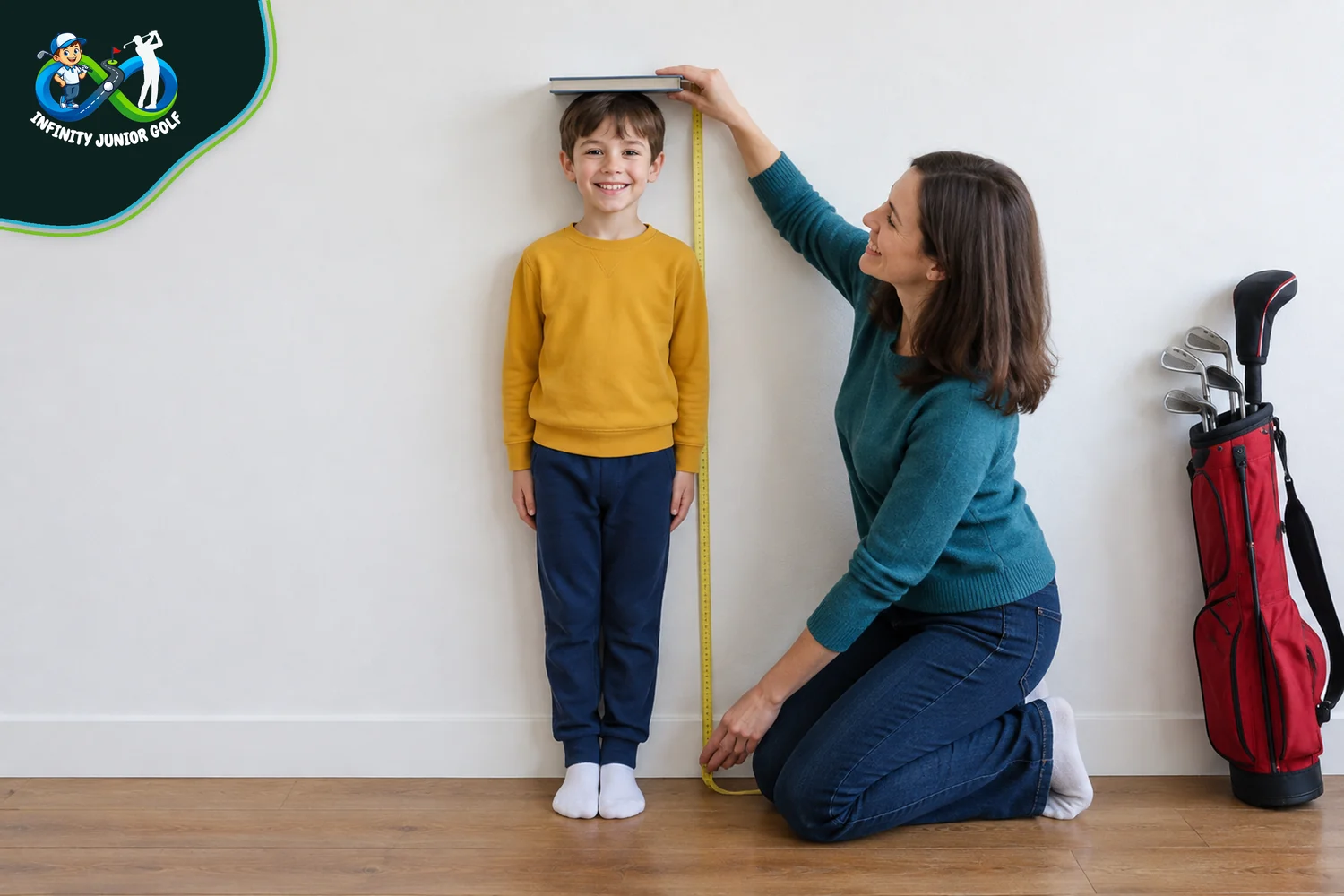
Measure, then read the chart: In practice, sizing means measuring your child's height and checking it against that brand's own chart, because the bands differ from one maker to the next. The US Kids Golf UL7 five-club set is listed in three-inch bands (opens in a new tab) from 48 to 66 inches. Callaway's XJ sets run 42 to 46 inches (opens in a new tab) for Level 1, 47 to 53 for Level 2 and 54 to 57 for Level 3. Wilson's Profile Medium covers a single 50 to 56 inch (opens in a new tab) band, for roughly ages 8 to 11. A child near the top of a band is close to needing the next size, which matters when you're deciding how long a set will last. For the very youngest golfers, under about five, there's a separate guide to getting started.
Once you know the size, the next question is what should actually be in the bag. The answer is fewer clubs than most parents expect.
What a First Junior Golf Set Actually Needs
Fourteen is a ceiling, not a target: The Rules of Golf say a player must not start a round with more than 14 clubs (opens in a new tab), and there's nothing that says they need that many. PGA TOUR Superstore's guide says beginners don't need 14 (opens in a new tab) clubs on day one, and the junior fitter quoted by GOLF.com is blunter still: "Does a junior golfer need 14 clubs? Absolutely not (opens in a new tab)."
The core five clubs: A beginner needs a driver, a fairway wood or hybrid, a 7-iron, a wedge and a putter, according to PGA TOUR Superstore's (opens in a new tab) first-set guide. Real sets follow that pattern closely. The US Kids Golf UL7 5 Club Stand Set is exactly that list: a driver, 4 hybrid (opens in a new tab), 7 iron, pitching wedge and putter, with a stand bag.
🏌️
US Kids Golf UL7 5 Club Stand Set
I picked it for this job because its five clubs match the beginner's list exactly, and the narrow height bands mean the set fits now rather than in two years.
- Height bands from 48 to 66 inches
- Lighter club heads in the smaller sizes
- $309.99 USD at Worldwide Golf Shops
Smaller sets drop the driver: Not every first set includes a driver. Callaway's smallest XJ set, for children 42 to 46 inches tall, has a fairway wood (opens in a new tab), 7-iron, sand wedge and putter, and nothing longer. At the other end, Top Flite's 9-piece youth set counts its bag and headcovers in the nine, so it's really six clubs (opens in a new tab): driver, hybrid, 7 iron, 9 iron, sand wedge and putter.
Why so few clubs work: The junior fitter quoted by GOLF.com explains that juniors may not have the speed to create a real difference (opens in a new tab) between small loft changes in the longer clubs. A slower swing simply doesn't separate a 5-iron from a 6-iron the way an adult's does. So a few clubs with big gaps in loft do the work of many, and MyGolfSpy notes that a smaller set that produces consistent contact (opens in a new tab) is better than a full set a child can't use yet. If you want to see how particular sets stack up club by club, there's a side-by-side comparison of junior sets elsewhere on this site.
How they compare
| Club | Its job for a beginner | In a typical first set? |
|---|---|---|
| Driver | The longest club, for the tee on longer holes | Usually. Callaway's smallest XJ set (opens in a new tab) leaves it out |
| Fairway wood or hybrid | Distance from the fairway, and easier to hit than a long iron | Yes, one or the other, per the first-set guide (opens in a new tab) |
| 7-iron | The all-round iron for middle-distance shots | Yes, in every set in this article that lists its irons |
| 9-iron | A shorter, higher-flying iron | Sometimes, as in the Top Flite set (opens in a new tab) |
| Wedge | Short shots around the green and out of sand | Yes, a pitching or sand wedge |
| Putter | Rolling the ball on the green | Always |
| Bag | Carrying everything | Every set in this article comes with one |
Look for graphite junior shafts: Junior clubs are built with lighter heads and flexible graphite shafts (opens in a new tab), sized in length for a growing player. The sets in this article list exactly that. Callaway's XJ set has graphite junior flex (opens in a new tab) shafts, and GlobalGolf lists the Wilson Profile with Wilson junior graphite (opens in a new tab) shafts in junior flex. A set described only as having "steel shafts" or with no shaft details at all deserves a second look.
Don't forget the bag: Bag weight matters more than anyone tells you. A child carrying too much bag over eighteen holes finishes tired and less keen to come back, and I watched that before I understood what was causing it. Our two use a push cart more often than they carry, which solves the weight problem outright, and it's worth considering earlier than most people do. Every set in this article comes with a bag, but if the one in the box is heavy, a lightweight bag or a cart can make a bigger difference to how long your child wants to play than any club in it.
So a first set is five or six clubs, sized by height, with light junior shafts and a bag your child can manage. The harder question is how much to spend on something they'll outgrow.
How Much to Spend on a First Set When They're Still Growing
The growth arithmetic: Between the ages of 6 and 12, children grow at a steady pace of about 2.5 inches a year (opens in a new tab), or 6 to 7 centimeters, according to KidsHealth. The UL7 bands are three inches wide (opens in a new tab). As a former math teacher, I'll do the rough sum: a child who starts at the bottom of a three-inch band can expect to move through it in roughly a year to eighteen months, and sooner if you buy partway up the band. That's my arithmetic, not a manufacturer's promise, and growth spurts upset it. KidsHealth notes that boys' fastest growth typically comes between 12 and 15 (opens in a new tab).
Fit a few months ahead, not years: None of this means buying big. The junior fitter quoted by GOLF.com fits for where the child will be six to seven months (opens in a new tab) from now, which is a long way from the two years I was aiming at with my eldest. A few months of growing room keeps a set useful for longer without making it too long today. If you're buying in February ahead of a northern-hemisphere spring, that's the height to buy for. Families in the southern hemisphere, including ours here in Australia, are buying at the end of summer instead, with autumn and winter ahead.

Growth is the real cost: Between roughly eight and fourteen you're replacing clubs on a cycle that has nothing to do with wear, so the question isn't what one set costs. It's what four sets cost. What I wouldn't do is conclude that you should therefore buy cheap through those years. We didn't, and I'd make the same call again. A child playing regularly gets more out of good equipment at exactly the stage they're forming habits, and the resale value on decent gear is far better than on entry-level, which claws back a real share of the difference. That said, for a child who hasn't yet decided whether they even enjoy golf, a budget set is a perfectly fair first step.
What the sets in this article cost: The six sets in the next section give a sense of the range. In the US, they run from $199.98 USD (opens in a new tab) for Top Flite's youth set at Golf Galaxy, through $259.99 (opens in a new tab) for the Wilson Profile Medium and $309.99 (opens in a new tab) for the US Kids Golf UL7 five-club set, to $349.99 (opens in a new tab) for Callaway's XJ Level 1. In Canada, Decathlon's Inesis set for ages 8 to 10 is $169.99 (opens in a new tab) on its Canadian site, and in the UK the Benross Junior Aero for children 50 to 54 inches tall is £139.00 (opens in a new tab) at American Golf. Prices were checked on November 4, 2026.
Secondhand is badly underused: Junior clubs get outgrown, not worn out, which means the used market is full of gear with years of life left. I wish I'd worked that out earlier than I did. GlobalGolf's used section, for example, can be filtered to junior clubs (opens in a new tab) in either hand, and the retailer says every used club goes through a 7-point inspection (opens in a new tab) and is graded before sale. Check the returns terms before you buy used, though: GlobalGolf gives store credit only (opens in a new tab), not a refund, on preowned clubs.
Cutting down adult clubs: The other budget route is shortening an old adult set. The junior fitter quoted by GOLF.com warns that cut-down adult clubs can leave a child with shafts that are too stiff and heavy (opens in a new tab), and suggests asking a club builder for light, flexible shafts if you go that way. The clubs are only one part of the budget, too, and there are other ways to keep costs down across a year of junior golf.
With the size, the clubs and the budget settled, here are six sets worth looking at, and where to buy them.
Brands and Tools That Help Juniors Thrive — Our Recommendations
These six sets were chosen because each lists a height or age band, comes with a bag, and between them they cover buyers in the US, Canada, the UK and Europe, with two US retailers that also ship internationally. I haven't bought any of these exact sets myself, so each is assessed from its maker's and retailer's published details. Prices were checked on November 4, 2026, and can change.
US Kids Golf
About
US Kids Golf sizes its junior sets by height rather than age. Its sets are available from Worldwide Golf Shops, which ships internationally by FedEx at a flat $100 (opens in a new tab), with duties paid by the buyer.
Our recommendation
The UL7 5-club set (opens in a new tab) is $309.99 USD, in three-inch height bands from 48 to 66 inches, with a driver, hybrid, 7 iron, wedge, putter and stand bag. It's the closest match to the beginner's five-club list; outside the US, the shipping and duties add a lot to the price.
Callaway Golf
About
Callaway's XJ junior line covers children from 42 to 57 inches (opens in a new tab) tall. This is Callaway's US store, with free shipping on orders over $150 (opens in a new tab).
Our recommendation
The XJ Level 1 (opens in a new tab) is $349.99 USD (US price) for children 42 to 46 inches, with a fairway wood, 7-iron, sand wedge, putter and stand bag. It suits the smallest first-timers; it's the most expensive set here for the fewest clubs, and left-handed sets come in black only.
GlobalGolf
About
GlobalGolf is a US retailer selling new and used clubs, including junior sets (opens in a new tab) from several brands, with a 90-day guarantee (opens in a new tab) on new, unused items. International orders ship duties paid (opens in a new tab), with an extra $39.99 USD for oversized items such as complete club sets.
Our recommendation
The Wilson Profile Medium (opens in a new tab) is $259.99 USD for children 50 to 56 inches tall (roughly ages 8 to 11), with a driver, hybrid, 7 iron, wedge and putter. It's good value, but one broad six-inch band means a child at the bottom of it may find the clubs long at first.
Golf Galaxy
About
Golf Galaxy is a US golf chain that ships to the 48 continental states (opens in a new tab) only, with no APO or FPO delivery.
Our recommendation
The Top Flite youth set (opens in a new tab) is $199.98 USD for children 53 inches and up (ages 9 to 12), with six clubs and a stand bag, in either hand, and 4.5 stars from 98 reviews. It's the budget pick for US families; its band is open-ended, and one recent reviewer reported a broken driver head.
Decathlon
About
Decathlon is a sporting goods retailer with its own Inesis golf range, sold through separate country websites, including Canada and Ireland (opens in a new tab), and its stores.
Our recommendation
The Inesis 8–10 set (opens in a new tab) is $169.99 on Decathlon's Canadian site (Canadian dollars) for children 130 to 150 cm (about 51 to 59 inches) tall, with a hybrid, 7 iron, 9 iron, sand wedge, putter and bag. It's the lowest-cost branded first set here and suits a child still trying golf out; it has only seven owner reviews so far.
American Golf
About
American Golf is a UK golf retailer delivering to the UK, Ireland and most of Europe (opens in a new tab), but not the US, Australia or New Zealand.
Our recommendation
The Benross Junior Aero (opens in a new tab) is £139.00 for children 50 to 54 inches tall (ages 8 to 10), with graphite shafts, a stand bag and a one-year guarantee. It's the pick for readers in the UK and Europe; the listing doesn't show a left-handed option, so check before ordering.
Choosing between sets that fit is the easy part. A few checks before you pay will save you a return, or a season in clubs that never felt right.
Before You Buy: Left-Handers, Returns and a Second Opinion
Check left-handed stock early: About one person in ten is left-handed. A 2020 meta-analysis in Psychological Bulletin put the best overall estimate at 10.6 percent (opens in a new tab). Junior left-handed stock is thinner than right-handed, and it varies by set. Callaway's XJ sets come in left-hand in black only (opens in a new tab), while Wilson lists left-hand versions of its Profile Jr sets (opens in a new tab) and Golf Galaxy offers the Top Flite youth set in either hand (opens in a new tab). Check the exact height and hand you need before your child falls for a color.
Read the returns policy before the price: Returns and sizing exchanges are where retailers differ most. When you're buying for a growing child at distance, the returns policy is a more important feature than the price. The policies behind the sets in this article show how much they vary. Worldwide Golf Shops lists a 90-day satisfaction guarantee (opens in a new tab) and free online returns on the UL7 set. GlobalGolf refunds new, unused items within 90 days but charges a $9.99 return label fee (opens in a new tab), and buyers outside the continental US arrange and pay for their own return. American Golf takes unused items back within 30 days (opens in a new tab), and Callaway lists a 30-day performance guarantee (opens in a new tab).
Get a second opinion before you buy: Across a decade, I've bought junior gear from club pro shops, custom fitters, manufacturer direct stores, big-box sporting goods retailers, online golf specialists and the secondhand market. The pro shop and the fitter are the two most people skip, usually on the assumption that they're for serious adult players and priced accordingly. For a junior who is between sizes or growing quickly, that's exactly backwards. They're the places most likely to stop you buying the wrong thing. If your child has lessons, bring the coach in too; the junior fitter quoted by GOLF.com says the instructor and the fitter have to be "in lockstep" (opens in a new tab). Once the clubs fit, the grip and setup are the next things worth getting right.
Let your child's interest set the pace: My two boys wanted completely different things from golf. One took to the competitive side early. The other was there for the time outdoors and the company. Treating them the same would have put one of them off entirely. A first set's job is to make the first few months enjoyable, not to anticipate a junior career, so the next set can wait until you know which kind of golfer you have. In the meantime there are plenty of ways to keep it fun while they find out.
Those checks are the difference between a set that's used every weekend and one that sits in the garage. Here they are as a quick list to take shopping.
Our Practical Tips For You
Ten tips for buying a first junior set, drawn from the sections above. Keep this open on your phone when you shop.
What to do
| Tip | How to do it | Why it matters |
|---|---|---|
| Measure height, not age | Stand your child straight against a wall and measure to the top of the head. | Two children the same age can be very different heights (opens in a new tab). |
| Use the brand's own chart | Compare the height with that maker's bands, not another brand's. | Bands differ, from three inches (opens in a new tab) wide to six. |
| Buy a few months ahead at most | Allow for about six months of growth, not two years. | A junior fitter fits 6 to 7 months (opens in a new tab) ahead. |
| Start with five or six clubs | Look for a driver or wood, hybrid, 7-iron, wedge and putter. | Beginners don't need 14 (opens in a new tab) clubs. |
| Choose junior graphite shafts | Check the listing says graphite and junior flex. | Light, flexible shafts are easier to swing (opens in a new tab) for a child. |
| Check the bag's weight | Lift the full bag yourself, or plan on a push cart. | A tired child is a less keen child by the back nine. |
| Confirm left-handed stock | Check the exact height and hand, not just the model. | Left-handed options can be limited by color (opens in a new tab). |
| Read the returns policy first | Note the window, who pays postage and what's refunded. | Terms on used clubs can be credit only (opens in a new tab). |
| Look at used sets once they're keen | Filter used listings to junior clubs in the right hand. | Junior clubs are outgrown long before they're worn out. |
| Ask a pro shop or fitter | Take your child in before you buy, with the coach if they have one. | Fitter and coach work best in lockstep (opens in a new tab). |
If you still have a question after that, these are the ones parents ask most.
FAQs
Short answers to the questions that come up most often with a first set.
What size golf clubs does my child need?
Measure their height and match it to the brand's own chart, because height is a far better guide (opens in a new tab) than age. If they're near the top of a band, look at the next size up.
How many clubs should a junior's first set have?
Five or six is plenty: a driver or wood, a hybrid, a 7-iron, a wedge and a putter. The Rules allow up to 14 (opens in a new tab), and a player can start with fewer.
Can I cut down my old clubs for my child?
You can, but shortened adult clubs can end up too stiff and heavy (opens in a new tab) for a child. If you do it, ask a club builder about light, flexible shafts.
How long will a junior set last?
Children grow about 2.5 inches a year (opens in a new tab) between 6 and 12, so a set sold in a three-inch band will usually last somewhere around a year to eighteen months. That's a rough estimate, not a manufacturer figure, and growth spurts can shorten it.
Our Related Articles
Top 5 Junior Golf Club Sets Reviewed
Picking a junior golf set feels simple until you actually stand in front of five options that all claim to be “the one.” Shaft
Read article

The Best Lightweight Golf Bags For Junior Players
Getting a young golfer excited about the game is a wonderful thing. But something that doesn’t always get the attention it deserves is the
Read article

How To Make Junior Golf Affordable For Families
Golf has a reputation for being expensive, and I won’t pretend that reputation came from nowhere. By the time you factor in clubs, green
Read article
Conclusion
A good first set starts with your child's height, not their age or the brand on the bag. Five or six clubs are enough, with light junior shafts and a bag they can manage, bought for a few months of growth rather than a few years. Budget for the sets that will follow, give secondhand a serious look, check left-handed stock and the returns policy before the price, and get a pro shop or fitter to look before you pay.
What did you get right, or wrong, with your child's first set of clubs?
