
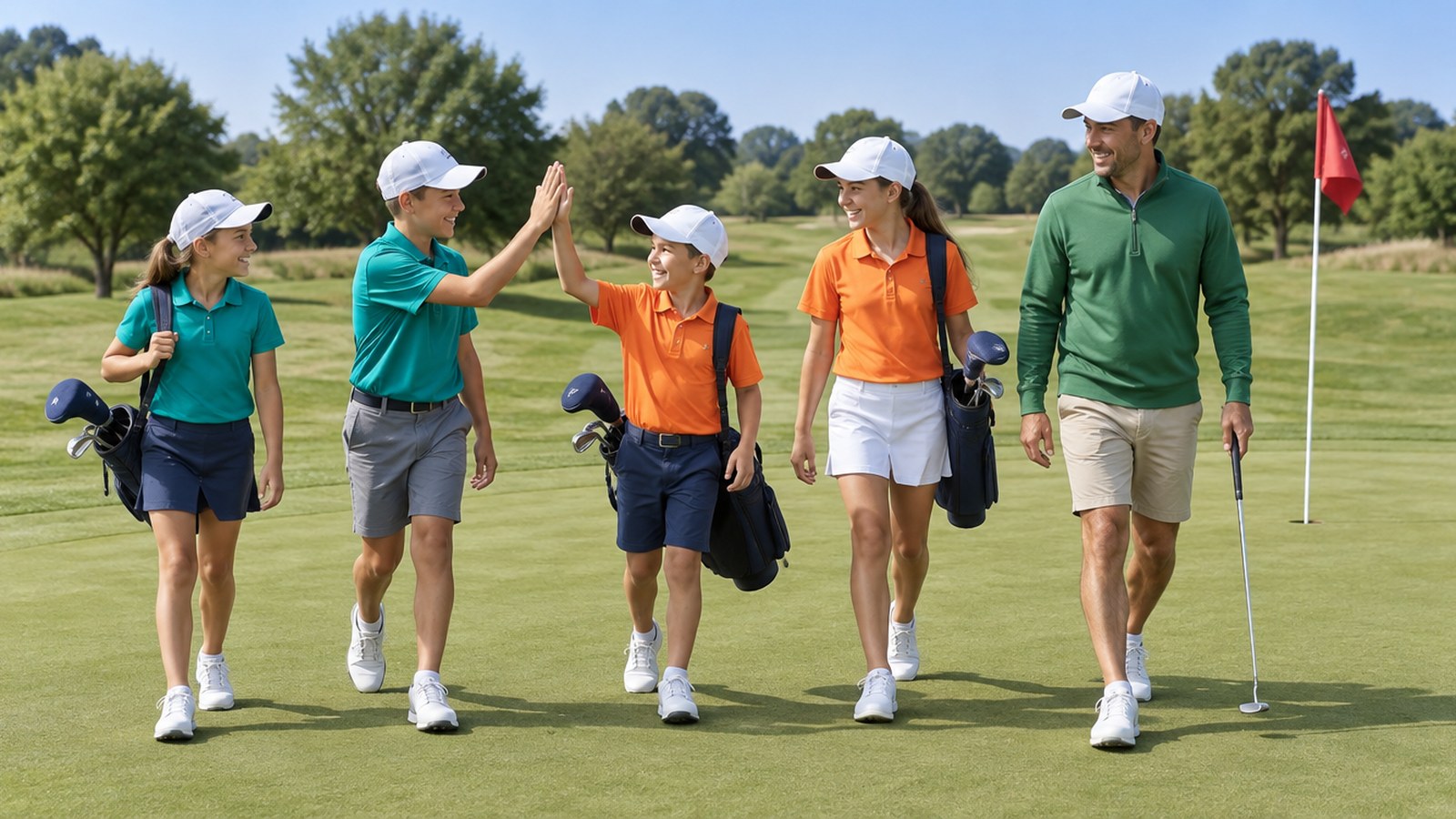

Most children learn golf on their own. They hit balls on a range, have a lesson, go round with a parent, and every bad shot belongs to them and nobody else. Joining a junior golf league changes that. Suddenly there’s a team, a shirt, a partner who might hit the better shot, another club to play against, and a season with a start and an end. For a lot of kids, that’s the moment golf stops being something they’re taken to and becomes something they belong to.
I’m Al. I trained and taught high school mathematics and science, and these days I’m a stay-at-home parent to two boys who are five years apart and came to golf at different ages, for different reasons, here in Australia. I’m not a coach or a league organizer, and everything I say about how particular leagues run comes from what their organizers publish. What I can bring is ten years of watching which formats kept my two keen and which didn’t. If your child has been offered a spot on a team, or you’re wondering whether a league is the next step, read on.
⛳🏌️
US Kids Golf UL7 5 Club Stand Set
I chose it over bigger sets because five clubs cover every shot a nine-hole scramble asks for, and it's sold by height rather than age.
A child gets a driver, hybrid, 7 iron, wedge and putter in a stand bag light enough to carry for a league match.
- Five clubs plus a stand bag
- Sized for players 48 to 66 inches tall
- Ships outside the US
What a Junior Golf League Actually Is
A team, a coach and a season: A junior golf league is a team format with a fixed schedule. A squad from one club or facility plays other teams across a season, usually under a coach. In the US, PGA Jr. League runs three age divisions (opens in a new tab) (9u, 13u and 17u, with 9u new in 2026), puts every team under a PGA Coach, and plays about six games (opens in a new tab) a season plus whatever practices the coach adds.
The scramble is what makes it work for beginners: In a PGA Jr. League match, each team splits into pairs and plays a two-person scramble (opens in a new tab): both players hit, the pair picks the better shot, and both play from there until the ball is in the hole. A beginner who tops a drive isn't sunk, because the partner's ball is still in play. England's GolfSixes League uses a Texas scramble (opens in a new tab) for the same reason, so that every child can contribute to the team.
Match play keeps a bad hole small: Most leagues score by match play, where a player and an opponent compete on holes won (opens in a new tab), lost or tied rather than total strokes. A nine on one hole loses that hole and nothing more. PGA Jr. League matches run over nine holes (opens in a new tab) split into three "flags" of three holes, with points available at the end of each flag, so even a team that falls behind early has two fresh starts. If your child is still getting their head around golf's basic ideas, both formats are simple to explain on the drive to the first match.
Shorter holes and shorter matches: Leagues shrink the game to fit younger players. PGA Jr. League's new 9u division uses shortened holes (opens in a new tab), practices and games. GolfSixes plays six shortened holes (opens in a new tab) in 75 to 90 minutes. In Australia, a 2019 Golf Australia report describes regional MyGolf leagues played as a modified nine-hole (opens in a new tab) two-person ambrose, which is what Australians call a scramble.
How a league compares with lessons and tournaments: The table sets the three side by side.
| Lessons and clinics | Junior league | Junior tournaments | |
|---|---|---|---|
| Who your child plays with | A coach and a group, or one-to-one | A team, usually split into pairs | On their own, against the field |
| How it's scored | Usually not scored | Match play, on holes won or lost (opens in a new tab) | Mostly stroke play, on total score (opens in a new tab) |
| What a bad hole costs | Nothing; it's practice | One hole, and the partner's shot may rescue it | Every stroke counts toward the total |
| How long it takes | Set by the coach | About 2½ hours (opens in a new tab) for PGA Jr. League; 75 to 90 minutes (opens in a new tab) for GolfSixes | Set by the event |
| Who it suits | Any beginner | A child who can hit the ball and wants company | A child who wants to measure themselves |
Who a league is for: Leagues are built for players near the start. PGA Jr. League welcomes all skill levels and says no prior experience (opens in a new tab) is required. GolfSixes is for players with no handicap (opens in a new tab) or a handicap of 37 and above. Golf Australia describes its MyGolf Junior League as a teams-based beginner competition (opens in a new tab) meant to introduce competitive golf in a modified setting.
Why group formats suit beginners: Here in Australia, both my boys came through group clinics before anything else, and for both of them that was the better start. Being one of several kids took the pressure off, they saw others struggling with the same things, and it stayed fun. It was also far cheaper, which matters when you don't yet know whether your child will stick with it. Later, the squad environment turned out to be its own thing rather than a bigger group lesson. The standard sets itself, and a child who is the strongest player in their group at the club discovers fairly quickly that they aren't. That lands better coming from peers than from a parent.
So a league is golf with the edges softened: a partner, a team, a shorter course and a scoring system that forgives a bad hole. The next question is what all of that actually does for a child.
The Benefits of Joining a Junior Golf League
A team in what's usually a solo sport: A 2022 study of 11,235 US children (opens in a new tab) aged 9 to 13 found that team sport participation was associated with fewer mental health difficulties, while individual sport participation was associated with more. The authors are clear that their design can't show cause (opens in a new tab) and effect, and golf isn't named in the study. What a league does offer is the team side of sport inside a game most kids otherwise play alone.
Fun is what keeps kids playing: The American Academy of Pediatrics says children who have fun playing sports are more likely to remain (opens in a new tab) involved, and that camaraderie and teamwork teach lessons in personal responsibility, sportsmanship, goal-setting and emotional control. Those are the same life skills golf teaches at its best, and a team makes them easier to practice.
Winning matters less than parents think: Research led by Amanda Visek at George Washington University ranked 81 things that make youth sport fun, and winning came in at No. 40 (opens in a new tab). Trying your best, working hard, staying active and playing well together as a team mattered most, to girls and boys alike. A league scramble, where the pair's best shot is the one that counts, is built around exactly those things.
Less pressure on every shot: Because the pair plays the better ball, one poor swing rarely decides anything. One Australian organizer quoted by Golf Australia says the two-person format takes the pressure (opens in a new tab) off children who would otherwise be playing every shot from the proper markers on their own.
Friends, and a reason to come back: The same Golf Australia report quotes a league organizer saying it's the friendships (opens in a new tab) that make it work, and that the social side helps keep players in the game, especially girls. In 2025, the Golf Foundation's GolfSixes League in England, Scotland, Wales and Ireland had 9,247 young players (opens in a new tab), one in four of them girls. Ninety-two percent rated their enjoyment excellent or good, and 88 percent said they wanted to play more (opens in a new tab) golf as a result.
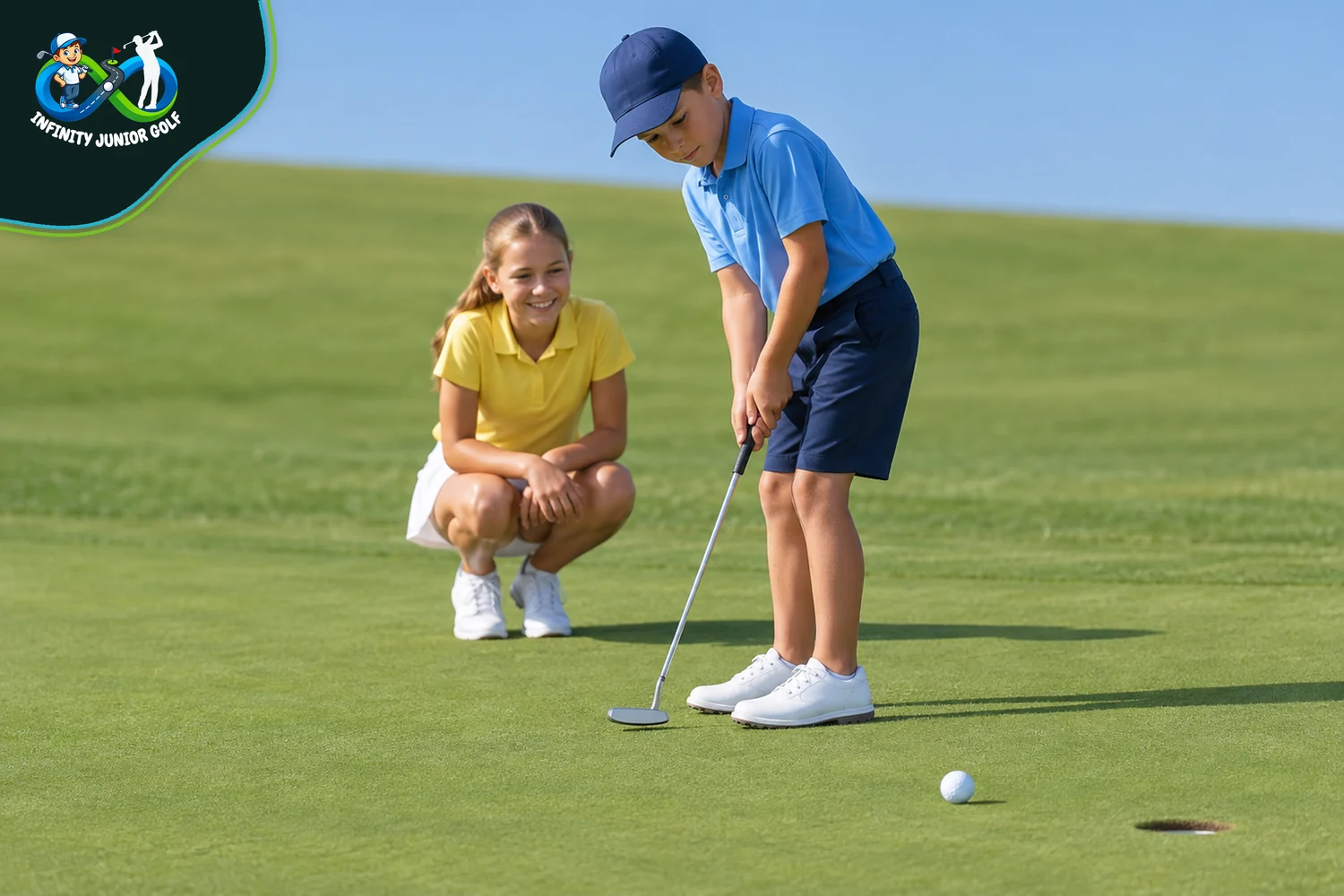
A first taste of competition, at the right size: In Australia, the regional MyGolf leagues were set up to fill the gap (opens in a new tab) between MyGolf programs and handicapped junior pennant, and one organizer reported that every child from the previous season had gone on to Junior Pennant or kept playing at their course. That's one league's experience, not a national figure, but it shows what a league can be for. In the US, PGA Jr. League's All-Star season adds team stroke play (opens in a new tab) and a postseason path through Play Days, Sectionals and Regionals to a national Championship, a stepping stone toward the junior golf tournaments a competitive child may want next.
Time outdoors and on their feet: The World Health Organization recommends an average of 60 minutes a day (opens in a new tab) of physical activity for children and adolescents, and it reports that 81 percent (opens in a new tab) of adolescents aged 11 to 17 were physically inactive. An international consensus on golf and health found that golf can provide moderate-intensity aerobic (opens in a new tab) activity, with greater benefits for players who walk, and that it can provide social interaction (opens in a new tab) too. A PGA Jr. League match lasts about 2½ hours (opens in a new tab), most of it walking.
Not every child wants a team: My two wanted completely different things from golf. One took to the competitive side early. The other was there for the time outdoors and the company. A league suits some children perfectly and leaves others cold, and the studies above describe groups of children, not yours. Treating them the same would have put one of mine off entirely.
The benefits are real, then, as long as the league is the right one and your child wants to be there. Finding one depends a great deal on where you live.
How to Find a Junior Golf League Where You Live
United States
PGA Jr. League is the national option: PGA Jr. League says over 81,000 kids (opens in a new tab) play on its teams. Registration opens in January and February, recreational seasons run March through June (opens in a new tab) and again from July through December, and the All-Star season runs from May to November. Programs are listed by facility on the league's site, so the club or range nearest you may already run a team.
Know the full cost before you sign: Every player needs a #GameChanger Club membership (opens in a new tab) at $120 USD a year, which covers access to a local league, as many seasons as they want in that calendar year, and a custom jersey and team kit. The PGA Coach then sets a separate program fee, which varies by location. League fees sit on top of lessons and club costs, so it's worth reading up on how to keep golf affordable before the season starts.
Safeguarding is built in: All PGA Jr. League coaches, assistant coaches and volunteers must pass a background screen (opens in a new tab) and complete abuse prevention training, and both have to be renewed every two years.
England, Scotland, Wales and Ireland
GolfSixes League is run through the clubs: The Golf Foundation runs GolfSixes League with England Golf (opens in a new tab), Scottish Golf, Golf Ireland and Wales Golf, and in 2025 it ran 133 leagues across 743 golf clubs and teams. Clubs are grouped into local leagues (opens in a new tab) of four to six, each hosting one fixture a season, with a squad of 12 from which six play each match.
Parents are part of it: Clubs taking part must be SafeGolf accredited (opens in a new tab) and have a nominated Welfare Officer, and parents act as chaperones on the day. In 2019, 59 percent of parents (opens in a new tab) volunteered at fixtures, and 38 percent of those volunteers didn't play golf themselves.
Australia
MyGolf Junior League runs through MyGolf centers: Golf Australia calls MyGolf Junior League Australia's national (opens in a new tab) junior golf teams-based beginner competition, built around fun, teamwork and participation, with a Finals Fun Day at the end. MyGolf centers register their interest and then create teams through their MyGolf account (opens in a new tab), so the question to ask is whether your local center has opted in.
Leagues here run regionally: The 2019 Golf Australia report describes leagues in regions across the country (opens in a new tab), including one played over five Sundays in February and March with an adult walking with each group. Seasons and formats vary from one region to the next, so ask the club rather than assuming.
Canada and everywhere else
No national league in Canada: Golf Canada's junior page points families to First Tee – Canada (opens in a new tab) and RBC Community Junior Golf, and it doesn't list a junior league. Golf Canada's Youth on Course program offers subsidized rounds (opens in a new tab) to members aged 6 to 18, which helps once a child is ready to play more. For a team format, ask your local club or First Tee facility what it runs.
Ask the people who already know: Wherever you live, the club's golf professional is the first person to ask, followed by the national federation. Then talk to other golf parents. A great deal of what I've learned about tournaments, entry processes and equipment came from conversations at the course, the practical, unwritten things that don't make it into an article because nobody thinks to write them down.
Once you've found a league, the next question is usually what your child needs to bring. Here's where to find the gear for a first season.
Brands and Tools That Help Juniors Thrive — Our Recommendations
A league match needs fewer clubs than most parents expect, and the right size matters more than the number. These six cover a range of heights, budgets and countries, from a complete set for a first season to a light bag for a child putting a set together from single clubs.
US Kids Golf
About
US Kids Golf makes junior clubs sized by the player's height rather than their age, from first sets through to tournament sets. Its Ultralight 7 range is aimed at beginner and intermediate players.
Our recommendation
The UL7 5-club set (opens in a new tab) costs $309.99 USD and comes in six height ranges from 48 to 66 inches, with a driver, hybrid, 7 iron, wedge, putter and stand bag. I chose it because five clubs cover a league scramble and the height sizing makes it easy to buy for the child in front of you.
Decathlon
About
Decathlon is a sporting goods retailer that sells its own Inesis golf range in its stores and online, including complete junior kits by age.
Our recommendation
The Inesis 8–10 kit (opens in a new tab) costs €120 on Decathlon's Irish site, with a driver, two irons, a putter and a tripod stand bag for children 125 to 140 cm tall. It's the cheapest complete kit here, but Decathlon Ireland delivers only within (opens in a new tab) the Republic of Ireland, so check your own country's Decathlon site, where the kit, price and stock differ.
American Golf
About
American Golf is a UK golf retailer selling clubs, package sets, clothing and accessories, including a junior range sorted by age.
Our recommendation
The COBRA KING Junior (opens in a new tab) Age 7–9 package costs £379 and includes a driver, hybrid, two irons, a sand wedge, a putter and a stand bag. A strong choice for GolfSixes families, with delivery across the (opens in a new tab) UK and Ireland and an international option. It's sized by age, so check your child's height against it.
GlobalGolf
About
GlobalGolf is a US retailer of new and used golf equipment that ships internationally, with duties and taxes paid at checkout (opens in a new tab).
Our recommendation
The Callaway XJ-1 set (opens in a new tab) costs $349.99 USD new and is the smallest size in Callaway's XJ junior range. A sensible pick for a 9u player; check Callaway's height chart first, and allow for GlobalGolf's oversized item fee (opens in a new tab) on international orders.
Golf Galaxy
About
Golf Galaxy is a US golf chain with stores and online ordering, carrying junior sets from the major brands.
Our recommendation
The Callaway XJ3 set (opens in a new tab) costs $649.99 USD for players 54 to 57 inches tall, with seven clubs, a stand bag and headcovers. It suits an older junior in a 13u or 17u team who has outgrown a five-club set. Golf Galaxy ships within the US (opens in a new tab) only.
PGA TOUR Superstore
About
PGA TOUR Superstore is a US golf chain selling clubs, bags, shoes and accessories in stores and online.
Our recommendation
The 27-inch junior bag (opens in a new tab) costs $89.99 USD, weighs 3.4 lbs and has a fold-out stand and padded strap. It suits a child carrying a handful of secondhand or single clubs, though no height range is listed. PGA TOUR Superstore ships to over 100 countries (opens in a new tab) through Borderfree, though some items can't be exported.
With the gear sorted, there's one more question worth asking before you pay the fee: is your child actually ready, and is this the right league for them?
How to Tell Whether Your Child Is Ready for a League
Readiness is about wanting to, not ability: Leagues are designed for children near the start, which is why PGA Jr. League requires no prior experience (opens in a new tab) and GolfSixes is open to players with no handicap (opens in a new tab). The better test is whether your child enjoys playing with other kids and wants to go. When they start, why they started, and who they were at the time shape it at least as much as their age.
Ask the coach the right questions: Ask which age division your child would play in, how matches are scored, how many games and practices the season has, and what the program fee is on top of any membership. PGA Jr. League's 13u minimum age is set by each facility (opens in a new tab), so ask before you register. Ask about safeguarding too: in the US, PGA Jr. League coaches and volunteers must pass a background screen (opens in a new tab), and in the UK, GolfSixes clubs need a Welfare Officer (opens in a new tab).
Size the clubs for today, not next year: What I got wrong with my eldest was sizing. I bought his first set too big because I'd been told he'd grow into it, which is advice that makes sense for school shoes and no sense at all for golf clubs. I couldn't tell you the brand now. What I remember is him working harder than he should have needed to, and enjoying it less than he otherwise would have. If you're buying a first junior set for the league, measure your child's height and buy for that.
🏌️
US Kids Golf UL7 5 Club Stand Set
Its six height ranges make it straightforward to buy for the child in front of you rather than the one they'll be in two years.
- Driver, hybrid, 7 iron, wedge and putter
- Stand bag included
- $309.99 USD
Plan for sun and supervision: The international consensus on golf and health says children should be adequately supervised (opens in a new tab) and that golfers may face an increased risk (opens in a new tab) of skin cancer. A hat, sunscreen and water belong in the bag for every match, and it's worth asking who walks with each group. In the Australian leagues Golf Australia described, an adult (opens in a new tab) went with every group.
Know your role on match day: GolfSixes asks parents to act as chaperones (opens in a new tab), and helping out is part of the fun for plenty of families. Coaching from the side is a different matter. The best thing I learned was to leave it alone. The drive home after a bad round is not the moment for technical feedback, however well meant. They already know what went wrong. What works better is asking whether they want to talk about it, accepting no as an answer, and saving anything technical for the next practice session. Leave the league coaching to the coach, and if you're coaching your own kids the rest of the week, keep match day separate.
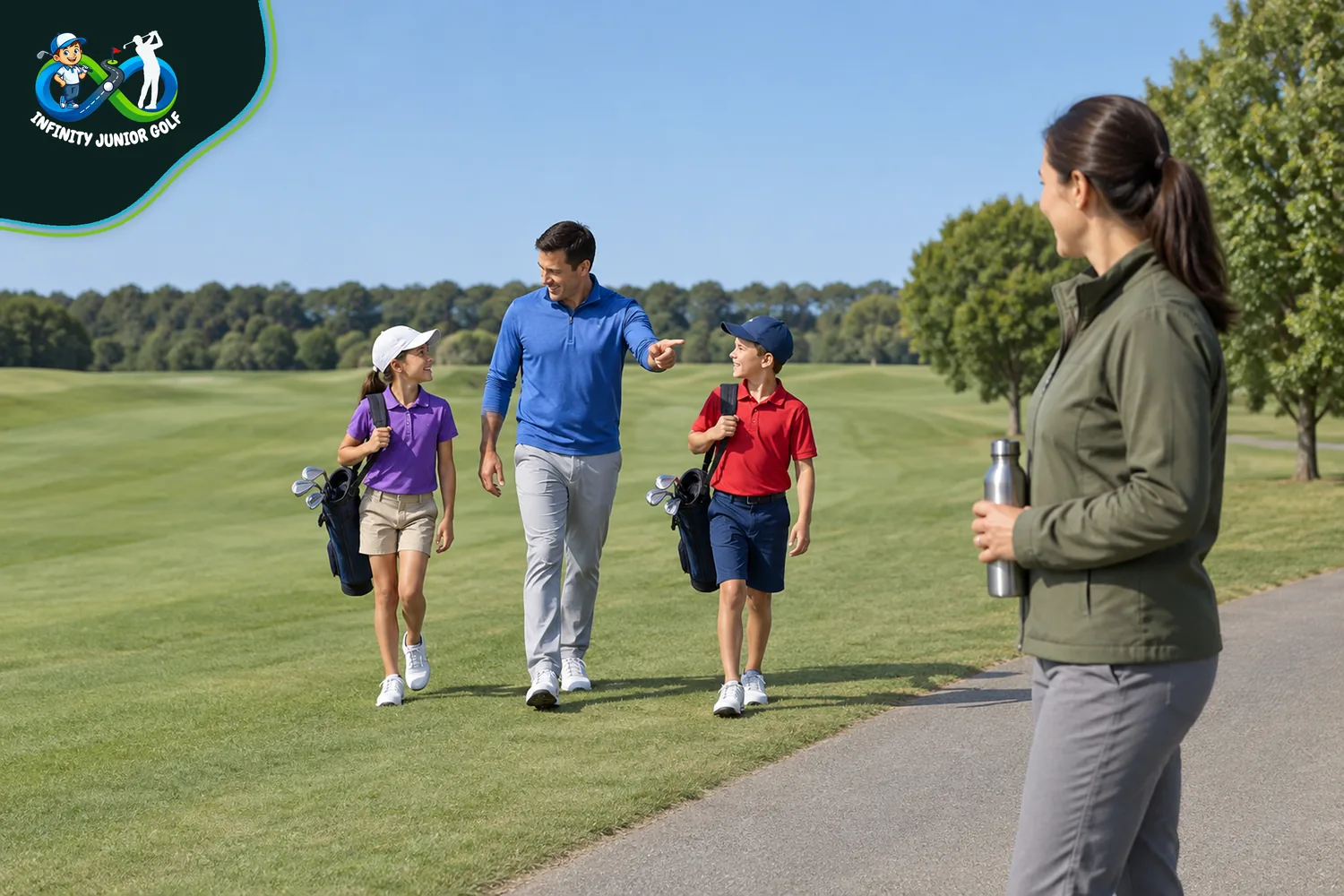
Check that the league fits the week: A league adds fixed match days and practices to a week that already has school, other sports and family in it. Junior golf isn't competing with free time, it's competing with everything else the child already does, and something has to give. Working out what gives, and letting the child have a say in it, matters more than any equipment decision you'll make.
Watch for your own enthusiasm: I've watched keen parents put their children off the game entirely, and I've had to check myself more than once. The child has to want it. If the league seems to be your project rather than theirs, it's worth a conversation before the season rather than halfway through it.
If your child wants to go, the league runs safely and the week has room for it, the rest is preparation. Here are the practical steps that make a first season go smoothly.
Our Practical Tips For You
What to do
| Tip | How to do it | Why it matters |
|---|---|---|
| Ask the club's pro first | Ask whether the club runs a league or knows the nearest one. | The pro usually knows what runs locally. |
| Pick the right division | Check your child's age against the league's divisions. | PGA Jr. League runs 9u, 13u and 17u (opens in a new tab) divisions. |
| Ask for the full cost | Ask for the membership and the program fee together. | PGA Jr. League's $120 USD membership (opens in a new tab) is separate from the coach's fee. |
| Check safeguarding | Ask how coaches and volunteers are screened. | US coaches need a background screen (opens in a new tab); UK clubs need SafeGolf accreditation (opens in a new tab). |
| Explain the format early | Walk through scramble and match play before match one. | A bad hole only loses that hole (opens in a new tab) in match play. |
| Size clubs to today's height | Measure your child and buy for that height. | A set that's too big makes golf harder and less fun. |
| Pack sun protection | Add a hat, sunscreen and water to the bag. | Golfers may face higher skin cancer (opens in a new tab) risk. |
| Volunteer once | Offer to chaperone or help at one fixture. | 59 percent of parents (opens in a new tab) volunteered at GolfSixes fixtures in 2019. |
| Save feedback for practice | Ask if they want to talk; accept no. | Technical talk lands better at the next session. |
| Ask before re-enrolling | At season's end, ask whether they want another. | Whether they talk about it tells you if it's working. |
Those ten steps cover most of what a parent needs to get right before and during a first season. A few questions come up again and again, so here are the short answers.
FAQs
These are the questions parents ask most often about junior golf leagues.
Does my child need to be good at golf to join a league?
No. PGA Jr. League welcomes all skill levels and requires no prior experience (opens in a new tab), and GolfSixes is for players with no handicap (opens in a new tab) or a handicap of 37 and above.
How much does a junior golf league cost?
In the US, PGA Jr. League costs $120 USD a year (opens in a new tab) for membership plus a program fee set by the coach, which varies by location. Elsewhere, fees are set by the club or center running the league, so ask locally.
What is a scramble?
Both players in a pair hit, they choose the better shot (opens in a new tab), and both play the next shot from that spot until the ball is holed. Australians call the same format an ambrose.
Is there a junior golf league in my country?
The US has PGA Jr. League, England, Scotland, Wales and Ireland have GolfSixes League (opens in a new tab), and Australia has MyGolf Junior League (opens in a new tab). Golf Canada's junior page lists no league (opens in a new tab), so ask your local club or First Tee facility.
Our Related Articles
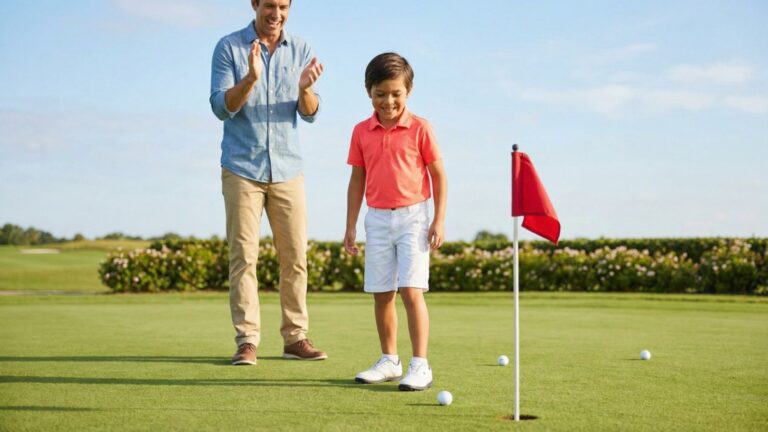
Explaining The Basics Of Golf To Kids In Fun Ways
Golf can seem like a big, grown-up game when you first look at it, but kids usually learn it best when it feels playful,
Read article
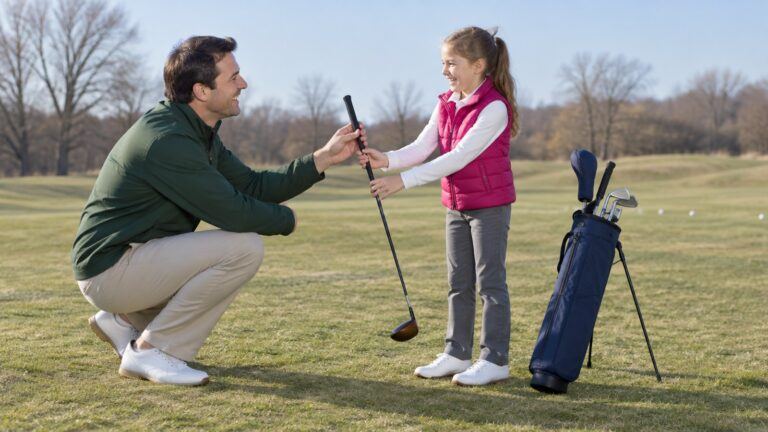
Best Junior Golf Club Sets For First-Time Players
A first set of golf clubs is the one purchase nearly every golfing family makes, and it’s usually made on a guess. The sets
Read article
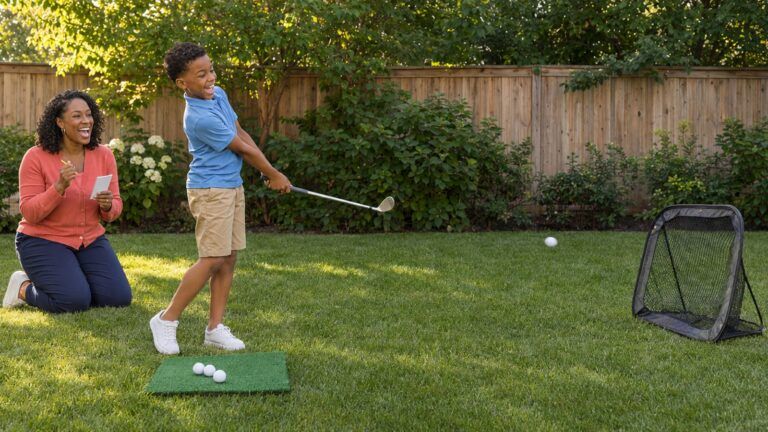
The Do’s And Don’ts Of Coaching Your Kids In Golf
Nobody decides to become their child’s golf coach. You take them to the range, they ask how to hold the club, and from that
Read article
Conclusion
A junior golf league takes a game most children learn alone and gives it a team, a partner, a coach and a season. The scramble and match play keep one bad shot from spoiling the day, the friendships give children a reason to come back, and the league gives a first taste of competition at a size a beginner can handle. It works best when the child wants to be there, the clubs fit, the league is run safely, and the parent is happy to watch from the cart path. Not every child will want a team, and that's fine too.
Has your junior played in a league or another team format yet, and did it change how they feel about golf?
