
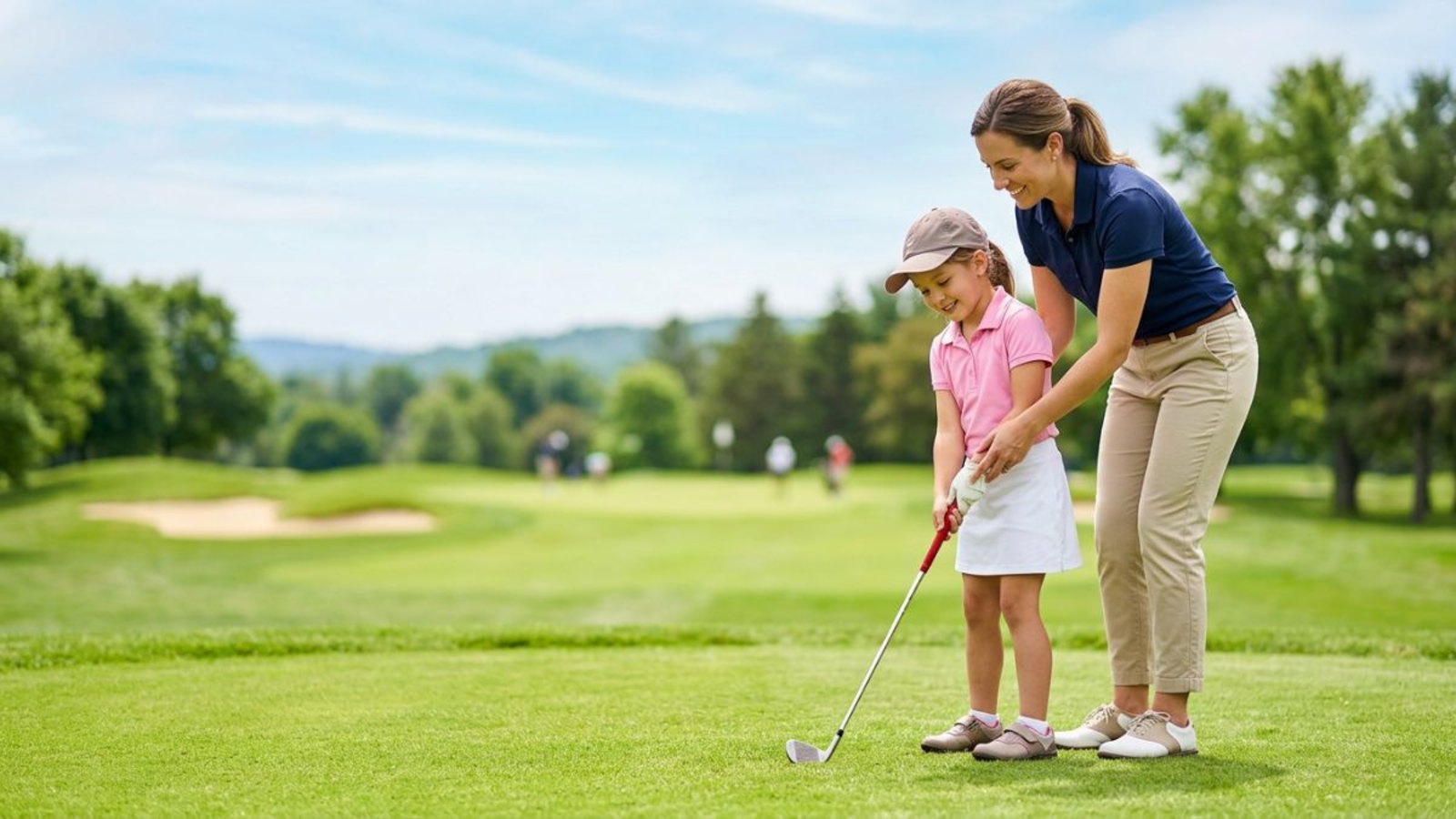

Getting your child into golf is one thing. Staying in the fairway as their coach, cheerleader, and occasional critic is another thing entirely. The way a parent approaches those first rounds and practice sessions can be the difference between a child who develops a lifelong love for the game and one who never picks up a club again. Golf rewards patience and process — qualities that matter every bit as much off the course as on it.
My name is Al, and like a lot of golf parents, I came to junior coaching through enthusiasm rather than expertise. I’ve made plenty of the mistakes described in this article, learned from them, and spent years reading the research, talking to instructors, and watching what actually works with young players. If you’re trying to figure out how to support your child’s golf journey without inadvertently making it harder, you’re in the right place. Keep reading — there’s a lot here that could change how you stand next to them on the practice tee.
⛳ Our Top Pick — Best Junior Golf Club Set
US Kids Golf UL7 7 Club Stand Set
I chose this set specifically because US Kids Golf's height-based sizing model is the most rigorously researched approach to junior fitting available, and the UL7's weight engineering directly addresses the single most common mistake parents make when buying junior clubs.
When clubs are sized and weighted correctly for a child's height and swing speed, kids can swing freely — and that physical freedom translates directly into better mechanics and a lot more enjoyment on the course.
- ✅ Height-fitted across multiple size options, each covering a three-inch range
- ✅ Graphite shafts designed for junior swing speeds
- ✅ Ships internationally
| Mid-range (~$390)
👉 Shop US Kids Golf (opens in a new tab)Why Your Coaching Approach Shapes Everything
The first few years define the relationship: A child’s early experiences with golf establish the emotional framework they carry into every round, practice session, and lesson for years afterward. Research published in the International Journal of Golf Science (opens in a new tab) confirms that coaching quality in the formative stages has a measurable effect on long-term golf development. When early experiences feel positive and exploratory, children build intrinsic motivation — the kind that sustains them through the inevitable hard rounds. When those experiences feel pressured or critical, they build performance anxiety instead.
The parent-coach occupies a unique position: No instructor spends more time with a junior golfer than a parent does. A club professional might see a child for an hour a week. A parent shapes the child’s relationship with golf in the car on the way to the course, in the backyard, during dinner conversations, and in the emotional space after a difficult round. That influence is constant, which means the opportunity to get it right — or wrong — is always present.
Fun is not a soft goal: The American Academy of Pediatrics (opens in a new tab) has been direct on this in its clinical research: enjoyment is the primary reason children play sports, and the absence of it is the primary reason they stop. This is not a throwaway finding. It has real implications for how parent-coaches structure practice, respond to poor shots, and frame expectations around competition. A coaching approach that squeezes the fun out of the game will, over time, squeeze the child out of it too.
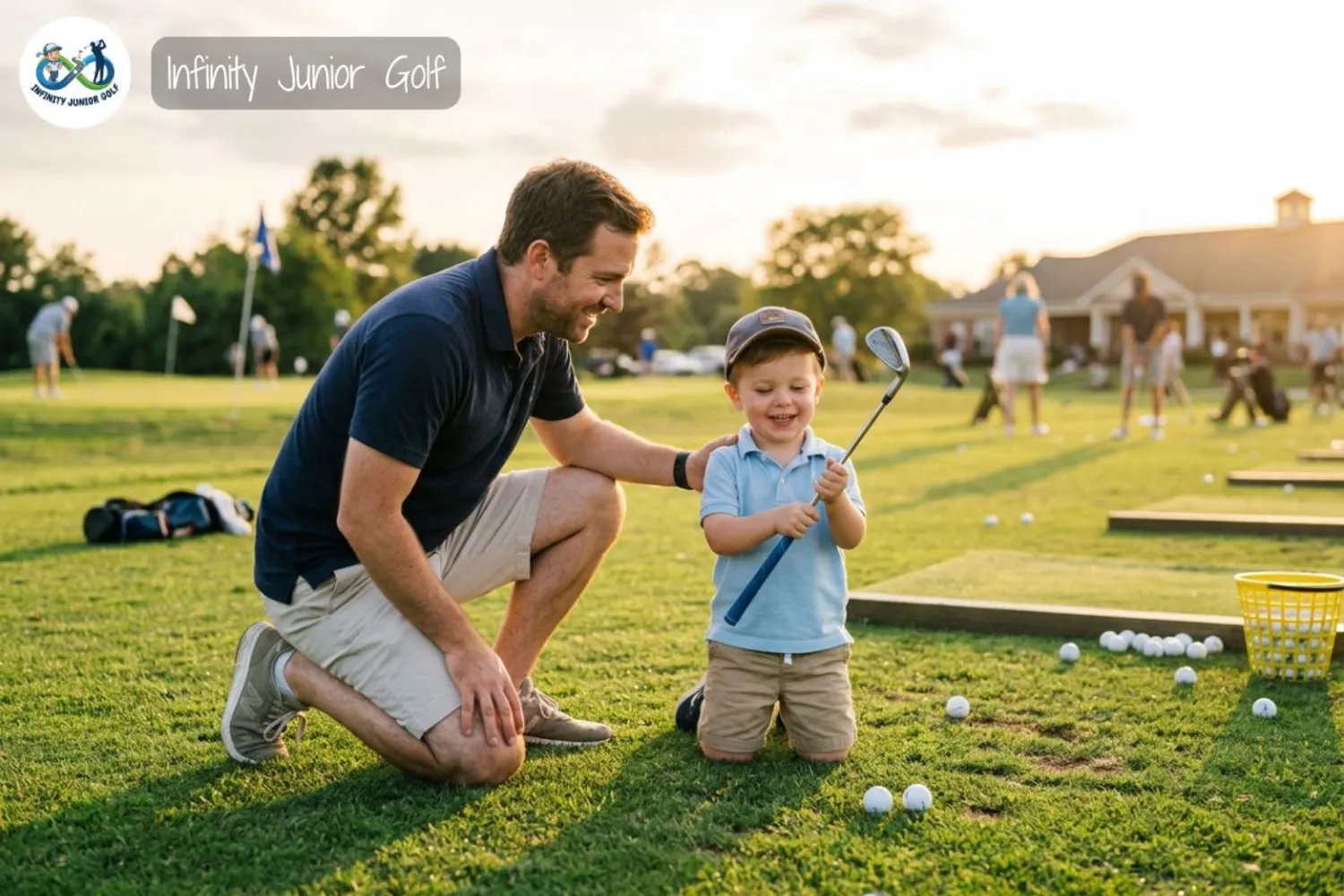
The research and the range tee agree: Sports psychologists, PGA professionals, and long-term athlete development specialists all reach the same conclusion from different starting points. Child-centered approaches that give young players autonomy, celebrate effort, and lean into discovery consistently produce better outcomes than adult-directed, results-focused methods. A useful companion read for getting these foundations right is our guide on explaining golf to kids (opens in a new tab).
The sections that follow translate all of that into practical do’s and don’ts any parent can apply the next time they step onto the course or into the backyard with their child.
The Do’s of Coaching Your Kids in Golf
Start on the putting green: Every experienced junior golf coach will tell you the putting green is where children should spend their first hours in the game. Putting requires no physical strength, produces immediate feedback, and can be practiced indoors on a carpet on a rainy afternoon. Children who begin there build genuine feel for the ball before they ever face the more physically demanding full swing. A putter that reaches a child’s belly button when standing upright is the single most valuable piece of equipment you can give a beginner.
Give tasks, not technical instructions: One of the most consistently agreed-upon principles in junior coaching is that task-based instruction works and mechanical instruction usually doesn’t. Ask a child how close they can chip a ball to a target, and their brain engages hand-eye coordination and natural problem-solving. Tell them to flatten their lead wrist at the top of the backswing, and you’ve introduced abstract mechanics that overwhelm a developing nervous system. TPI (opens in a new tab) — the Titleist Performance Institute — trains coaches to present challenges rather than positions, and this works at every age.
Let children self-organize: PGA professional Neil Plimmer of the JOLF youth program makes a compelling case for giving children a club, a ball, a starting point, and a finishing point — and then stepping back. Children have an innate capacity to self-organize movement, much as they figured out how to walk and run without formal instruction. Adult intervention that interrupts this process often removes a child’s ability to learn through experimentation, rather than enhancing it.
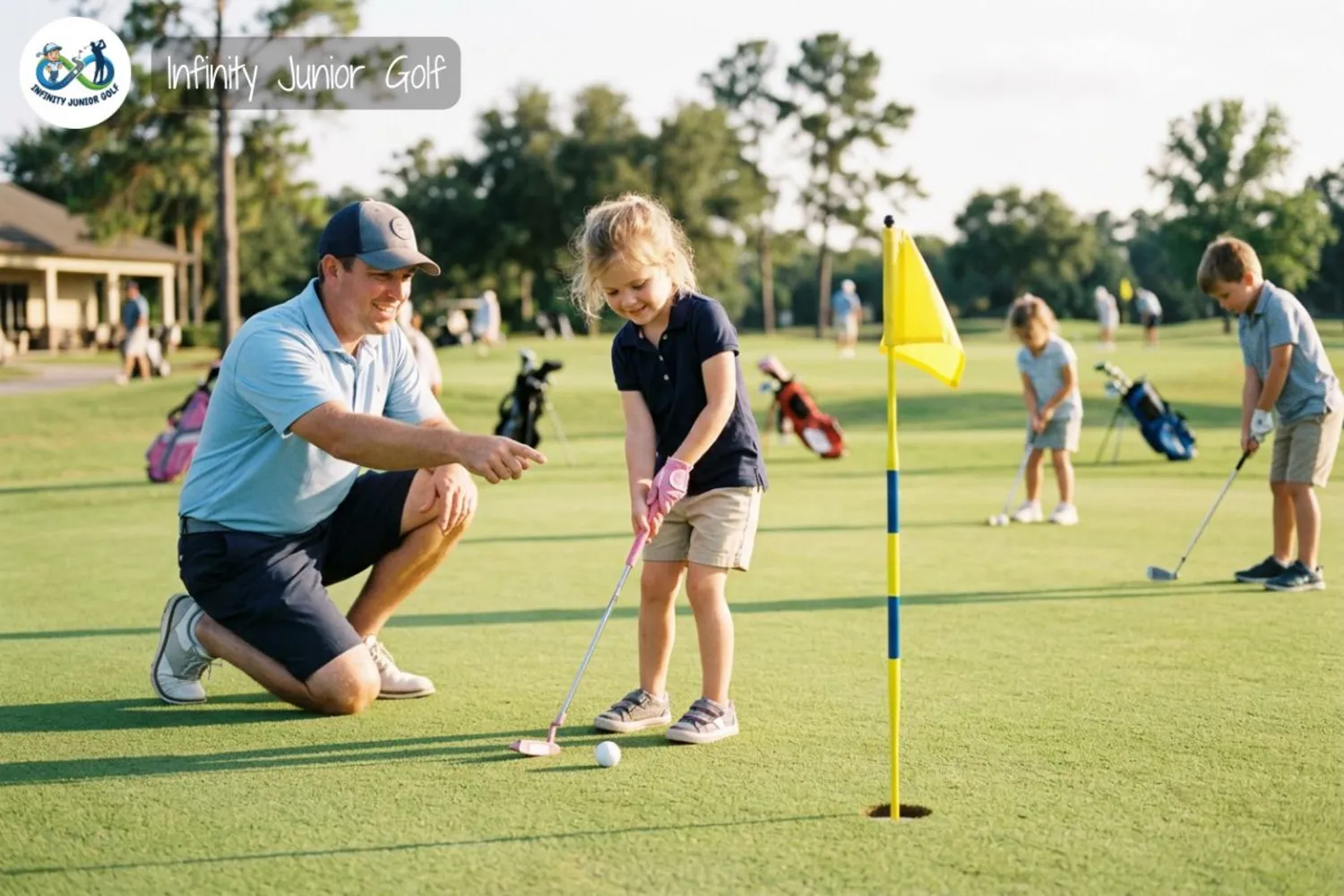
Focus on the right fundamentals: Setup, posture, ball position, and alignment are the fundamentals worth reinforcing gently in the early years. Swing plane, wrist angles, and hip rotation sequencing are not — those are conversations for a qualified instructor when the child is ready for structured technical development. Getting the basics right gives a young golfer a foundation from which an individual, effective swing can naturally emerge.
Use properly fitted equipment: This is one of the highest-impact investments a parent can make. Clubs fitted to a child’s height and weighted correctly for their strength level allow them to develop proper mechanics and feel what a well-struck shot actually feels like. Clubs that are too heavy, too long, or too stiff work against the child at every stage. If you’re still working out what to buy, our junior club sets guide (opens in a new tab) walks through the options by age and ability.
🏌️
I chose this set because the height-based fitting model directly addresses the most common error parents make when equipping young golfers — buying by age rather than by swing mechanics.
- ✅ Multiple height-based size options covering a three-inch range each
- ✅ Graphite shafts optimized for junior swing speeds
- ✅ Ships internationally
Teach the mental game early: Stanford professor Carol Dweck’s growth mindset research has practical applications on the golf course. Children who understand that ability grows through effort — rather than being fixed at birth — respond to bad shots as learning opportunities rather than evidence of failure. Parents reinforce this simply by asking “What did you learn from that round?” rather than “What did you shoot?”
Keep sessions short and varied: Children under ten have attention spans that are genuinely shorter than adults’, and that is a developmental reality to work with rather than to overcome. Switching between putting, chipping, and full swings in a 20-to-30-minute session keeps engagement high and covers more skill ground than an hour of repetitive range work.
Model what you want to see: Children absorb behavior from the adults around them far more than they absorb verbal instruction. Playing alongside your child and demonstrating composure after a bad shot, respect for course etiquette, and genuine enjoyment of the game teaches those values more durably than anything you can say.
Once you’ve worked through the do’s, it’s equally important to know which habits work against young players — and they’re more common among well-meaning golf parents than most people like to admit.
The Don’ts of Coaching Your Kids in Golf
Don’t yell or use negative language: Yelling is the single most damaging thing a parent-coach can do. It creates anxiety, signals to a child that there is a “wrong” way to play, and destroys the safe environment children need in order to learn. The emotional damage caused by hostile communication around golf can persist for years — there are adult golfers who abandoned the game for a decade because of what a parent said to them on the course as a child. No shot is worth that cost.
Don’t overload with technical tips: Most parents know enough about the golf swing to be genuinely unhelpful on the coaching tee. YouTube swing tips and magazine instruction pieces are designed for adult learners with already-formed movement patterns. Applying them to children overwhelms developing nervous systems and creates self-consciousness where there should be free exploration. Leave technical coaching to qualified instructors and keep your own input focused on encouragement and challenge-setting.
Don’t make the score the centerpiece: Shifting focus to scores and results too early creates performance anxiety and removes the intrinsic enjoyment that sustains long-term participation. Coaches consistently recommend delaying score-keeping until children are making reliable solid contact and have developed some emotional resilience. When scores do come into play, frame them as information for learning — not as measures of a child’s worth or potential.
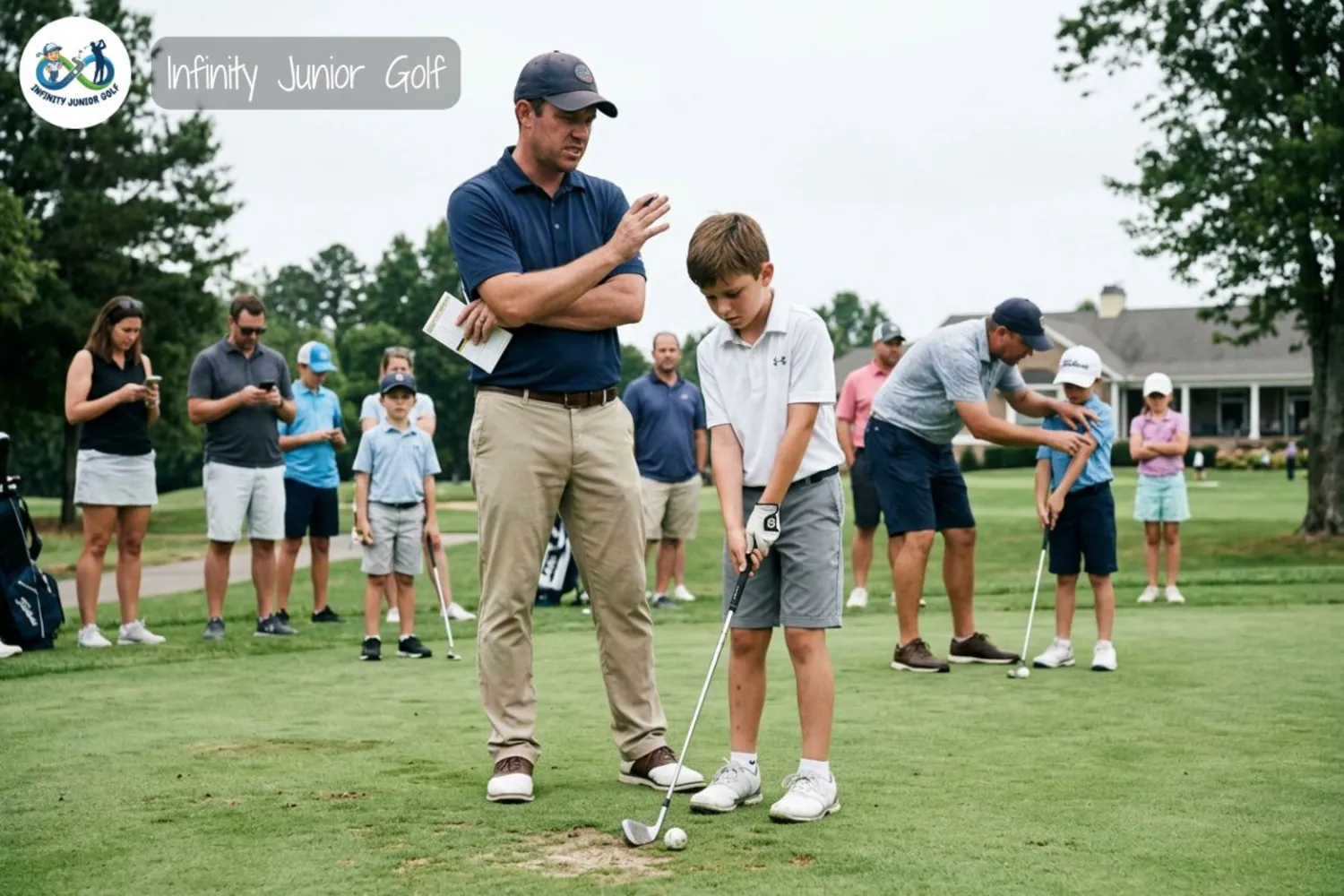
Don’t compare your child to other juniors: Every child develops at a different rate, and developmental readiness for golf skills varies enormously. Comparing your child’s progress to a peer’s — even with good intentions — feeds what mental coach David MacKenzie of Golf State of Mind (opens in a new tab) calls “ego golf”: measuring yourself against others rather than pursuing personal mastery. Framing the journey around your child’s own progress removes this trap entirely. It’s also worth remembering that every great golfer had a story all their own — the Tiger Woods origin story (opens in a new tab) is a compelling reminder of how individual every path in this game really is.
Don’t analyze the round in the car on the way home: The car ride home is not the time for a debrief. Children need emotional space after competition. Research in sport psychology consistently shows that immediate analytical feedback from parents is received as criticism, even when it is entirely well-intentioned. A simple question like “Did you have fun?” is the right way to open that conversation.
Don’t force the game: Golf has to be your child’s genuine choice. Parents can create exposure — mini golf, watching tournaments together, backyard putting games — but if a child does not want to play, dragging them to the course achieves nothing except resentment. The decision to pursue golf seriously must come from the child.
Don’t neglect rest and multi-sport participation: The American Academy of Pediatrics recommends that young athletes take at least one to two days off per week and two to three months off per year from their primary sport. Early sport specialization is consistently linked to higher rates of overuse injury and burnout. Junior golf has no natural off-season, and year-round rankings can create the illusion that every event is critical. Other sports build movement variety that benefits a young golfer’s athleticism directly. A structured balanced schedule (opens in a new tab) is one of the most effective tools a parent has for managing this well.
Don’t use adult or oversized equipment: Handing a child an adult club — or a poorly fitted hand-me-down — makes the game physically harder and encourages compensatory swing movements that are genuinely difficult to correct later. The investment in properly fitted, lightweight junior equipment is one of the most evidence-supported decisions a parent can make, and it does not have to be expensive at every stage.
Now that you know what to do and what to avoid, the following brands and platforms are the ones I trust to help you put those principles into practice.
Brands and Tools That Help Juniors Thrive — Our Recommendations
Whether you are setting a beginner up for their first round or equipping a more serious junior for competitive play, the right gear and the right platform make a real difference. The following brands and services are ones I genuinely trust to help parents and young golfers at every stage.
US Kids Golf
US Kids Golf builds clubs specifically for children, fitted by height in three-inch increments across multiple size options. Their UL7 (Ultralight 7) series features graphite shafts and club head weights engineered for junior swing speeds, producing the kind of clean ball flight that keeps young players engaged. I keep recommending this brand because the fitting logic is sound and the results show in how kids actually move with the clubs. Ships internationally. Browse their UL7 stand sets (opens in a new tab).
Golf Galaxy
Golf Galaxy carries a full junior section across all major brands, including US Kids Golf, Callaway, and TaylorMade lines sized for children. Their in-store fitting service is a strong reason to visit in person before committing online — if you have a location nearby, the trip is worth it. I appreciate that their staff are equipped for a real conversation about junior sizing rather than just pointing at a shelf. Primarily US-based with online shipping options. Browse their kids’ golf clubs (opens in a new tab).
PGA Tour Superstore
PGA Tour Superstore stocks an extensive junior inventory across all major manufacturers, and their in-store junior fitting and introductory lesson services make this more than a retailer. For a family just getting started, having an expert help size clubs and watch a few swings in person is worth more than any amount of online research. US-based with select international shipping. Browse their junior clubs range (opens in a new tab).
Global Golf
Global Golf’s certified pre-owned inventory is one of the most practical resources for families who want quality equipment without paying full retail. Their U-Try program lets customers test clubs before committing, which removes much of the guesswork when buying for a growing player. For families facing frequent equipment upgrades as a child grows, this platform makes the cost genuinely manageable. Ships internationally. Browse their junior golf clubs (opens in a new tab).
Carl’s Golfland
Carl’s Golfland carries one of the strongest US Kids Golf selections available online, alongside a broad range of other junior brands and training accessories. Their customer service has a well-earned reputation for genuine equipment knowledge — staff can talk specifically about junior fitting rather than giving generic answers. The breadth of their US Kids Golf inventory, including harder-to-find size options, is what makes them stand out. Ships internationally per the retailer’s stated policy. Browse their junior clubs category (opens in a new tab).
Operation 36 Golf
Operation 36 is a junior development platform built around a progressive scoring model that starts every new golfer 25 yards from the hole and moves them progressively back to the full tee box as their skills develop. The parent-facing features include progress tracking and coach communication, which addresses one of the most common frustrations I hear from golf families: not knowing whether what their child is doing is actually working. Available globally through over 800 affiliated facilities. Find a local program (opens in a new tab).
The gear and resources above cover everything from first beginner sets to structured long-term development programs. The next section maps coaching approach and equipment choices across the different age stages, so you can match what you’ve read above to exactly where your child is right now.
Age-Appropriate Frameworks and the Equipment That Supports Them
Ages three to five — pure play: At this stage, golf should feel indistinguishable from any other play activity. Backyard putting games, mini golf outings, and hitting foam or real balls with an appropriately sized club are all ideal. No formal instruction is needed or recommended. The First Tee (opens in a new tab) developmental model places children in this age range firmly in a play-exploration phase, and the parent’s role is simply to provide a safe, low-pressure environment with access to a club and a ball — nothing more structured than that.
Ages six to eight — task-based games: Short sessions built around fun challenges work well here. Putting games to a target, closest-to-the-pin chipping competitions, and gentle introductions to course etiquette are all appropriate. Formal swing instruction at this stage should be minimal — if any technical coaching is happening beyond a basic grip and setup, it should come from a qualified instructor in a group setting. Multiple sports are strongly encouraged, and sessions should stay under 30 minutes for younger children in this range.
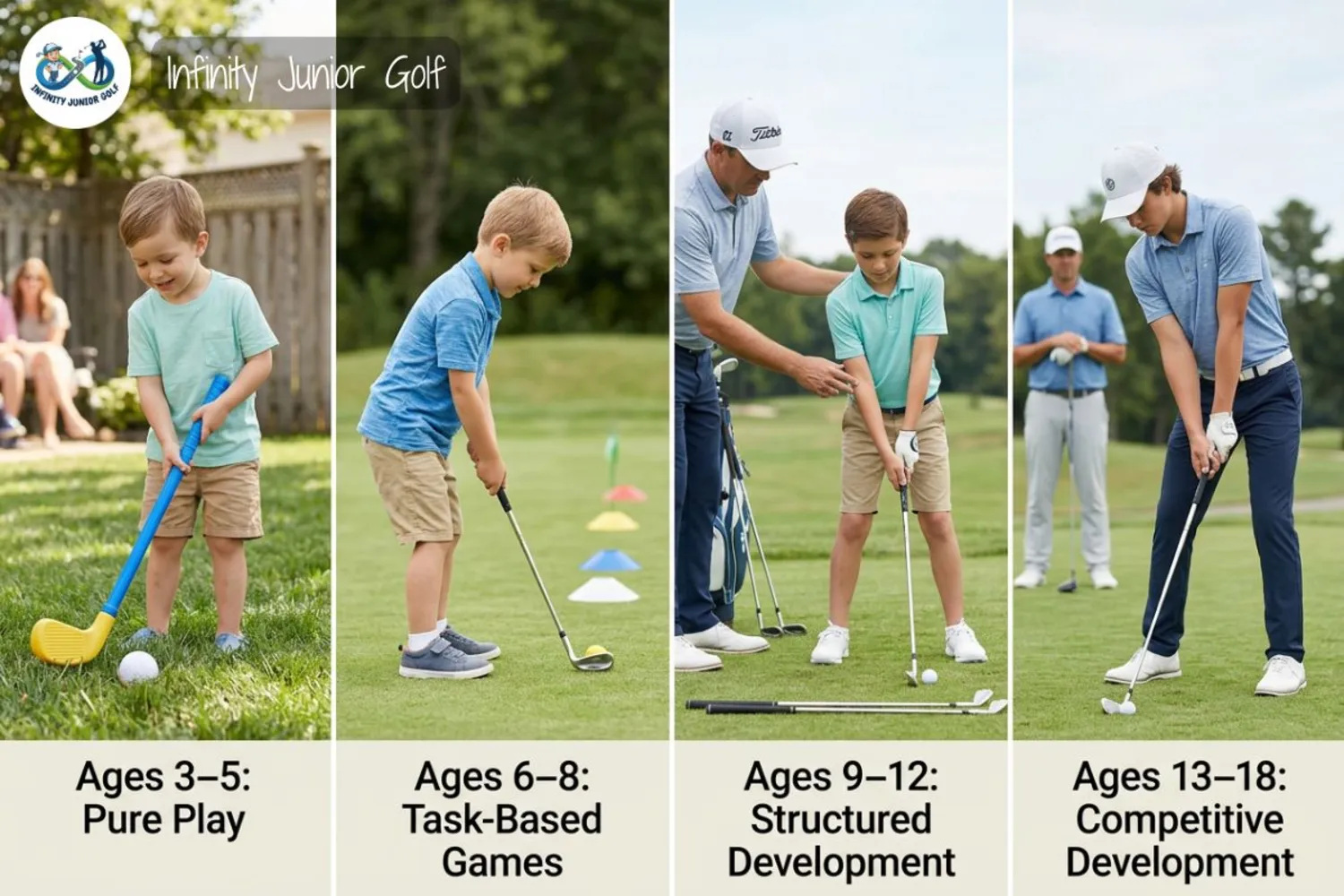
Ages nine to twelve — structured development begins: This is the window when qualified instruction becomes genuinely valuable. A PGA-certified coach with experience in junior development can introduce full-swing fundamentals in a way that builds on the exploratory foundation laid in the earlier years. Understanding a clean, structured swing (opens in a new tab) becomes more relevant as children start competing and comparing themselves to peers. The growth mindset framework is particularly important at this age. Parents should step back from technical coaching entirely and focus on emotional support and logistics.
Ages thirteen to eighteen — competitive development: Tournament preparation, course management, advanced mental skills, and sport-specific fitness training all come into focus during adolescence. Specialization is appropriate only when it is entirely self-directed by the young golfer. Parents should operate as advocates and logistical supporters at this stage — not technical coaches. The coach-athlete relationship is the one that matters most, and parents who respect that boundary give it the room to thrive.
Equipment across the age groups: Properly fitted clubs are the non-negotiable at every stage. US Kids Golf’s height-based sizing system covers children from approximately 36 inches to 66 inches in height, with clubs engineered at the correct weight and flex for each size range. As juniors grow into competitive play, brands like PING and Callaway offer junior lines that bridge toward adult equipment. Our top junior club sets review (opens in a new tab) covers the leading options across all age bands in more detail.
With the age-by-age picture now in view, the tips in the next section pull the most actionable points from across the whole article into a single, quick-reference format.
Our Practical Tips For You
Here are ten practical takeaways drawn from the research and from real experience alongside young golfers.
| Tip | How to Implement | How It Helps |
|---|---|---|
| Start with putting | Set up a backyard putting target or use a cup on the carpet. Keep it short and game-like. | Builds feel, confidence, and an intuitive understanding of what the game is actually trying to do. |
| Use tasks, not positions | Ask “Can you land the ball inside this circle?” instead of giving swing mechanics instructions. | Engages natural hand-eye coordination and lets the body self-organize without anxiety. |
| Keep sessions short | Aim for 20 to 30 minutes for children under ten. Stop when engagement drops. | Prevents boredom and negative associations with practice before they set in. |
| Fit clubs by height | Use a junior sizing chart or visit a fitting-capable retailer before buying. | Properly sized clubs support sound mechanics from the beginning and prevent compensatory habits. |
| Praise effort, not talent | Say “I loved how you kept trying” rather than “you’re so naturally good at this.” | Builds a growth mindset and resilience for difficult rounds ahead. |
| Let them lead | Follow your child’s interest level. If they want to stop, stop without argument. | Keeps the child in the role of decision-maker, which sustains long-term engagement. |
| Model course etiquette | Repair ball marks, rake bunkers, and stay composed in front of your child. | Children learn behavioral values by watching, not by being instructed. |
| Wait before the debrief | Save any round analysis for at least 24 hours after play. | Gives children the emotional processing space they need after a competitive experience. |
| Support other sports | Actively encourage participation in swimming, soccer, athletics, or whatever else your child enjoys. | Builds broad movement literacy and reduces overuse injury risk across the board. |
| Find a qualified instructor | Research PGA-certified coaches with junior experience when structured development is the right next step. | Ensures technical coaching is age-appropriate, well-paced, and pedagogically sound. |
Junior golf development works best when parents play a supporting role rather than a directing one. The FAQs below address some of the most common questions that come up along the way.
FAQs
Here are a few of the questions parents most often ask when they start thinking about coaching their children in golf.
At what age should my child start learning golf? There is no single right answer — readiness varies by child. Many coaches suggest ages four to six as a natural window for first exposure through play-based activities, but some children show genuine interest earlier and others later. Your child’s enthusiasm is a more reliable guide than any age chart.
How do I know when my child is ready for formal lessons? Sustained interest, the ability to follow simple instructions, and an attention span of around 20 to 30 minutes for a single activity are good indicators. Most coaches suggest waiting until around age seven or eight for structured group lessons, though individual sessions with an experienced junior coach can work earlier if the child is genuinely keen.
Should I take lessons myself so I can help at home? Taking adult lessons gives you a better intuition for the game and helps you recognize sound fundamentals when you see them. It does not, however, qualify you to instruct your child technically — and combining the parent and coach roles in one person almost always creates tension. Use what you learn to play alongside your child and model enjoyment; leave the swing coaching to a qualified junior instructor.
How do I handle a child who gets frustrated on the course? Stay calm, stay positive, and resist the urge to analyze or correct in the moment. Acknowledge the frustration simply — “that was a tough hole” — and move on quickly. Children take their emotional cues from the adults around them. Your composure in that moment is more powerful than anything you could say.
Our Related Articles
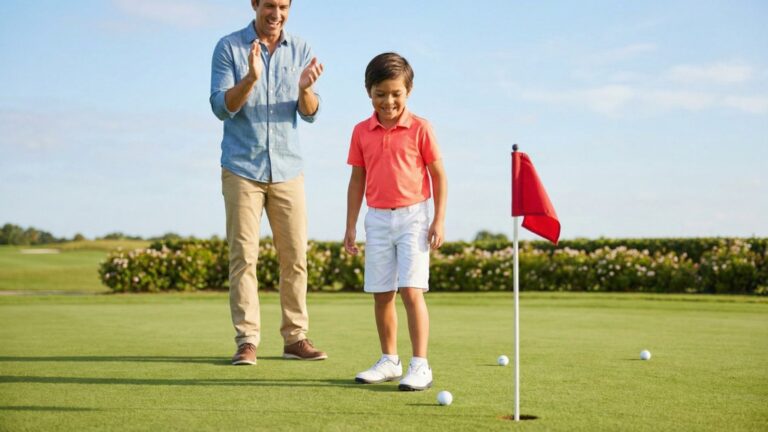
Explaining The Basics Of Golf To Kids In Fun Ways
Golf can seem like a big, grown-up game when you first look at it, but kids usually learn it best when it feels playful, simple,…
Read More (opens in a new tab)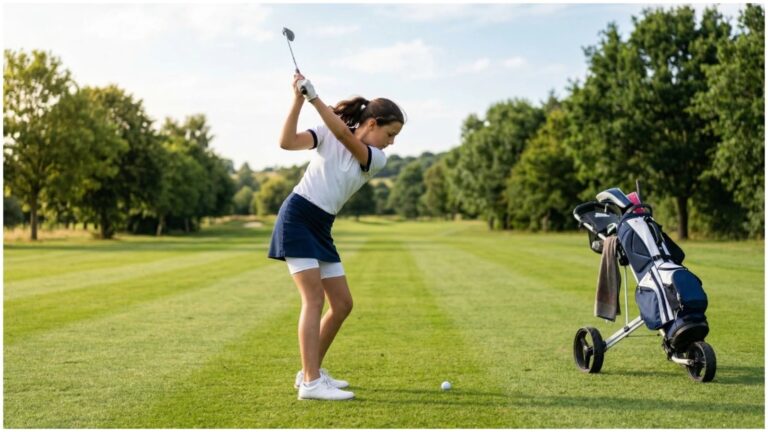
How To Build A Balanced Schedule For Junior Golfers
For any family with a junior golfer in the house, the weekly juggle is very real. School homework sits on one side of the table,…
Read More (opens in a new tab)
Top 5 Junior Golf Club Sets Reviewed
Picking a junior golf set feels simple until you actually stand in front of five options that all claim to be “the one.” Shaft flex,…
Read More (opens in a new tab)Conclusion
Coaching your child in golf is one of the most rewarding things a parent can do — and one of the easiest to overcomplicate. The evidence from sports psychology, developmental research, and the practical experience of qualified junior coaches points consistently in one direction: less instruction, more support, more fun. Children who associate golf with enjoyment, exploration, and their parent’s positive presence tend to become lifelong players. Children who associate it with criticism, pressure, and adult-driven expectations often don’t.
The do’s and don’ts in this article are not abstractions — they are things I have seen make a real difference on practice tees and on the course with real families. Start with the putting green. Let your child explore freely. Fit the clubs properly. And remember that the best coaching you can provide is simply being a joyful, patient presence alongside a young golfer learning one of the most interesting games in the world.
Have you tried any of these approaches with your own child, or found something that worked particularly well — or badly — in your own experience? Share your thoughts in the comments section below. I’d love to hear what other parents are discovering in the field.
