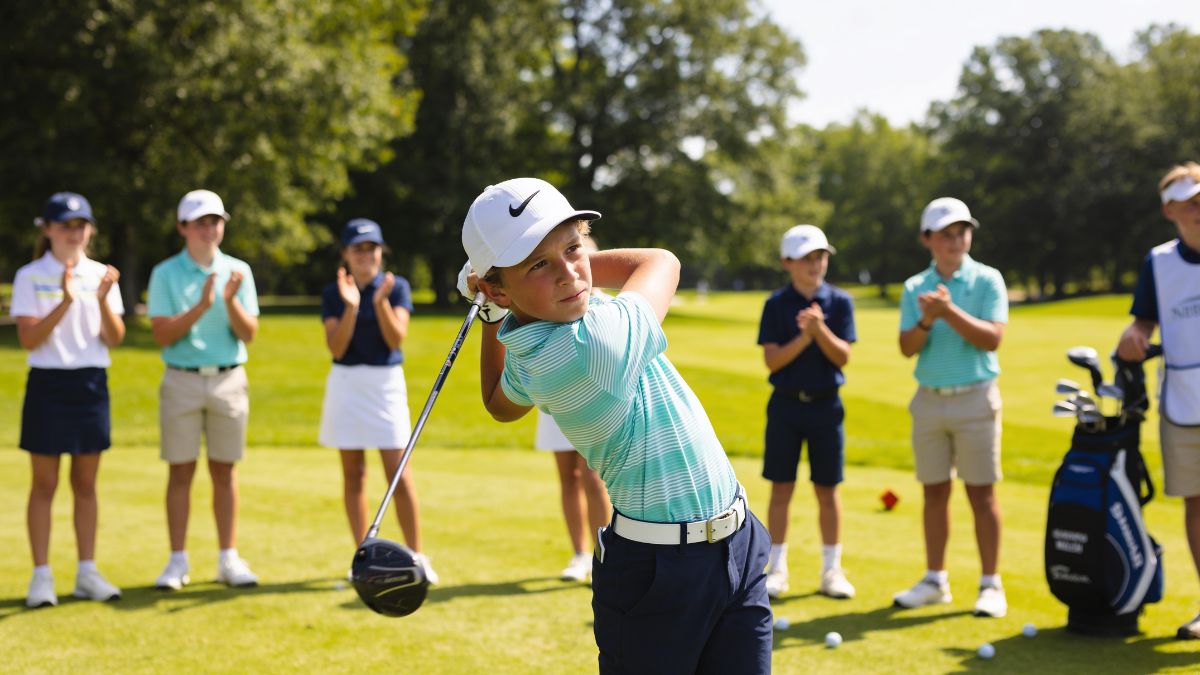

Golf has a reputation for being difficult — the courses are unforgiving, the technique takes years to develop, and the rules fill a book. What gets said far less often is that golf is one of the most effective sports on earth for building genuine life skills in young players. The lessons it teaches — honesty when no one is watching, the ability to recover from setbacks, the discipline of delayed gratification, and sincere respect for other people and shared spaces — are not borrowed from an add-on program. They are woven into the game’s structure so completely that a junior golfer encounters them on practically every hole.
I’m Al, a golf dad who came into this sport not as a former competitive player or an instructor, but as a parent who started paying attention. Over the past several years, watching my own kids navigate the course has taught me as much as any golf book. This article brings together what I have observed firsthand, what the research clearly supports, and what golf families around the world continue to discover: the game does not just teach your child to swing a club. It teaches them who they want to be. If you have ever sat in the parking lot after a round wondering whether all of this is genuinely worth it, I think you will leave this page with a clear answer.
⛳🏌️
US Kids Golf Juniors’ UL7 7 Club Stand Set
I chose this set specifically because it fits by height rather than age — which means the clubs are matched to how your junior actually swings, not just how old they are. That proper fit is the foundation for everything the game requires of a developing player. The UL7’s seven-club configuration gives a beginner-to-intermediate junior everything needed to cover every situation on the course from tee to green, without carrying gear that does not serve them yet. Where this set is not the right fit: juniors who are already competing at a high level and need club-by-club custom fitting will have outgrown a complete package set and should look at individual club options.
- ✅ Height-based sizing system (nine options from 39″ to 66″)
- ✅ 7 clubs: driver, hybrid, irons, wedges, putter + stand bag included
- ✅ Graphite shafts
- ✅ Beginner to intermediate
- ✅ Ships internationally
|~$419.99 | Mid-range
👉 Shop UL7 SetHonesty, Integrity and the Life Skills Golf Teaches
Golf is the only major sport where the players are also the referees: In most sports, officials watch for infractions and impose consequences. In golf, the player is expected to call every penalty on themselves, regardless of whether anyone else saw the situation. That principle sits at the heart of USGA Rule 1, which states that every player is expected to act with integrity — specifically, by following the rules, applying all penalties, and being honest in all aspects of play. This self-governance model has been part of the game since its earliest written rules in 1744, and it has never changed. For a junior golfer, the question “what should I do here?” is answered not by a coach on the sideline, but by the player’s own conscience.
The situations that test this are constant and specific: A ball that moves slightly when the club is grounded behind it. A stroke that catches nothing but air but still counts. A ball played out of bounds. In each case, calling the penalty correctly costs the junior strokes — real strokes, on a real scorecard, in front of real playing partners. The most famous examples from professional golf make clear how seriously this is taken at every level. Bobby Jones called a penalty on himself at the 1925 U.S. Open after his ball moved in the rough — no one else present saw it happen. His response when praised afterward was to say you might as well praise a man for not robbing a bank. Brian Davis called a penalty on himself during the 2010 RBC Heritage playoff after his backswing brushed a loose reed in a greenside hazard — a contact invisible to everyone watching in real time and confirmed only in super-slow-motion replay. In both cases, the only voice that mattered was the player’s own.
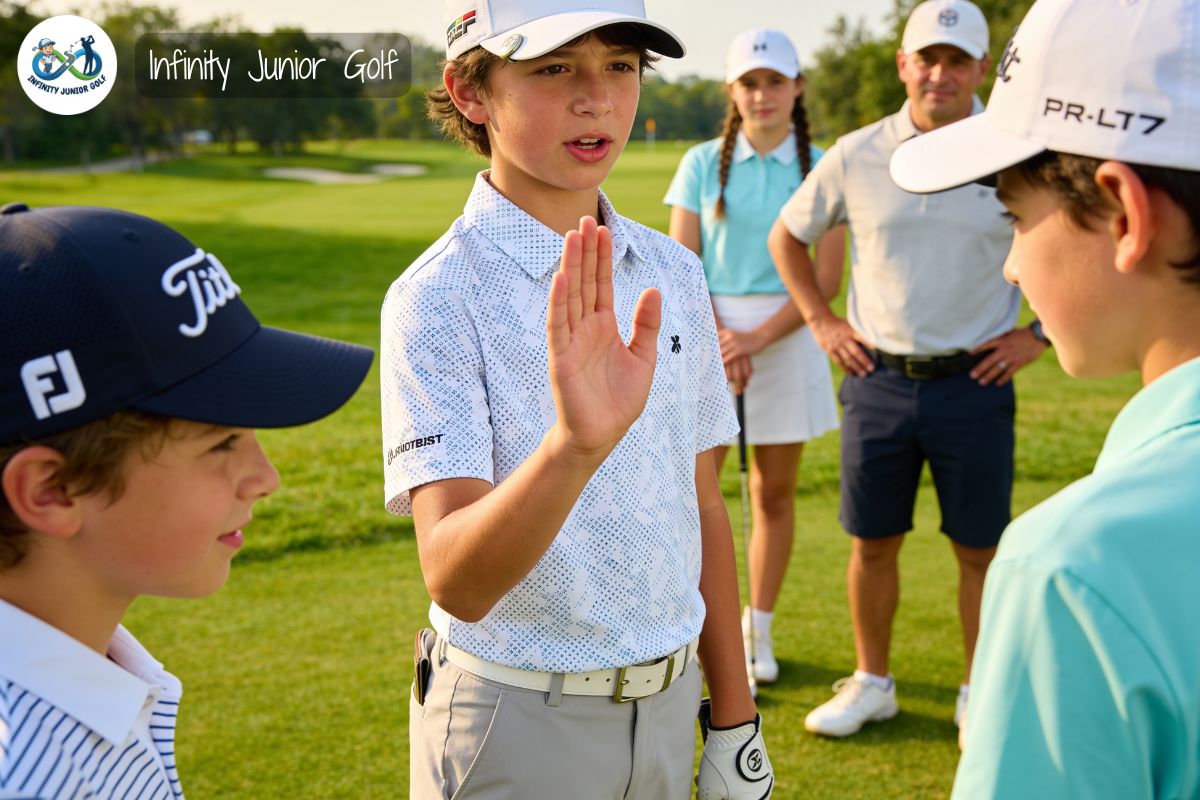
What that habit means beyond the course: A child who has practiced calling penalties on themselves in a context that costs them something concrete has exercised a specific and important muscle. They have practiced telling the truth when the easier option is silence. Academic honesty, professional accountability, and the straightforward honesty that good relationships require are all expressions of the same core habit. Golf does not teach them through a lecture. It teaches them through repetition, in real situations with real consequences, across years of play.
Who the integrity lessons come harder to: Not every junior golfer embraces self-refereeing easily. Some struggle with it early. Some need encouragement from parents and coaches to report a situation accurately when it costs them. That difficulty is not a character flaw; it is exactly the friction that makes the lesson real. The appropriate adult response is to acknowledge the discomfort, explain why the rule exists, and affirm that calling the penalty is the right move regardless of outcome. The guidance in our article on coaching young golfers covers how to handle these conversations in ways that reinforce rather than undermine the lesson.
To step onto the course and experience all of this firsthand, a junior needs properly fitted equipment — clubs that match their height and swing speed give them the contact and feedback that make each round a genuine learning environment rather than a fight with the wrong gear.
🏌️
The UL7 is what I recommend for any junior at the beginner-to-intermediate stage who is ready to start playing proper rounds and engaging with the game’s real rules — including the integrity rules this section covers. Height-based fitting means the clubs are genuinely matched to the player, not an age estimate. This is not a set for a competitive junior who needs custom shaft flex; it is the right choice for a junior who needs to actually start playing.
- ✅ Seven clubs including driver, hybrid, irons, wedges, putter + stand bag
- ✅ Nine height options from 39″ to 66″
- ✅ Graphite shafts | Ships internationally
The honesty and integrity that golf demands are probably the most immediately visible life lessons the game offers, and they are impossible to miss once you know to look for them. But there is a second lesson that runs just as deep and shows up just as reliably — one that happens not in the moment of a rules decision but in every shot that does not go the way it was intended. That lesson is resilience, and the golf course may be the best classroom for it in sport.
The Resilience Every Round Demands
Golf is built from adversity, and that is the point: Every round contains bad shots, bad bounces, and results that do not reflect the effort behind them. Some of those come from poor execution and some from chance. A perfectly struck iron that catches a sprinkler head and skips into the bunker. A chip that lips out of the hole and rolls six feet past. An approach that lands exactly where it was aimed and then feeds down into the back rough because the slope was invisible from the fairway. These are not exceptional events; they are the ordinary texture of a golf round for players at every level. The difference between a junior who develops well and one who stalls early is almost always in how they handle the situation immediately after.
Resilience in this game is a learnable skill: What happens between shots — the emotional processing period — matters as much as the physical skill of the next shot. Research published in Frontiers in Psychology found that individual sports in particular build psychological resilience through self-efficacy: the belief that one’s own adjustment can produce better outcomes. Golf fits this profile precisely. When a junior faces a difficult lie, nobody else can take the shot. No teammate rescues the situation. The player assesses, decides, commits, and executes — then accepts the result and moves on. That sequence, practiced thousands of times across years of play, builds something that transfers well beyond the course.
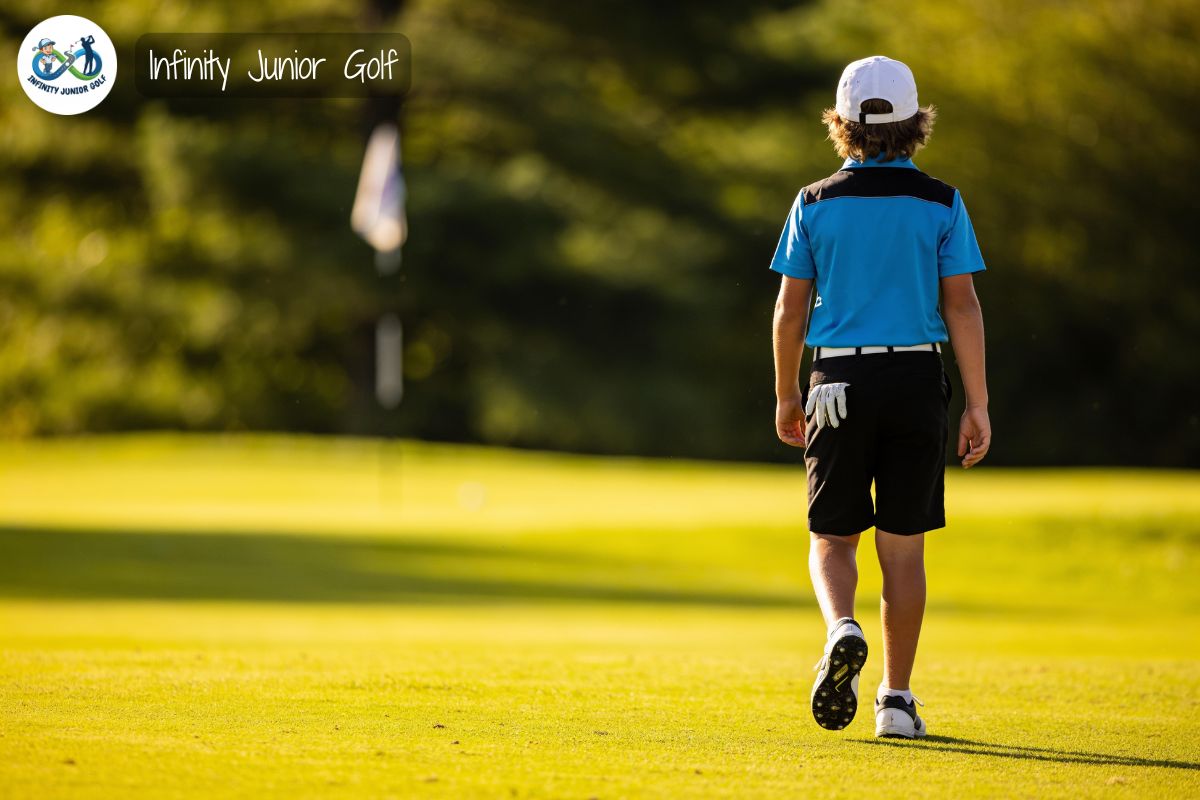
What building resilience actually looks like: A junior who is developing this skill does not throw clubs or sulk across the fairway. They take a breath, assess the next situation, and focus on what they can control from here. As sport development research consistently shows, structured sport participation meaningfully improves self-esteem, self-efficacy, and sense of belonging in adolescents — outcomes that reinforce recovery from adversity rather than avoidance of it. For juniors who are actively working on the habit of mental reset after a poor shot, it matters to know that elite juniors develop exactly this quality — deliberately, through years of play — and the process always begins with the first round.
The honest limitation: Some juniors take longer to develop emotional control than others, and that is completely normal. A round where your child visibly loses composure after a string of bad holes is not evidence that the character development is not working — it is evidence that there is still more to build. The parent’s job in those moments is to stay calm and revisit the conversation later at home, never on the course.
What this resilience looks like off the course: A junior who has practiced picking themselves up after a lost ball, a double bogey, or a windy round that undoes three holes of good work is practicing the exact skill they will need for a failed exam, a missed opportunity, or a relationship conflict. The golf course is a training ground for life, with consequences real enough to make the lessons stick.
Understanding how golf builds resilience goes hand in hand with understanding the second great skill the game demands: patience. And in golf, patience is not a soft virtue — it is something the game forces in specific, measurable ways, starting from the very first round.
Patience, Practice, and the Long Game
Golf improvement does not come quickly, and that is not an accident: Most youth sports offer visible, rapid improvement during the early stages. Golf is different. The feedback loop between practice and measurable performance is longer, the variables are harder to isolate, and the standards the game measures against — par, scratch, course rating — are objective and demanding. A junior who starts at nine and commits to consistent practice might carry an 18 handicap at twelve, a 12 by fourteen, and a single-digit handicap by sixteen or seventeen. Each step requires months of sustained work. There are no shortcuts, and the game does not pretend otherwise. Helping a junior understand this from the beginning — and connect it to other areas of their life — is something our guide on goal setting for young golfers addresses directly.
Patience shows up in the immediate sense too: Golf asks juniors to wait. They wait their turn on the tee. They wait while playing partners search for a ball. They walk between shots at a pace the course and the group ahead dictate, not a pace they choose. Pace of play — the expectation that a group keeps up without dawdling — teaches the specific patience that considers other people’s time, not just one’s own. That is a different and more demanding version of patience than simply waiting, and it is one that golf enforces through direct social consequence rather than abstract instruction.
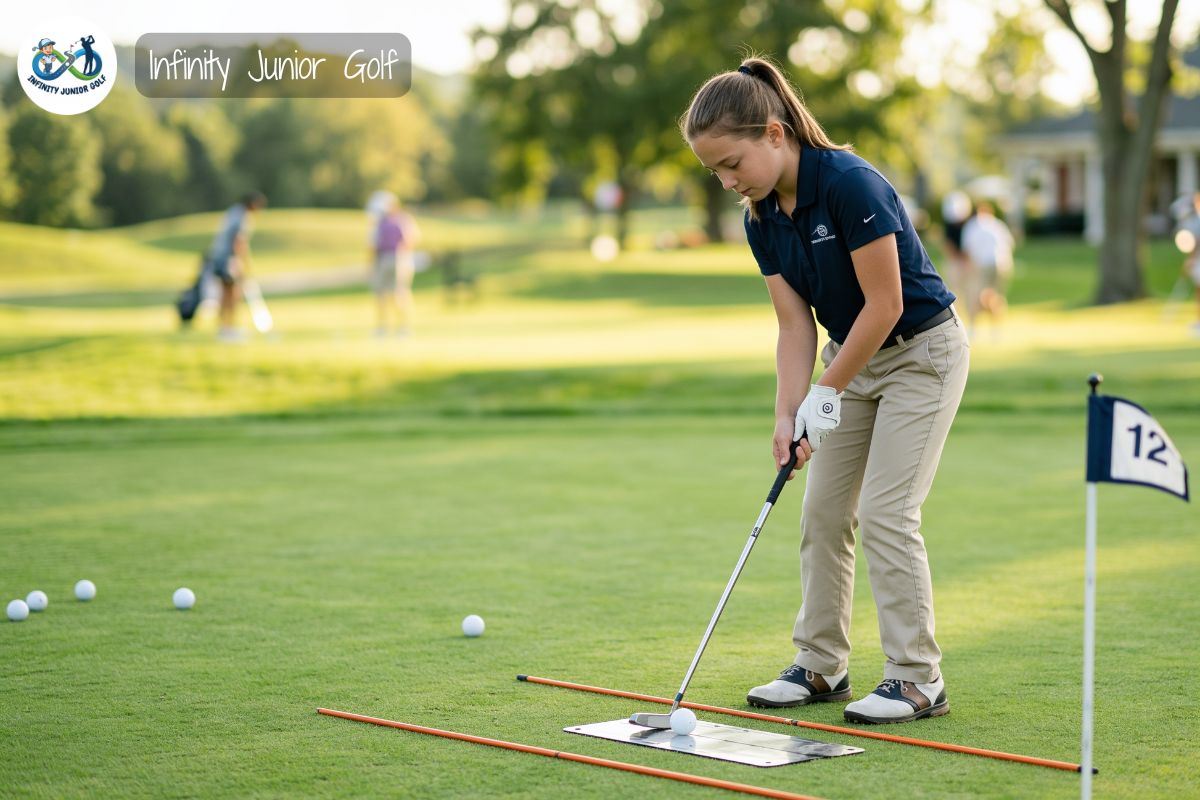
Trusting the process when results are slow: The First Tee programs page — one of the world’s most established junior golf and character development organizations — lists “Growing through Challenge” and “Pursuing Goals” as two of their five core Key Commitments for junior participants. These are not coincidental choices. They reflect exactly what golf demands: a sustained investment in a long-term goal, with acceptance that results come gradually and that the effort itself has value. A junior who sticks with golf through the period of slow progress learns that sustained effort toward something difficult is worthwhile — a lesson that transfers directly to academic persistence and the professional patience that adult careers require. Building the right structure around practice and school time is a practical part of how that patience develops, and our article on a balanced schedule for junior golfers is a useful guide to getting that structure right.
The practical honest challenge: Not every junior who starts golf stays with it, and some leave precisely because the patience required is more than they are willing to give at a particular stage of development. That is a real outcome and not a failure — different sports suit different personalities, and knowing which environment pushes a child to grow and which frustrates them without productive result is genuine parenting wisdom. For the juniors who do stay with it, the patience golf demands tends to be one of the qualities their parents notice most clearly transferring to the rest of their lives.
There is more practical equipment, training, and support that can help a junior golfer develop both the skills and the character the game is trying to teach. The following brands and retailers focus specifically on what junior golfers need at every stage of that development.
Brands and Tools That Help Juniors Thrive — Our Recommendations
Every junior golfer’s development depends partly on having the right equipment, training resources, and support to engage with the game properly. The retailers below sell products that directly serve junior golfers at various stages — from first-time players learning the basics to developing competitors building a complete game. Each recommendation is chosen for its specific relevance to what this article covers.
US Kids Golf
About
US Kids Golf is the world’s most dedicated junior golf equipment brand, with products available in more than 50 countries. Their entire range is built around height-based fitting — a system that puts properly matched clubs in junior hands rather than scaled-down adult equipment. For juniors at any stage from beginner through competitive player, they cover the full equipment range.
Our Recommendation
The UL7 Stand Set is the hero product for this article: a complete seven-piece set with graphite shafts and a stand bag, fitted by height across nine sizing options. It is the right starting point for any junior ready to engage with the game properly — including with the integrity and etiquette rules discussed here. Where it does not fit: juniors who have progressed to competitive golf and need club-by-club fitting should move to the individual club range. Ships internationally.
Golf Galaxy
About
Golf Galaxy is one of North America’s largest dedicated golf retailers, carrying equipment, training aids, footwear, and apparel from all the major brands. Their training aid section is genuinely extensive, with options suited to the kind of deliberate, disciplined practice that builds patience and consistency. Note: primarily serves North American customers.
Our Recommendation
The SKLZ Gold Flex 40″ Strength and Tempo Trainer ($79.99) is designed specifically for female and junior golfers. It teaches swing tempo and kinetic sequence through repetition — both of which require the same deliberate patience the article discusses. Worth noting: it does not suit a junior who wants to see results in one session. The benefit builds over weeks of consistent use, which is the point.
Global Golf
About
Global Golf carries both new and certified pre-owned golf equipment from all major brands, shipping to customers in more than 40 countries. Their new and pre-owned selection makes quality equipment accessible at varied price points — a genuine option for families investing in specific brands without a full new-equipment outlay while a junior’s commitment is still developing.
Our Recommendation
The UL7-57 Club Set by US Kids Golf covers juniors in the 57-inch height range — older or taller players stepping up from a smaller starter set. Buying through Global Golf gives you the same product quality as buying direct, often with varied promotional pricing. Worth noting: ordering any club set online without in-person fitting requires an accurate height measurement — check the US Kids Golf fitting guide before selecting a size. Ships internationally.
PGA TOUR Superstore
About
PGA TOUR Superstore is the largest off-course golf specialty retailer in the United States, with an exceptional in-store experience for junior golfers including fittings, clinics, and simulators. Their junior golf lesson program is based on the US Kids Golf Learning Program, which explicitly covers rules, etiquette, and the values that make golf what it is. Note: stores and lessons are US-based only. Their online store ships primarily within the United States.
Our Recommendation
The junior golf lessons program at PGA TOUR Superstore is worth highlighting for US families as a structured alternative to private lessons. The six-hour program across two skill levels covers the foundations a new junior needs — including the rules and etiquette context this article discusses in depth. Honest limitation: this is an in-store program. Families outside the US cannot access it.
Callaway Golf
About
Callaway Golf is one of the sport’s most recognized equipment brands globally, and their junior XJ Series sets are purpose-built for developing players. The XJ sets are available in three levels sized by player height, with titanium drivers and graphite shafts engineered for junior swing speeds. Callaway ships directly worldwide.
Our Recommendation
The XJ Junior Level 2 Complete Set is a 7-piece set for juniors between 47 and 53 inches tall — the mid-range of the XJ line and the option that suits the widest band of school-age junior golfers. It is a step up from a first-time starter set and the right choice for a junior who is ready to progress. The main limitation is price: XJ sets sit toward the premium end of the junior equipment market.
FootJoy
About
FootJoy is the most recognized name in golf-specific footwear and gloves, and has been the number one glove on the professional tour for decades. Their junior range covers properly fitted gloves and shoes designed for young players — often the most overlooked part of a junior’s equipment, and the one most directly connected to the dress standards and course-readiness expectations golf maintains. FootJoy primarily ships from their US-based website; their junior products are also widely available through international golf retailers.
Our Recommendation
The FJ Junior Golf Glove is a practical first purchase for a junior taking the course seriously. It features a MicroTac synthetic palm for grip and flexible stretch across the knuckles to accommodate growing hands. A proper glove is a small but real signal of preparation and respect for the game. Honest note: junior sizes run small relative to adult sizing, so check FootJoy’s size guide carefully before ordering.
The equipment, training tools, and lesson programs above support a junior’s technical development — but the game also asks something that no piece of equipment can provide on its own. The fourth major life lesson golf teaches is one that most junior golfers need time and deliberate exposure to absorb: the deeply practical habit of respect.
Respecting the Course, Your Playing Partners, and the Game Itself
Golf’s etiquette tradition is the oldest active code of conduct in sport: Before any governing body was writing rules about equipment or technique, golf’s early practitioners were defining how players should treat the course and each other. The R&A Rules of Golf — which governs the game outside North America alongside the USGA — embeds the core etiquette principles directly into Rule 1: players are expected to act with integrity, show consideration to others, and take good care of the course. These are not advisory suggestions. They are foundational to how the game defines itself. For juniors who are still getting to grips with what all of this means in practice, our article on golf basics for kids introduces the customs and expectations in a way that is engaging rather than overwhelming.
Caring for the course teaches stewardship that outlasts the round: A junior who learns to replace their divots, rake the bunker they just played from, and repair the ball mark their approach shot left on the green has learned a transferable habit: leave the environment you have used in better condition than you found it. That applies equally to a classroom, a shared workspace, a hiking trail, or a rented apartment. Golf teaches it in context, with immediate visual feedback — an unrepaired ball mark leaves a lasting scar on a putting surface — so the principle never feels abstract.
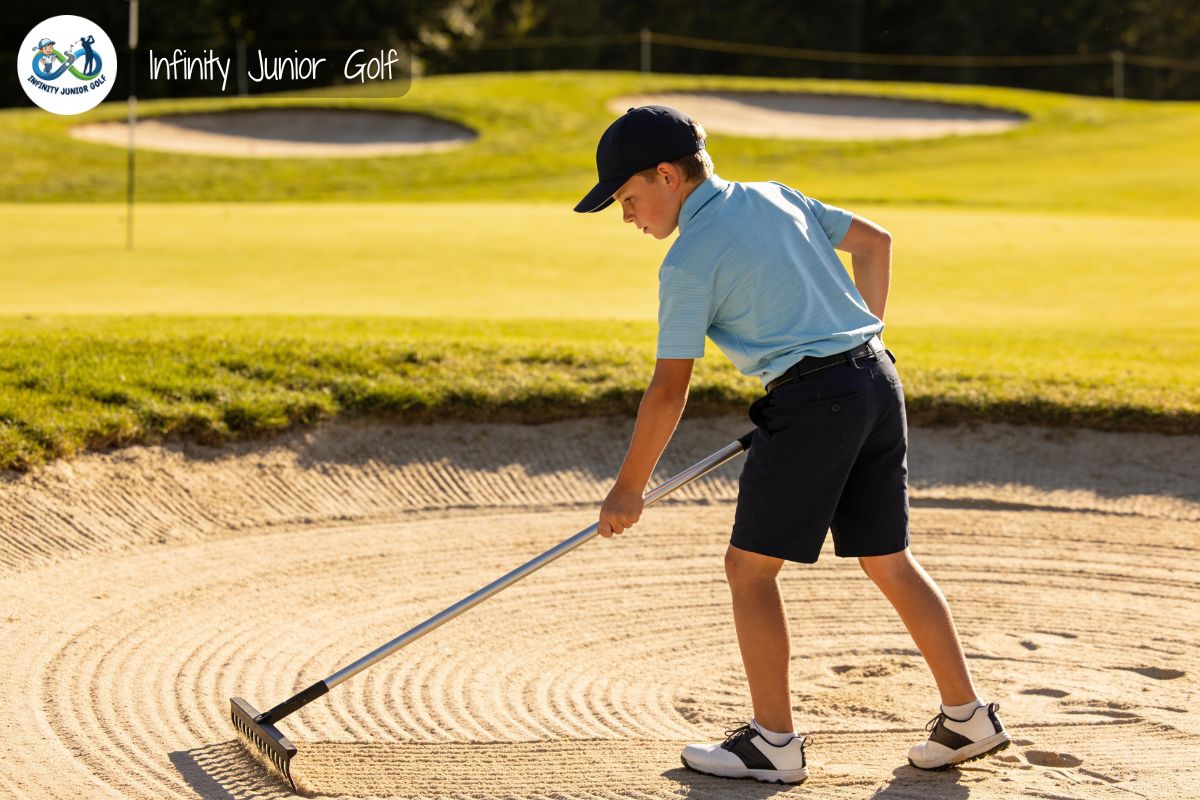
Consideration for playing partners is respect made practical: Golf asks juniors to stand still and stay quiet while another player prepares. It asks them to avoid walking across a playing partner’s putting line. It asks them to call a warning when a shot is heading toward another group, regardless of how embarrassing that is. These are small actions individually, but they require a junior to consistently set their own immediate interest aside in favor of another person’s experience. That habit — automatic consideration for others — is one of the more difficult things to teach in the abstract and one of the more natural things golf forces through play. The intensity of these expectations becomes very real the first time a junior plays in junior golf tournaments, where conduct standards are formally observed and carry genuine consequences.
Pace of play connects individual behavior to collective experience: Every junior golfer who is slow on the course creates a downstream effect for every group behind them. Golf makes this visible and consequential in a way most environments do not. Your pace of play is not just about you. A junior who genuinely internalizes this is learning something that matters at work, in shared living situations, and in any context where individual behavior affects the people around them.
The post-round handshake is a ritual worth taking seriously: At the end of every round, players shake hands or acknowledge their playing partners regardless of how the round went. A junior who has just had the worst round of their life still does this. The adult who shot ten strokes better than them still does this. It teaches that the quality of the competition between players does not determine the basic respect owed to the person who played it. That is a genuinely difficult thing for a competitive junior to practice after a poor performance, which is exactly why it matters.
The four life lessons explored in this article — honesty and integrity, resilience, patience, and respect — do not arrive automatically because a junior picks up a club. They develop through experience, reinforcement, and the kind of deliberate attention that good parenting and coaching provide. The practical tips below are designed to help you support exactly that.
Our Practical Tips For You
These tips are drawn from the specific life skills covered in this article and are written for parents and coaches who want to actively reinforce what the game is already trying to teach, rather than leave it to chance.
| Tip | How to Implement | How It Helps |
|---|---|---|
| Let your junior call their own penalties | Resist the urge to intervene. Wait and let them identify the situation, then ask what the rule is if needed. | Integrity becomes their habit, not a rule they follow because an adult is present. |
| Stay quiet after a bad shot | Give them a moment before offering words. Follow their lead on when they want to talk. | They learn to process difficulty internally — the foundation of genuine resilience. |
| Focus on process goals, not scores | Before a round, agree on one specific process goal. After: “Did we stick to our routine?” | Patience builds when the standard is something achievable through effort, not luck or conditions. |
| Save analysis for the car ride home | Wait until you are off the course before discussing what happened. | On-course analysis disrupts focus and recovery. Car conversations happen when they are ready. |
| Model the etiquette yourself | Replace your divots. Rake the bunker. Repair your ball mark. Every time, visibly. | Children who see adults treat the course with care adopt it as the obvious default, not a rule to follow. |
| Ask “what did you learn?” not “what did you shoot?” | One consistent question after every round, regardless of outcome. | Shifts attention to growth and process — the mindset that sustains long-term improvement. |
| Arrange rounds with other juniors | Organize peer play in their age range whenever possible, not just parent-child rounds. | Peer play introduces real etiquette accountability that parent-child rounds do not replicate. |
| Introduce the rules gradually | One rule family at a time, one situation at a time — do not overwhelm a beginner with every rule at once. | A junior overwhelmed by rules struggles to apply them with confidence. Gradual introduction builds fluency. |
| Acknowledge when bad luck genuinely was bad luck | Some outcomes are pure misfortune. Name that clearly when it is true. | Resilience includes knowing which outcomes you can control and which you cannot. Both kinds of adversity matter. |
| Celebrate the handshake as much as the round | After every round, ask how the handshake went. Treat it as a point of pride. | Respect for playing partners becomes a personal goal rather than an afterthought at the end of a round. |
The tips above work best when they become habits — reinforced consistently over time rather than applied selectively based on how the round went. The questions below address the things parents most commonly ask when thinking through junior golf’s broader value.
FAQs
At what age do juniors start genuinely understanding golf’s integrity rules?
Most children from about age seven or eight can grasp the basic principle that a missed shot counts and that you call your own mistakes. Depth of understanding grows with age — a ten-year-old understands the principle, a fourteen-year-old can navigate the nuance. Starting the expectation early matters more than starting it perfectly.
What if my junior gets very upset when they make a mistake on the course?
Some frustration after a poor shot is completely normal and is not a sign that golf is not working. The goal is not zero frustration — it is a junior who can recover from frustration and refocus. If strong emotional reactions persist across many rounds without any improvement, it is worth having a calm conversation at home about what specifically triggers the response and working together on a practical post-shot routine.
Do the patience and resilience lessons transfer to schoolwork and other areas of life?
The research on sport participation and character development supports a genuine transfer effect, but it is not automatic. Transfer is more likely when parents and coaches explicitly connect what happens on the course to what happens elsewhere. “You pushed through twelve holes of a tough round today — that is the same mental work as pushing through a difficult revision week” is the kind of direct connection that makes it concrete.
Do these life skills require a junior to compete, or do recreational players develop them too?
They develop through any genuine engagement with the game. Integrity is tested every time a ball is addressed. Resilience is tested every time a shot goes wrong. Patience is tested every time a junior walks to their ball and chooses their club. Competition amplifies some of these pressures, but the lessons are fully present in a casual family round as much as in a formal tournament.
Our Related Articles

The Do’s And Don’ts Of Coaching Your Kids In Golf
Getting your child into golf is one thing. Staying in the fairway as their coach, cheerleader, and occasional critic is another thing entirely. The way…
Read More
Explaining The Basics Of Golf To Kids In Fun Ways
Golf can seem like a big, grown-up game when you first look at it, but kids usually learn it best when it feels playful, simple,…
Read More
Why Goal Setting Matters For Young Golfers
Goal setting transforms how young golfers approach the game, turning aimless practice sessions into purposeful development opportunities. When junior players establish clear targets, they create…
Read MoreConclusion
Golf’s reputation as a teacher of life skills is entirely deserved, but it comes from something more specific than the game’s difficulty or its traditions. It comes from the fact that the game is structured in a way that makes honesty, resilience, patience, and respect not optional extras but direct requirements of every single round. A junior who plays golf for a few years and genuinely engages with what the game is asking of them has been asked — repeatedly, in real situations with real consequences — to tell the truth, recover from setbacks, work toward long-term goals without shortcuts, and treat shared spaces and other people with genuine care. Those are not abstract qualities. They are the precise skills that adult life demands most consistently.
None of this is to suggest that golf is the only path to strong character, or that every junior who plays will absorb every lesson on offer. The degree to which these values take root depends substantially on the adults alongside them — parents who model respect on the course, coaches who ask the right questions after a round, families who value the process over the scoreboard. When that support is present, the game does an extraordinary amount of the teaching on its own.
What moment from your junior golfer’s time on the course has surprised you most — a call they made on themselves, a recovery you did not expect, or a quiet patience that showed up somewhere you did not think to look?
