
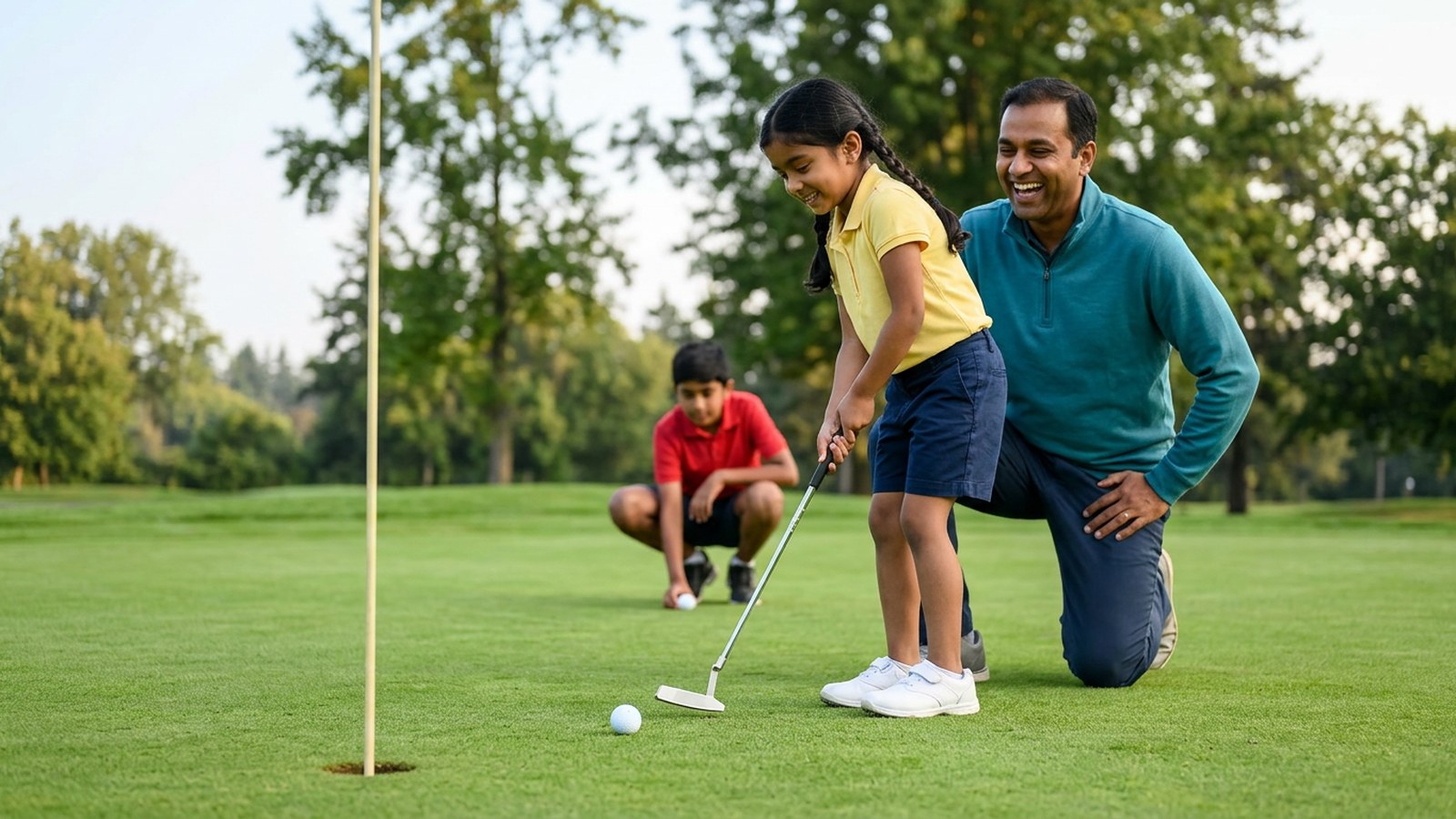

The moment a child says they want to try golf, the questions start. What age is right? Do they need lessons, or their own clubs, and what size? Where do kids actually play, what does it cost, and what on earth is a handicap? These answers to common questions about junior golf follow the order most families meet them in, from the first group lesson to the first small competition.
I’m Al. I trained and taught high school math and science, and these days I’m at home with two boys, now 17 and 12, who have played junior golf here in Australia for about a decade between them. I’m not a golf coach or a club fitter, and I won’t pretend to be. What I can offer is two starts five years apart, one of which I got partly wrong, plus a teacher’s habit of checking each answer against the governing body, program or maker that actually sets the rule. If you’re at the start of this, read on.
❓⛳🧒 Our Top Pick — Best First Junior Club Set
Team TaylorMade Junior Package Set
I haven't bought one myself; I chose it because it's sized by height in three steps from about age 4 to 12, which answers the question new parents ask most.
Each size comes as a complete set with a stand bag, so a child gets clubs built for their height and swing rather than cut-down adult ones.
- Three sizes | 42 to 59 inches tall
- Unisex | right or left hand
- Four to seven clubs | bag included
Getting Started: Age, Readiness and First Lessons
There's no single right age: Most organized programs begin around age 5. First Tee in the US runs group golf lessons (opens in a new tab) for kids and teens aged 5 to 18, Golf Australia's MyGolf is the national introductory program (opens in a new tab) for children aged 5 to 12, and in England, clubs that hold the Junior Hub award (opens in a new tab) from England Golf and the Golf Foundation are recognized as good places for juniors to try and learn the game. PGA Jr. League in the US added a 9u division (opens in a new tab) in 2026, with shortened holes for its youngest players.
Under five, keep it at home: A preschooler doesn't need a program to get started. Short, playful sessions in the backyard or living room are enough, and it's easy to play at home with a light club and soft balls long before a first lesson.
Age is only one of the variables: My two boys are five years apart, but they came to golf at different ages as well, which turned out to matter more than the gap between them. A lot of junior golf advice is pinned to a child's age as though it were the only variable. When they started, why they started, and what kind of child they were at the time all shape it at least as much.
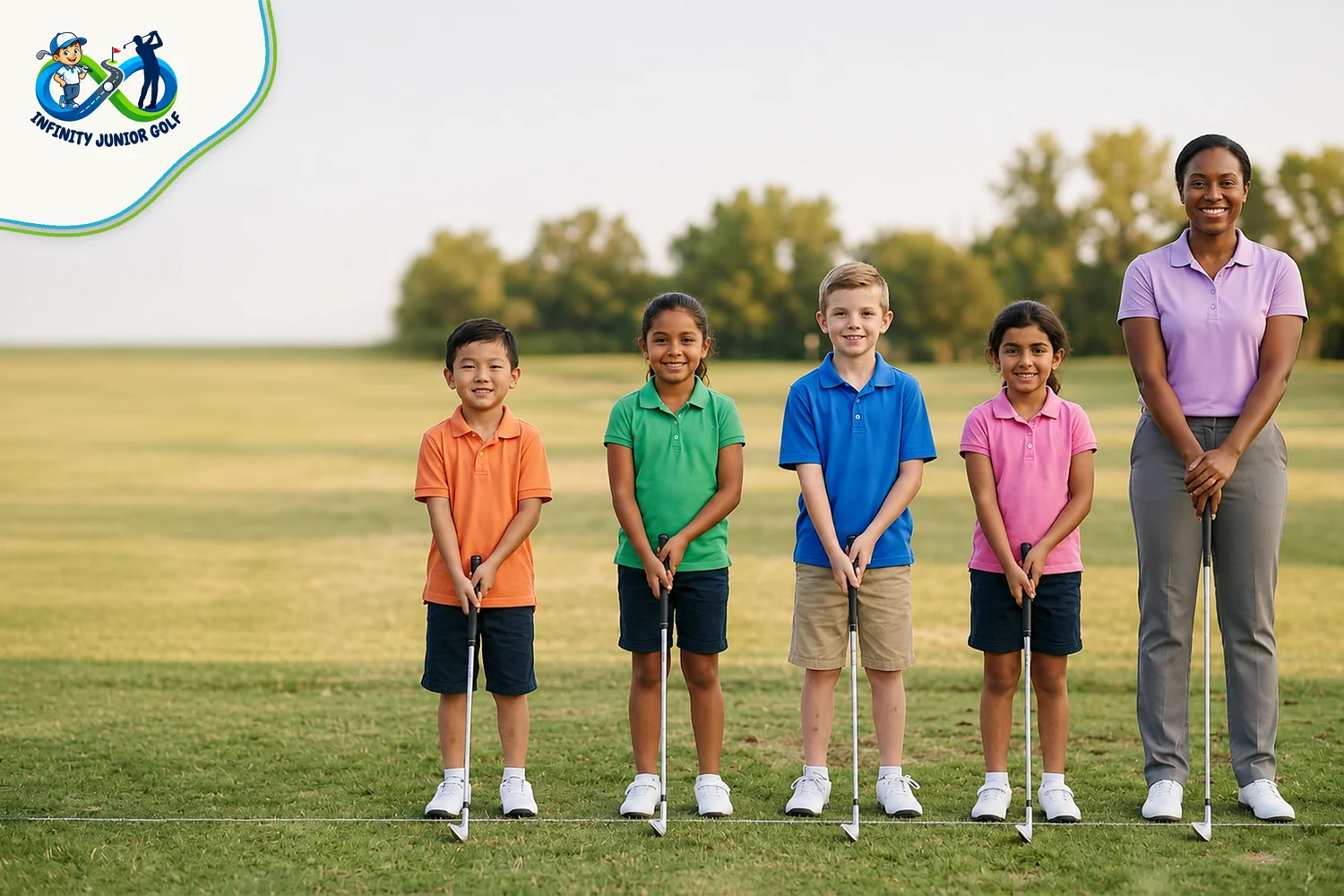
Start with a group, not a private coach: Group clinics were better at the start for both of mine. Being one of several kids took the pressure off, they saw others struggling with the same things, and it stayed fun. It's also far cheaper, which matters when you don't yet know whether your child will stick with it. You don't need golf experience to join, either: PGA Jr. League says all skill levels are welcome and no prior experience (opens in a new tab) is needed.
Private lessons come later: Private lessons earned their cost once there was something specific to fix. Not before. A one-to-one hour spent on general fundamentals a group session would have covered is money spent on attention rather than instruction. The switch came at a different point for each of my boys, and it tracked commitment rather than age.
You don't need to buy clubs first: First Tee chapters provide the equipment (opens in a new tab) a child needs and say there's no need for special golf attire. Golf Australia says no equipment or experience (opens in a new tab) is necessary to join a MyGolf program. Check with your local program, but a first term rarely needs a shopping trip.
Coaching your own child has limits: There's a point where being Dad and being the person correcting your grip are incompatible, and pushing past it damages the first role to marginally improve the second. I've had to step back more than once. If you do end up coaching your own child, it helps to decide early where that line sits.
Golf doesn't need to be their only sport: Scripps Health notes that the American Academy of Pediatrics recommends young athletes wait until age 15 or 16 (opens in a new tab) before focusing on one sport, to lower their risk of injury. Golf fits happily alongside a team sport or two.
Each child wants something different: My two wanted completely different things from golf. One took to the competitive side early. The other was there for the time outdoors and the company. Treating them the same would have put one of them off entirely. The best early signal I've found is simple: watch whether your child talks about the lesson afterwards. That tells you more about whether the format is working than any assessment of their swing.
Once a child is hooked, the next questions are about gear: which clubs, what size and how many.
Questions About Clubs, Sizing and Gear
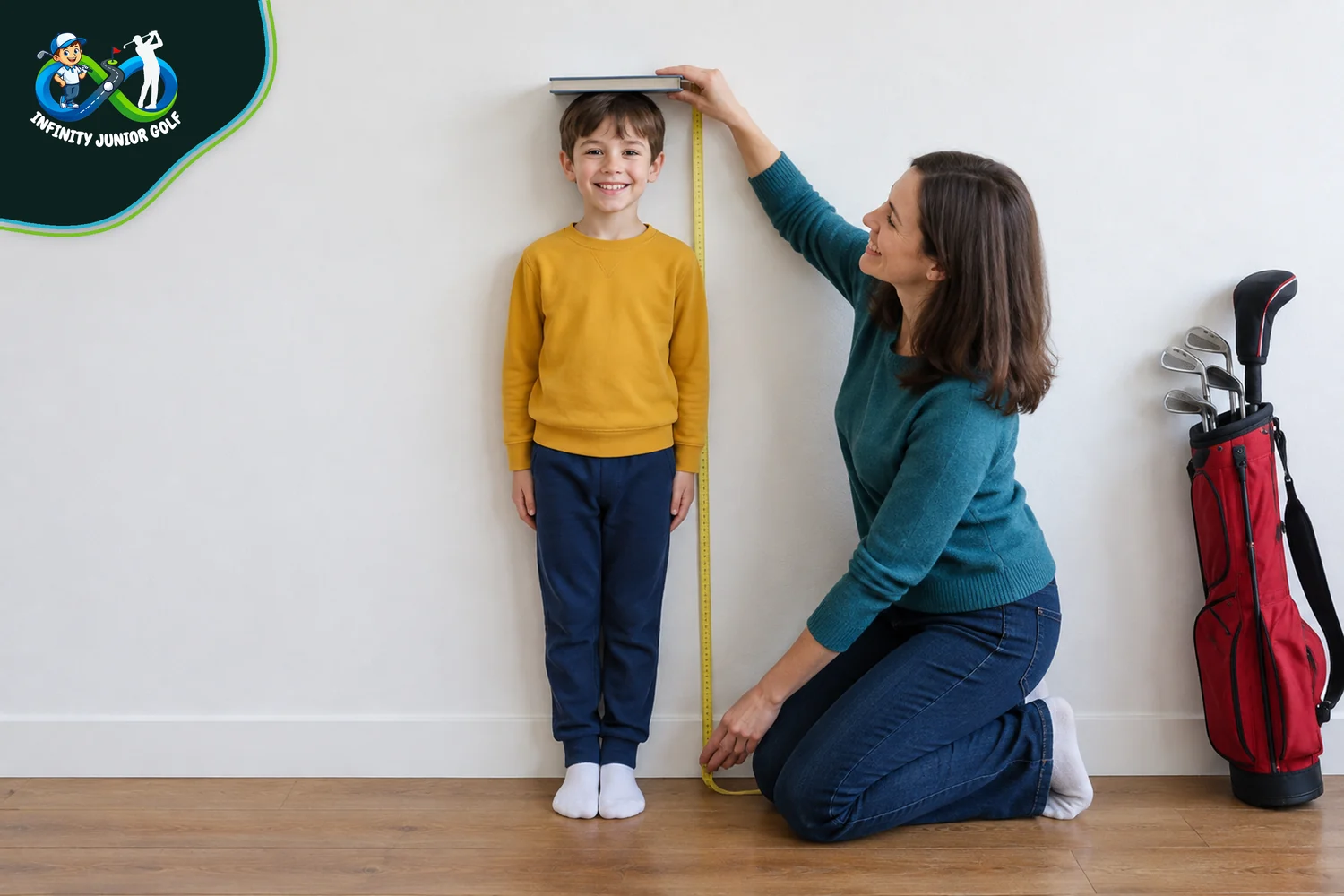
Size by height, not age: PGA TOUR Superstore's buying guide says choosing a club size starts with height (opens in a new tab), not just age, because two children the same age can be very different heights. MyGolfSpy's junior fitting guide agrees that height is far more effective (opens in a new tab) than age as a starting point. Measure your child standing straight in sports shoes, then check the maker's height chart.
How one maker sizes a set: The Team TaylorMade Junior Package Set comes in three height ranges (opens in a new tab): Size 1 for 42 to 47 inches (about ages 4 to 6), Size 2 for 48 to 53 inches (about 7 to 9) and Size 3 for 54 to 59 inches (about 10 to 12).
📏🏌️ Recommended
Team TaylorMade Junior Package Set
I picked it for this question because each size is set by a height range rather than an age, so you measure first and buy the size that fits today.
- Size 1 | 42 to 47 inches
- Size 2 | 48 to 53 inches
- Size 3 | 54 to 59 inches
Don't buy a size up to grow into: What I got wrong with my eldest was sizing. I bought his first set too big because I'd been told he'd grow into it, which is advice that makes sense for school shoes and no sense at all for golf clubs. I couldn't tell you the brand now. What I remember is him working harder than he should have needed to, and enjoying it less than he otherwise would have. The second time around I measured properly and bought for the child in front of me rather than the one he'd be in two years. It cost more over time because he outgrew things faster. It was worth it. If you've made the same call, you're in good company.
The buying guides agree: PGA TOUR Superstore warns that oversized clubs (opens in a new tab) often do more harm than good. MyGolfSpy is blunter: it does not matter (opens in a new tab) if the club fits your child next year, because a club that's hard to hit today is the wrong club.
Fewer clubs is fine: A beginner only needs (opens in a new tab) a driver, a fairway wood or hybrid, a 7-iron, a wedge and a putter, according to PGA TOUR Superstore, and MyGolfSpy says a smaller set (opens in a new tab) that gives consistent contact beats a full set a child can't use yet. The Rules of Golf allow up to 14 clubs (opens in a new tab) in a bag, so a junior set of four to seven is well inside the limit.
Size first, then brand: A set that doesn't fit undoes whatever else it has going for it, but I'd resist the opposite conclusion, that any correctly sized set is as good as any other. The better brands earn it with shaft weight and flex suited to a slower swing, sensible lofts, forgiving heads and build quality that survives the car trunk several times a week. Junior clubs are also built much lighter: Golf Digest reports the Size 1 Team TaylorMade 7-iron at 205 grams (opens in a new tab), against 270 grams for a stock adult P-Series 7-iron. Lighter isn't automatically better, though, and MyGolfSpy notes that clubs that are too light (opens in a new tab) can hold a stronger child back.
Comparing specific sets: The main first-time club sets each size and price things a little differently, so it's worth seeing a few side by side before you commit.
Growth is the real cost: Between roughly eight and fourteen you're replacing clubs on a cycle that has nothing to do with wear, so the question isn't what one set costs, it's what four sets cost. We didn't buy cheap through those years, and I'd make the same call again. The resale value on decent gear is far better than on entry-level, which claws back a real share of the difference. Secondhand is the answer to the growth problem, and it's badly underused: junior clubs get outgrown, not worn out. I wish I'd worked that out earlier than I did.
Shoes get outgrown, not worn out: A growing child almost always outgrows golf shoes before wearing them out, which makes spending hard to justify. My answer now is to buy well and accept a short life, because a pair that's been outgrown rather than destroyed still has value to someone else, and the secondhand market for junior golf shoes is better than most people realize.
Watch the bag weight: A child carrying too much bag over eighteen holes finishes tired and less keen to come back, and I watched that before I understood what was causing it. Ours use a push cart more often than they carry, which solves the weight problem outright and is worth considering earlier than most people do.
With the gear sorted, the next questions are where a child actually gets to play and what all of this costs over a year.
Where Kids Play and What Junior Golf Costs
Programs and leagues come first: Most children play their first holes inside a program rather than on a busy course. First Tee runs its group sessions through local chapters (opens in a new tab), and every PGA Jr. League team in the US has a PGA Coach (opens in a new tab) behind it. In Australia, MyGolf is delivered by PGA Professionals (opens in a new tab) and Community Instructors at facilities around the country.
Teammates help: Playing in a junior golf league gives a child people their own age to play with, which is often what keeps them coming back.
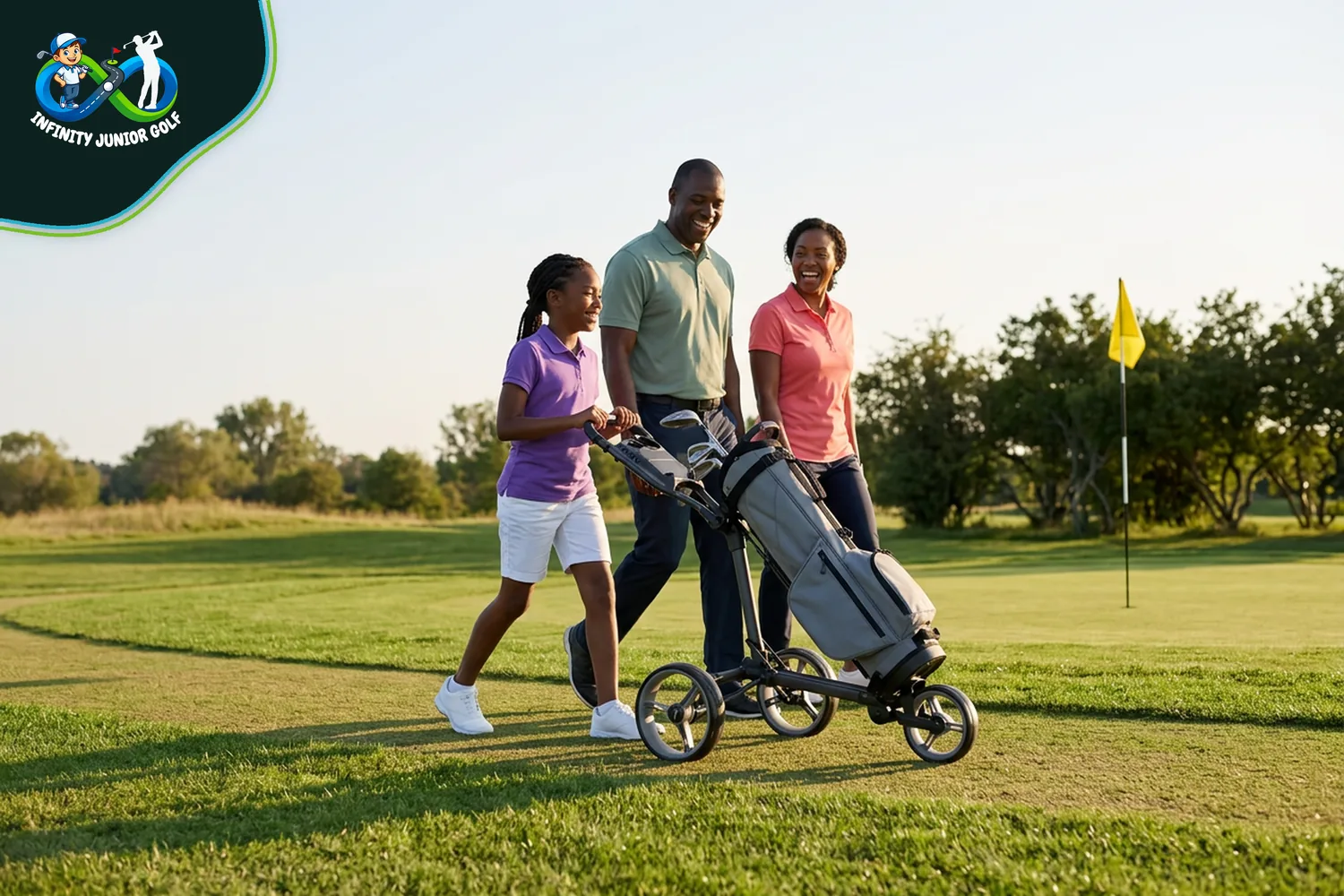
Ask about junior rates: Youth on Course, which runs in Canada, the US and Australia, lets members play participating courses for $5 or less (opens in a new tab) a round. In Canada, children can join from age 6 until their 19th birthday through a Golf Canada membership costing $64.95 CAD, and those under 12 have to play with a paying adult. Elsewhere, ask your local course or club what it charges juniors, because junior rates are often far below the adult price.
Help with fees exists: First Tee chapters in the US offer full scholarships (opens in a new tab) or reduced-fee programs for families who need them, so cost alone shouldn't rule a child out.
What families spend: In the US, the Aspen Institute's Project Play survey found the average family spent $1,016 USD (opens in a new tab) on a child's main sport in 2024, up 46 percent since 2019, and nearly $1,500 USD on that child's sports in all. That figure covers every sport, not golf alone, and it's US-only, but it's a useful sense of scale.
Budget for the whole year, not the purchase: Clubs are the visible cost and the one everyone asks about. Club membership, entry fees, travel and accommodation, coaching, and replacing outgrown gear are the actual cost, and unlike the clubs, they recur every year whether or not anything needs buying. Membership in particular is easy to overlook when you're pricing up a starter set, and for a child playing regularly it's often the largest single line on the list.
Cutting the cost: There are plenty of ways of keeping costs down, from secondhand gear to junior rates and shared lessons.
Your child is in good company: The R&A's 2025 Global Participation Report counts 47.1 million juniors (opens in a new tab) playing golf in some form outside the US and Mexico, with 19.9 million in Europe alone.
Once you know where your child will play, the next job is finding clubs that fit, from a shop that delivers where you live.
Brands and Tools That Help Juniors Thrive — Our Recommendations
These six shops cover the same well-sized starter set in the US, the UK and Europe, and Australia, plus a budget set and a secondhand option. I haven't bought from any of them for this article, so each is assessed from its own published details. Prices were checked on November 24, 2026, and can change.
Worldwide Golf Shops
About
Worldwide Golf Shops is a large US golf retailer with a wide junior range. Its product pages list a 90-day satisfaction guarantee, and it ships to many countries with duties paid, at a rate that depends on the country.
Our recommendation
The Team TaylorMade set (opens in a new tab) starts at $249.99 USD for Size 1 and comes in three height-based sizes, with free shipping inside the continental US. It costs more than a budget starter set, and buyers outside the US should check the delivery cost at checkout.
Visit Worldwide Golf Shops (opens in a new tab)
Photo 1
Decathlon
About
Decathlon is a French sporting goods chain that sells its own-brand gear through local stores and websites in many countries. Its kids' golf sets are sized by age band with a height range for each.
Our recommendation
On Decathlon's Canadian site the kids' 8–10 set (opens in a new tab) is $169.99 CAD for children 130 to 150 cm tall, with a hybrid, two irons, a sand wedge, a putter and a bag. It's the budget option; the age bands are broader than a height-based set, and range and price vary by country.
Visit Decathlon (opens in a new tab)
Photo 2
GlobalGolf
About
GlobalGolf is a US golf retailer that sells new and preowned clubs and takes trade-ins. It says it ships to over 100 countries, with import charges paid by the buyer.
Our recommendation
Its preowned Team TaylorMade set (opens in a new tab) for ages 10 to 12 (54 to 59 inches) has seven clubs, with a 90-day satisfaction guarantee. The price depends on condition and stock changes often, so check what's listed when you look.
Visit GlobalGolf (opens in a new tab)
Photo 3
Clubhouse Golf
About
Clubhouse Golf is a UK golf retailer that sells online. It offers free mainland UK delivery on orders over £30 and delivers to 23 European countries, free on most orders over £100.
Our recommendation
Its Team TaylorMade 4–6 set (opens in a new tab) is £249.00, the same Size 1 set as above, in stock with free next-day delivery in mainland UK. It's the easiest way to buy this set in the UK or the EU, but it's listed right-handed only, and its delivery page covers only the UK and Europe.
Visit Clubhouse Golf (opens in a new tab)
Photo 4
2nd Swing Golf
About
2nd Swing Golf is a US golf retailer that sells new and used clubs and accepts trade-ins. It ships internationally by FedEx only, at $34.99 USD to Canada and $99.99 USD to other countries.
Our recommendation
Its Team Size 2 set (opens in a new tab) for ages 7 to 9 (48 to 53 inches) starts at $399.99 USD, with five clubs and a 60-day play guarantee. Free US shipping doesn't cover complete sets, and international delivery adds a lot to the price.
Visit 2nd Swing Golf (opens in a new tab)
Photo 5
GolfBox
About
GolfBox is an Australian online golf retailer. It ships to 21 other countries, including New Zealand and much of Asia and Europe, but not to the US, the UK or Canada.
Our recommendation
The Team TaylorMade S2 set (opens in a new tab) for ages 7 to 9 is listed at $519.00 AUD, down from $649.99, with five clubs from a 34-inch driver to a 27-inch putter. It's the simplest way to buy this set in Australia; confirm the final price, including GST, at checkout.
Visit GolfBox (opens in a new tab)
Photo 6
Clubs are the visible part. The questions that come next are about how the game itself is played: the rules, the manners, the handicap and the first small competition.
Rules, Etiquette, Handicaps and First Competitions
Start with the spirit of the game: Rule 1.2 of the Rules of Golf asks every player to act with integrity (opens in a new tab), show consideration for others, including their safety, and take good care of the course by replacing divots and repairing ball marks. Rule 1.3 asks players to be honest in applying their own penalties. A new junior doesn't need the full rulebook, but those three ideas cover most of what matters on day one.
Etiquette has to be taught: Children absorb a good deal of golf's culture without being taught, but some of it does need teaching. The specifics of etiquette — where to stand, when to be quiet, repairing what you've damaged, keeping pace — have to be explained, usually more than once. So does calling a penalty on yourself when nobody saw it, which is the one that matters most and the least instinctive thing in the game. Left to absorption alone, a child will pick up the atmosphere and miss the rules.
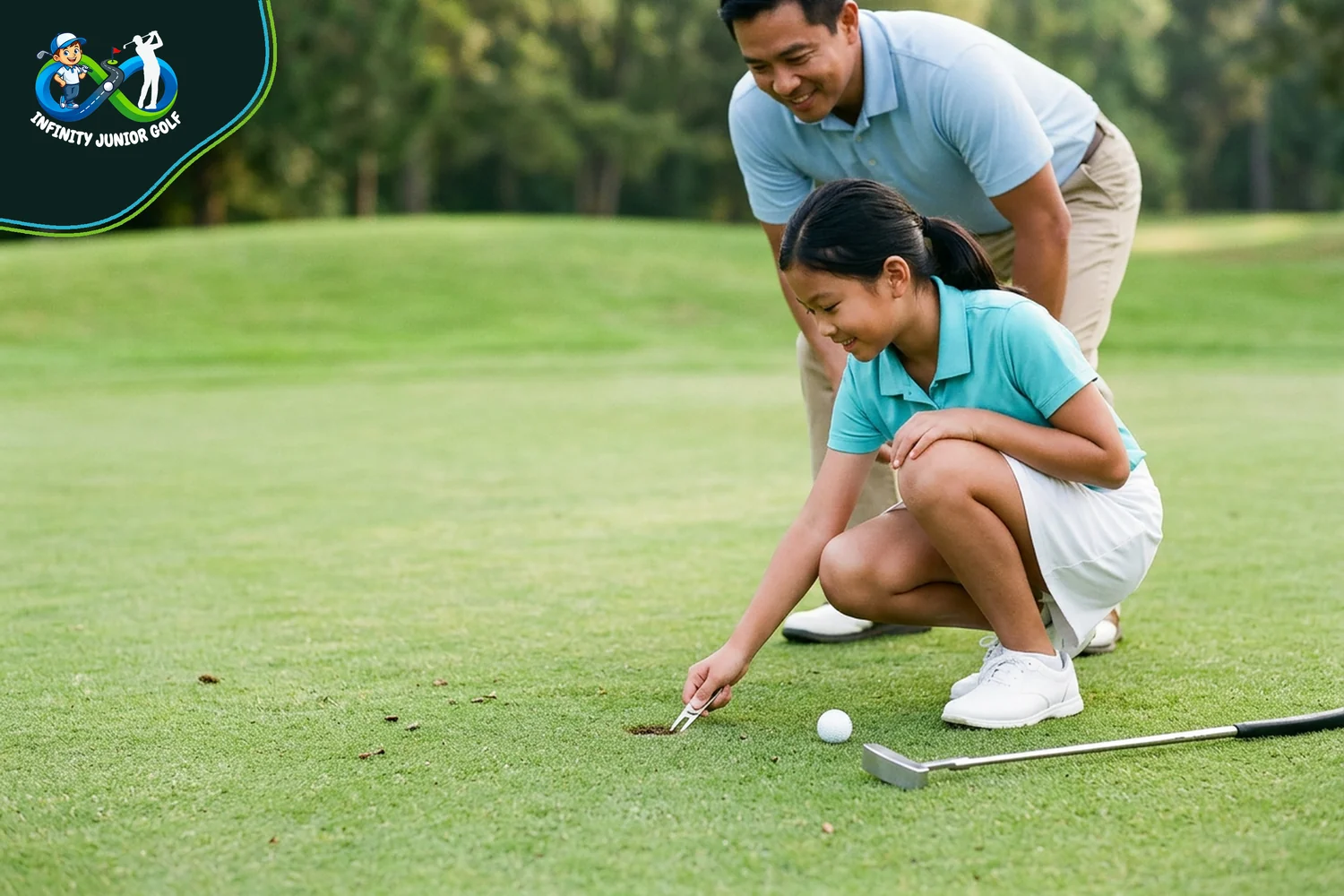
What a handicap is, and when to get one: A handicap evens out players of different standards so they can compete fairly. Under the World Handicap System, a player needs scores from 54 holes (opens in a new tab), from any mix of 9- and 18-hole rounds, to get a first Handicap Index, and the maximum is 54.0 for everyone. In the US, the USGA says you have to belong to an authorized golf club to hold one; elsewhere, ask your club or national golf body how it works.
Handicaps make family golf work: Straight scoring across a five-year gap is meaningless, because the result is known before anyone tees off. Playing off handicap puts a real contest back on the table, and in our family the younger one wins often enough for it to matter.
First competitions are often skills events or team leagues: In the US, Drive, Chip and Putt is open to ages 7 to 15 (opens in a new tab), has no entry fee and holds local qualifying in all 50 states. PGA Jr. League adds team matches, and its All-Star season (opens in a new tab) is open to players aged 10 to 17, depending on league and eligibility.
Where it leads in the US: For families in the US, this list of US junior tournaments shows where the competitive pathway goes next.
The step from club to state: My eldest has competed at club level, state championships and national championships here in Australia; my younger is at the earlier end of that path. In Australia, the step up from club to state is bigger than the step from state to national. Club events are recognizable, with familiar faces, a familiar course and a parent nearby. State is where it becomes genuinely competitive, and where the mental side starts to matter more than the swing.
After a bad round, leave it alone: The drive home after a bad round is not the moment for technical feedback, however well meant. They already know what went wrong, and hearing it again from the passenger seat adds nothing except the sense that the round is still being played. That took me longer to work out than it should have. What works better is asking whether they want to talk about it, accepting no as an answer, and saving anything technical for the next practice session.
That covers the big questions. Here they are boiled down into ten things you can do this week.
Our Practical Tips For You
Ten small steps that cover the questions above, from the first lesson to the first scorecard.
| Tip | How to implement | How it helps |
|---|---|---|
| Start with a group program | Look for First Tee, MyGolf, a Junior Hub club or a local clinic. | Programs such as First Tee provide equipment (opens in a new tab), so you can try before buying. |
| Measure before you buy | Measure your child standing straight in sports shoes. | Club size starts with height (opens in a new tab), not age. |
| Buy for today's height | Choose the size that fits now, not next year. | Oversized clubs do more harm (opens in a new tab) than good. |
| Start with five clubs or fewer | A wood or hybrid, a 7-iron, a wedge and a putter is plenty. | A smaller set (opens in a new tab) gives more consistent contact. |
| Check secondhand and trade-ins | Look at preowned junior sets and resell outgrown ones. | Junior clubs are outgrown, not worn out. |
| Budget the whole year | List membership, lessons, entry fees, travel and outgrown gear. | Shows the real cost, not just the clubs. |
| Ask about junior rates | Ask local courses what juniors pay, and check Youth on Course. | Members play for $5 or less (opens in a new tab) at participating courses. |
| Teach one etiquette habit per round | Pick one: ball marks, divots, standing still or pace. | Matches what Rule 1.2 (opens in a new tab) asks of every player. |
| Keep scorecards from the start | Save 9- and 18-hole scores once they play a course. | A first handicap needs 54 holes (opens in a new tab) of scores. |
| Pack sunscreen and a hat | Apply SPF 30 or higher before the round and again around the turn. | Experts advise reapplying every two hours (opens in a new tab). |
None of these costs much, and most cost nothing. A few more questions come up often enough to answer quickly.
More Answers to Common Questions About Junior Golf
Four more questions parents often ask when their child is starting out.
Can left-handed kids get junior clubs?
Yes. The Team TaylorMade junior sets come in left and right hand (opens in a new tab), so check that the size you need is in stock in the left-handed version before you order.
What should my child wear?
Comfortable sports clothes are fine to begin with, and First Tee says there's no need (opens in a new tab) for special golf attire. Add sunscreen of SPF 30 or higher, or SPF50+ as Australia's SunSmart (opens in a new tab) advises, and a hat.
Do boys and girls need different clubs?
Not at the start. Sizing comes from height, and sets such as Team TaylorMade's are made unisex (opens in a new tab).
Is 13 or 14 too late to start?
No. PGA Jr. League's 17u division is for ages 14 to 17 (opens in a new tab) and needs no prior experience, and First Tee runs to age 18 (opens in a new tab).
Our Related Articles
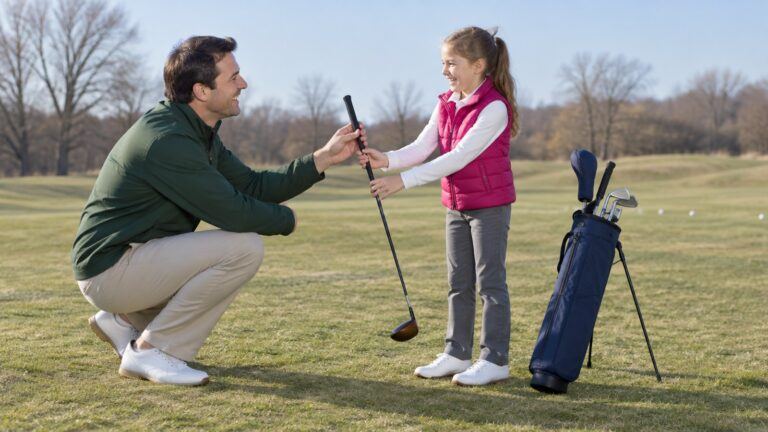
A first set of golf clubs is the one purchase nearly every golfing family makes, and it’s usually made on a guess. The sets
Read article
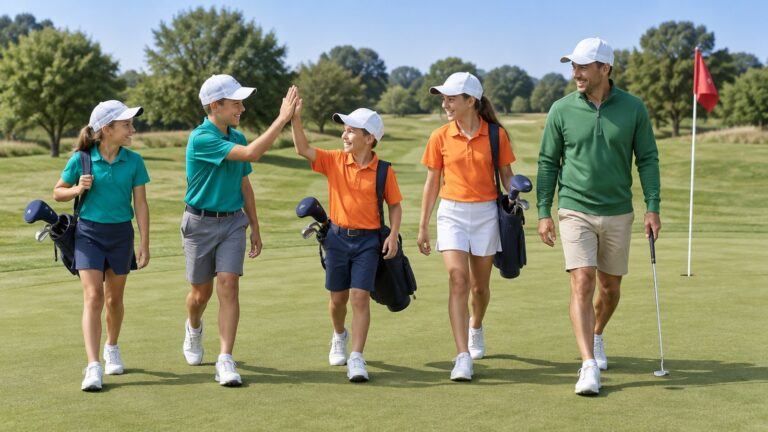
Most children learn golf on their own. They hit balls on a range, have a lesson, go round with a parent, and every bad
Read article

Golf has a reputation for being expensive, and I won’t pretend that reputation came from nowhere. By the time you factor in clubs, green
Read article
Conclusion
Most of the early questions have simpler answers than they first seem. Start in a group program, size clubs by height for the child in front of you, budget for the year rather than the purchase, and teach the spirit of the game before the fine print of the rules. The rest, from handicaps to first competitions, can wait until your child shows they want it.
Which question do you wish you'd asked before your child's first lesson or first set of clubs?
