
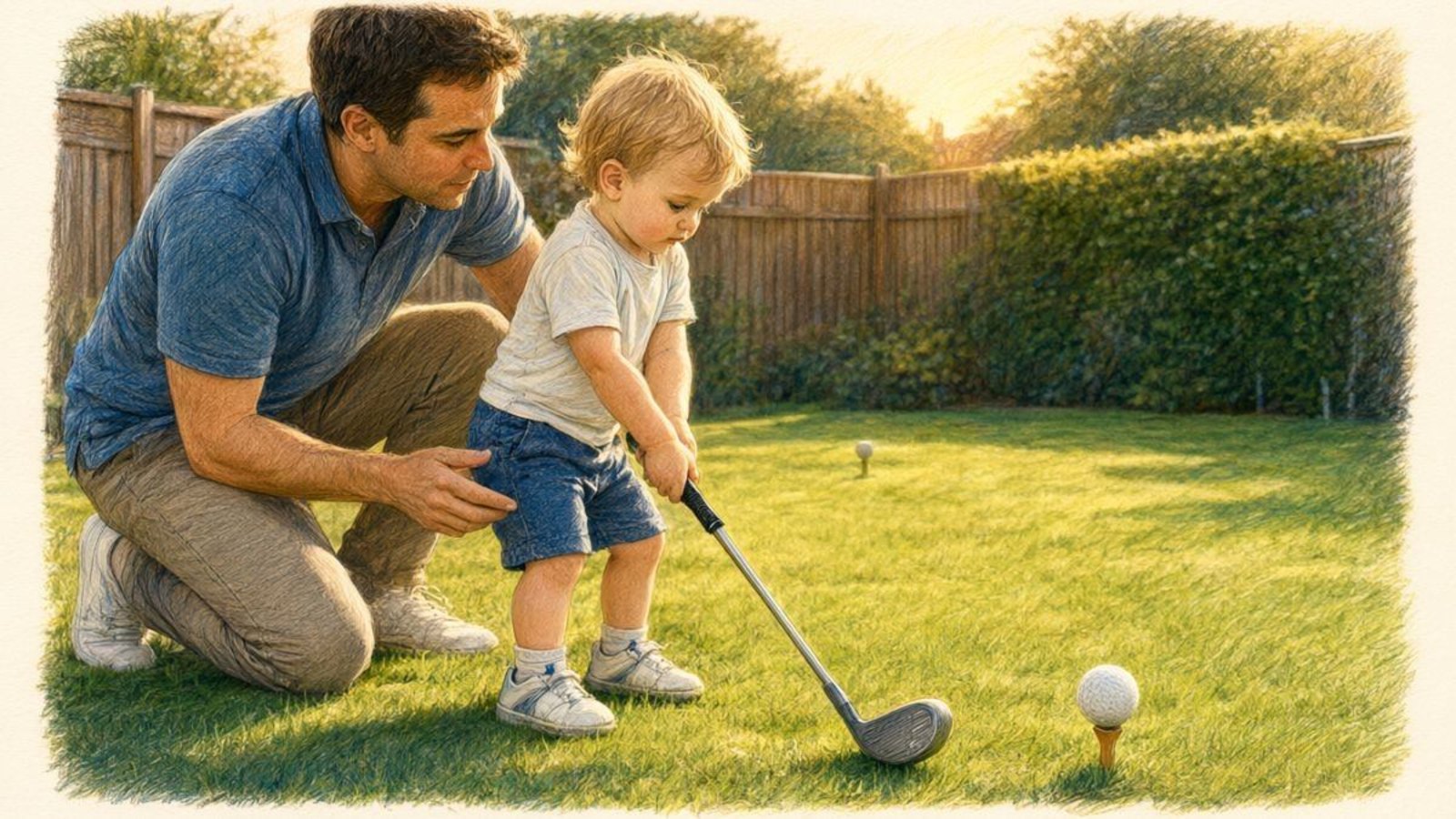

There’s a particular moment that happens with almost every golfing parent: a toddler picks up a club — often a hand-me-down from an older sibling, sometimes a gift from an overenthusiastic grandparent — and takes a wild swipe at nothing in particular. It looks like the start of something, and the question that follows is usually how to teach a toddler to swing a golf club without turning a two-year-old’s afternoon into something that feels like school. The honest answer is that a toddler isn’t ready for anything that looks like a lesson yet. That’s not bad news. It just means the job in front of you is smaller and more forgiving than it feels.
I’m Al, and I’ve bought beginner golf equipment for two children five years apart — got the sizing wrong the first time, got it right the second. I should say plainly that neither of my boys started at toddler age; by the time golf clubs came into our house properly, they were both a bit older than the child you’re probably picturing right now. So the toddler-specific part of what follows is built from the same research I’d hand a stranger, alongside the one lesson I did learn early and the hard way: buy for the child in front of you, not the child you imagine they’ll be in a year. If you’ve got a toddler swinging at thin air in your backyard right now, here’s what’s actually worth doing about it — and what can comfortably wait.
⛳🏌️
U.S. Kids Junior's Yard Club
We haven't put this one in a toddler's hands ourselves, so this pick is built on the numbers rather than a claim we can't make: it's the only club in this category built down to a 36-inch height band instead of scaled down from a bigger junior set.
The single biggest thing it gets right is weight — a light, oversized head on a flexible shaft means a two- or three-year-old can actually move it, which is the whole problem with handing a toddler anything built for an eight-year-old.
- ✅ One lightweight club, not a set
- ✅ Six height bands from 36" to 54"
- ✅ Available right or left-handed
- ✅ Ships internationally
One honest limitation: it's a single club with balls and a tee, not a full set — plan on a proper junior set once they're past this stage.
What a Toddler Can Actually Do With a Golf Club
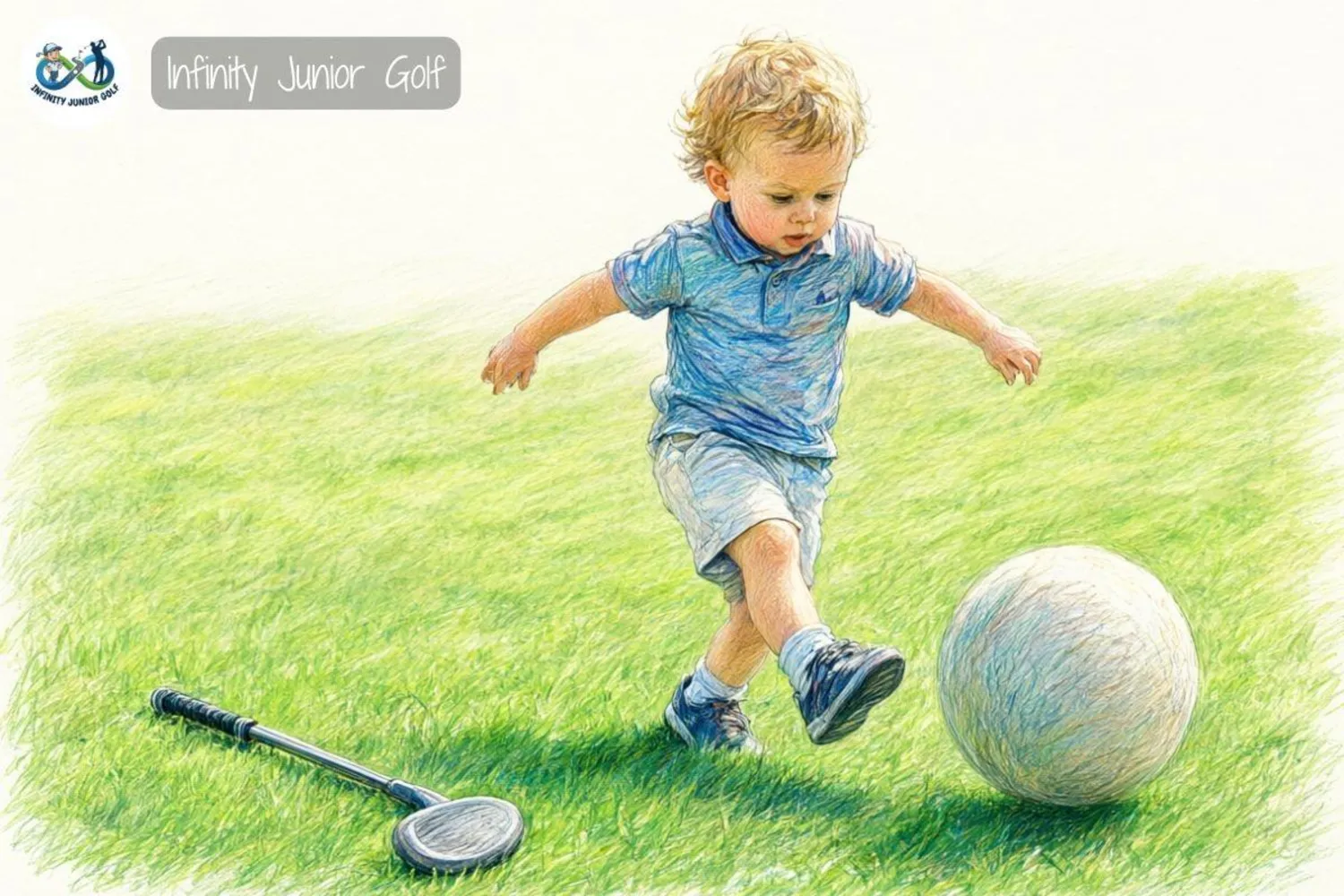
Readiness is a movement question, not a birthday. A toddler who can already run and kick a ball has more of the physical groundwork in place than most parents assume — both skills sit on the CDC's milestone list (opens in a new tab) for a typical two-year-old. That matters more than the date on a birth certificate. A body that can run and kick already has enough balance to take a genuine swipe at a ball; the golf swing itself comes later.
Set the bar honestly, and the pressure comes off everyone. Most children don't have the basic motor skills organized sport actually requires until around age six (opens in a new tab), and at toddler age, balance and attention span are still limited and the ability to track a moving object isn't fully developed yet either. None of that is a problem to fix. It's just where a two- or three-year-old actually is, and it explains almost everything about how this should be taught.
This age is built for play, not instruction. Sport for Life's Active Start framework (opens in a new tab) covers birth to six and asks for exactly one thing: unstructured access to a variety of equipment, non-competitive games, and movement skills built through play rather than coaching. A golf club, on that list, is just one more toy in the rotation — not a project.
Backyard swings count as real activity, not a substitute for it. Toddlers aged one to two are recommended at least 180 minutes (opens in a new tab) of physical activity a day, spread throughout the day at any intensity; three- and four-year-olds get the same target with at least 60 of those minutes at a livelier pace. Ten minutes swinging at a foam ball in the yard is a genuine contribution to that number, not a token gesture.
Don't lock in a hand yet. A preferred hand typically starts to show up around age three (opens in a new tab) and usually isn't settled until four or five, so a toddler who swings right-handed one day and left-handed the next isn't doing anything wrong. Let them swap freely and the preference will show up on its own.
There's no calendar pressure behind any of this, either. The youngest age division on the U.S. Kids Golf Local Tour (opens in a new tab) starts at five, and Drive, Chip and Putt doesn't accept an entrant under seven years old (opens in a new tab). Tiger Woods was swinging before he could talk — the example most parents have somewhere in the back of their mind — but the organized side of the sport genuinely doesn't open its doors for years yet, and nothing is lost by waiting for it.
Once you've made peace with what this age is and isn't for, the only real decision left is what to put in a toddler's hands — and getting that part wrong is the single easiest way to make the whole thing harder than it needs to be.
Choosing a First Club and a Ball That Cannot Hurt Anyone
Weight decides more than anything else on a spec sheet. Cut down an adult club and the physics goes wrong twice over — the head stays heavy and the shaft turns far too stiff (opens in a new tab) for a small, developing swing. The clubs actually built for this age are lightweight from the ground up, not adapted down from something bigger.
Fit by height, not by the number on a birthday cake. U.S. Kids Golf sells its Yard Club in six height bands (opens in a new tab) from 36 to 54 inches, and even sets driver loft in their Ultralight 7 sets by how tall the child is rather than how old they are — a 39-inch player gets 23 degrees of loft (opens in a new tab), more forgiving than anything built for an adult swing. Measure before you shop; the number in inches matters far more than the one in years.
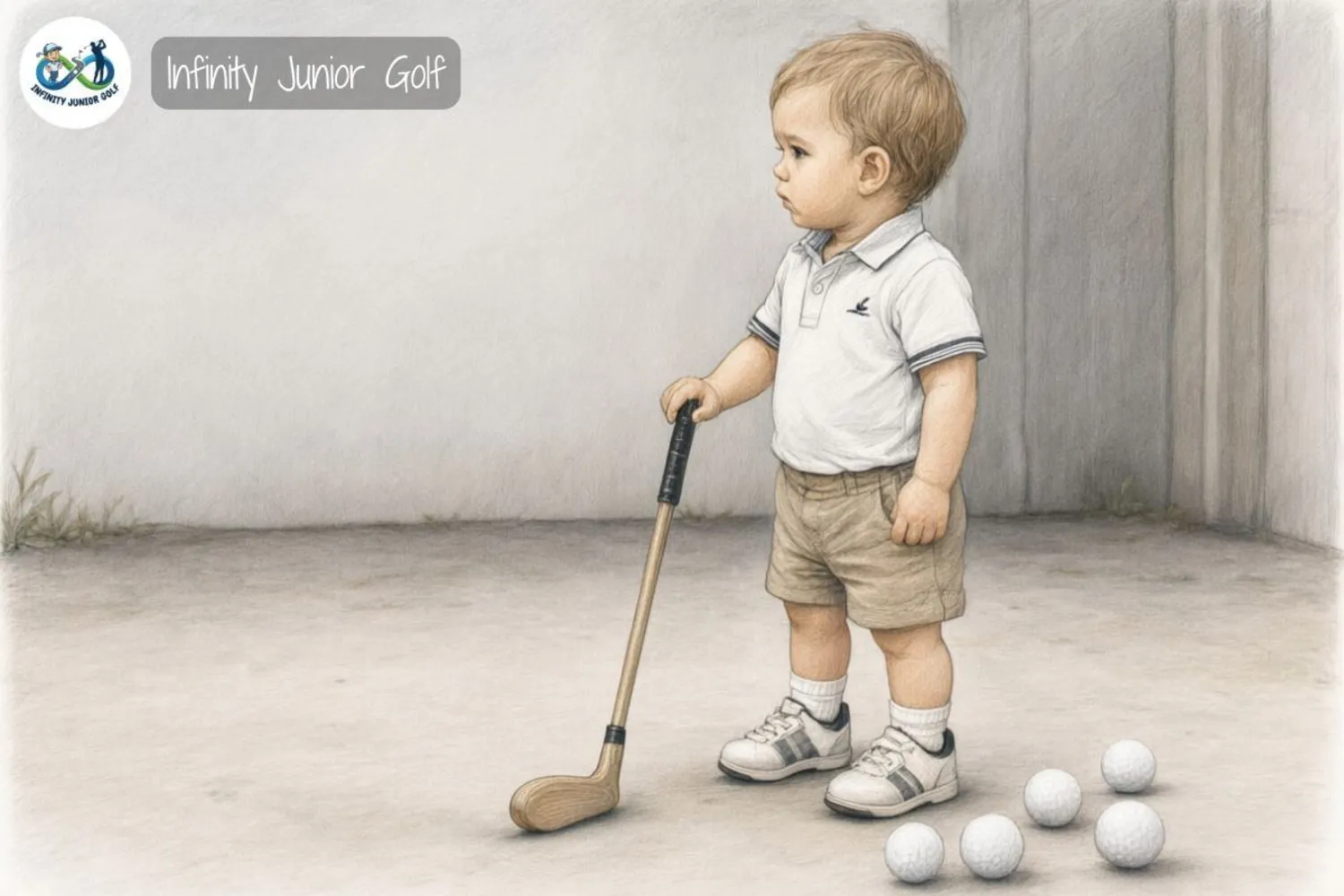
I made this mistake myself, just a few years further down the track. When my eldest was starting out, I bought his first set a size up because I'd been told he'd grow into it — sound advice for school shoes, useless for golf clubs. I couldn't tell you the brand now. What I remember is him working harder than he should have needed to, and enjoying it less than he otherwise would have. The second time round, with my younger son, I measured properly and bought for the child in front of me rather than the one he'd be in a year. It cost more over time. It was worth every bit of it.
One club is plenty for a toddler — you do not need a bag yet. A single lightweight club, in the right height, will occupy a two- or three-year-old completely. When the time comes to expand past a single club, that's a first junior set question, not a today question.
🏌️
U.S. Kids Junior's Yard Club
We haven't tested this one ourselves, but it's the only club we found built specifically for this height range rather than scaled down from a bigger junior set — which is exactly the problem with most "toddler golf" gear on the market.
- Fits 36" to 54" players
- Light, oversized head
- Comes with balls and a tee
Growth is the real cost at this age, and it starts earlier than people expect. A toddler outgrows a club roughly every year, sometimes faster, long before it's worn out. It's worth thinking about what it actually costs before the first purchase rather than after the third one — a single lightweight club now is a far smaller bet than a full set.
Adjustable clubs buy you a year or two of slack. Decathlon's INESIS First Club telescopes from 52 to 83 centimetres (opens in a new tab) on a 45-gram shaft and is sold for ages two to thirteen, which means it can genuinely follow a child through a growth spurt rather than being replaced by it.
Foam or inflatable balls only — this one isn't a suggestion. Decathlon's own product instructions for the First Club are explicit: use it under adult supervision (opens in a new tab) with foam or inflatable balls only, and never aim at anyone's face. Treat that as the baseline for any club in a toddler's hands, not just this one.
Grip matters less than you'd think, this early. A training grip genuinely helps once a child is old enough to hold a position, but a toddler's hands won't hold a textbook grip for more than a few swings, and correcting them over and over is the fastest way to turn a fun five minutes into a chore neither of you wants to repeat.
Once you've got something light enough for them to actually swing and something soft enough that it can't do any damage, the equipment side of this is genuinely done — and the only thing left to work out is what you actually do in those first few sessions.
How to Teach a Toddler to Swing a Golf Club Without Giving a Lesson
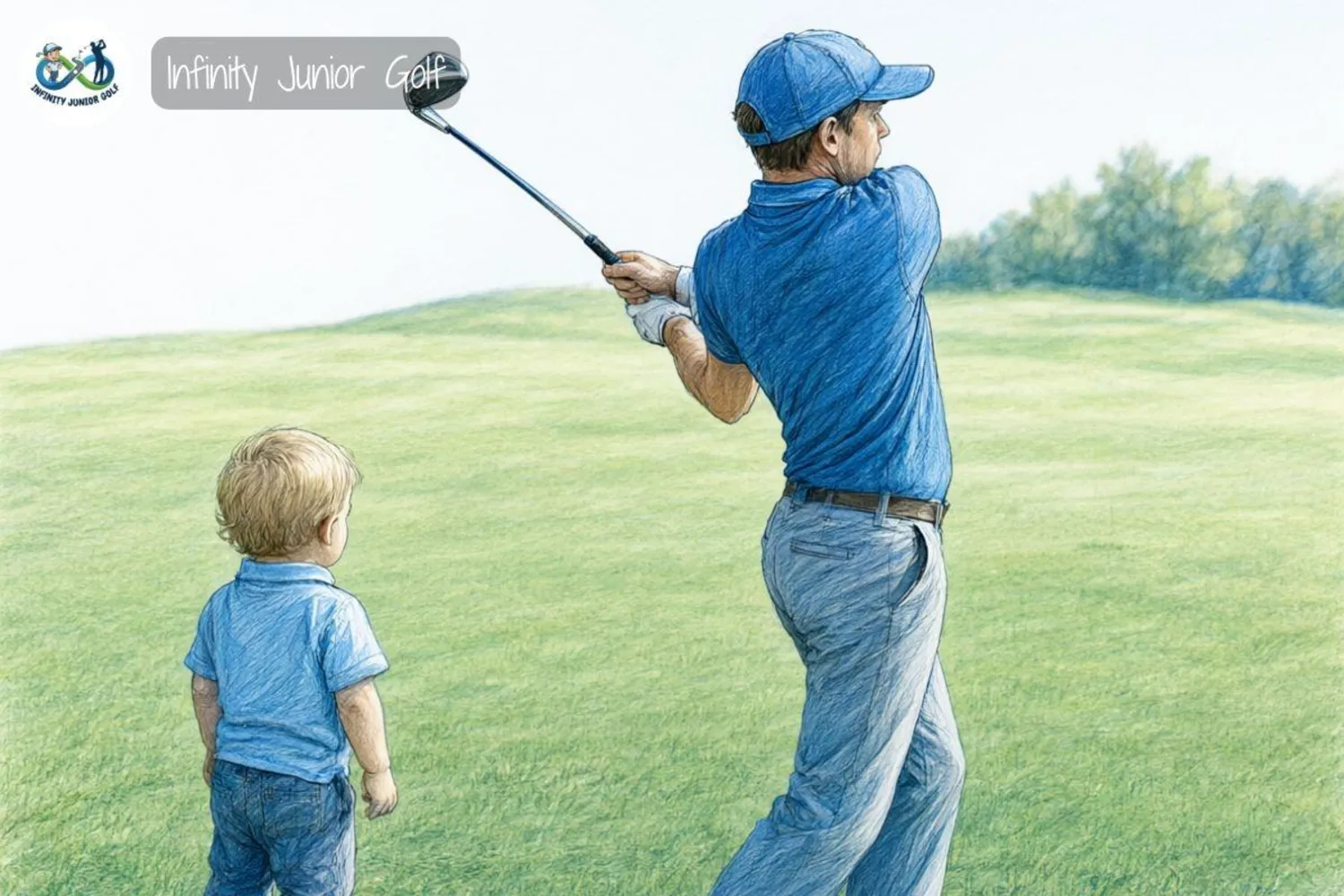
Show them, don't explain it to them. At this age, children learn best when they can explore, experiment and copy (opens in a new tab) others rather than being told what to do. Take a few slow, exaggerated swings yourself before you ever hand them the club.
Give them one cue, and only one, per session. Attention span is still short at this age, and a second correction usually undoes whatever the first one accomplished. Pick the single most useful thing — "look at the ball," or "swing like this" — and let everything else go for today. The rules and etiquette side of the game, and explaining the basics of how it works, is a conversation for a few years from now, not this one.
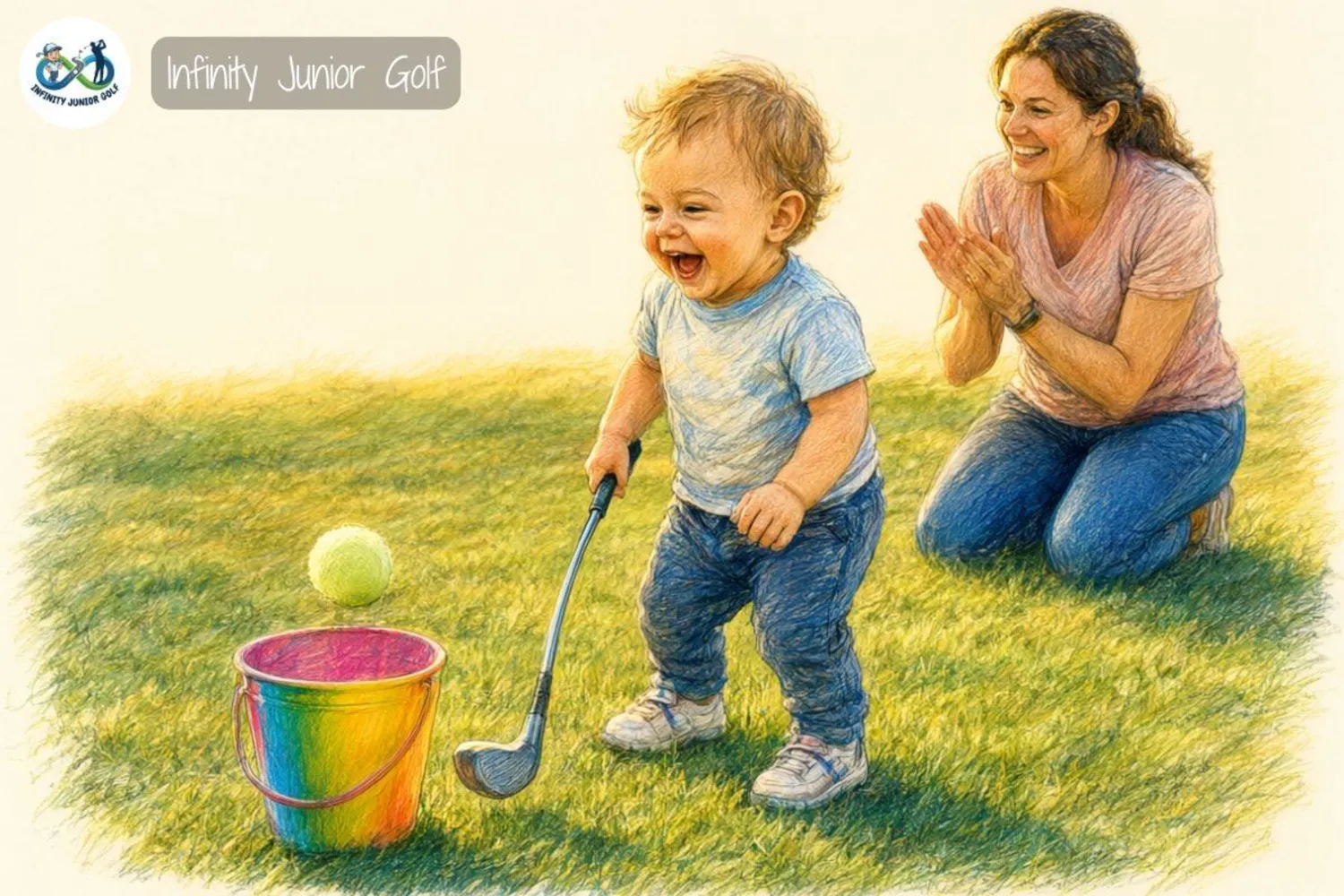
A target beats a technique every time. Aiming at something — a bucket, a towel, a cone — turns the swing into a game a toddler wants to repeat. Positioning a shoulder or squaring a clubface is a lesson, and a toddler has no interest in lessons. The full swing sequence is years away and none of it is relevant yet — and that's fine.
Put the ball somewhere it can't move. Tracking a ball in flight, or even one rolling across grass, asks more of a toddler's eyes than they're capable of yet — vision and the ability to follow a moving object are still developing (opens in a new tab) at this age. A ball on a tee, or resting on a low mound of grass, removes the hardest part of the task entirely.
Set the safe zone before the first swing, and hold it without exception. This is the one rule in this whole article that isn't optional. A peer-reviewed study of children struck by clubs (opens in a new tab) found no direct adult supervision in any of the cases reviewed — not one. Decide where anyone else stands before the club comes out, not after.
Praise the swing, not the result. Contact will be rare for a while, and it shouldn't be the thing that earns the reaction. Cheer the swing itself, every time, and the outcome will follow eventually on its own schedule.
You don't need much to put all of this into practice — one light club and something soft to hit — but "not much" still means choosing something, and that's worth doing carefully.
Brands and Tools That Help Juniors Thrive — Our Recommendations
Everything below sells something that actually fits a toddler-sized swing, not a scaled-down version of adult or older-junior gear. The first two are single clubs, which is genuinely all you need right now. The last four are complete sets — worth knowing about, but they're next year's purchase more than today's.
US Kids Golf
About
US Kids Golf builds its entire range around player height rather than age, with clubs sized specifically for young beginners rather than adapted from bigger junior sets, and ships internationally. It's the most toddler-specific brand in junior golf, and its smallest sizes start well below what most other manufacturers offer.
Our recommendation
The Yard Club (opens in a new tab) is the lightest, most flexible club the brand makes, sized from 36 inches, and it's the club we'd point a toddler's parent toward first — though it's a single club, so budget for a proper multi-club set down the line.
Decathlon
About
Decathlon's INESIS golf line is built around affordability and genuine adjustability, and the First Club is one of the few products in this category designed to grow with a child rather than be replaced by them. It's a UK and Europe listing rather than a US one, so shipping reach depends on where you are.
Our recommendation
The INESIS First Club (opens in a new tab) telescopes from 52 to 83 centimetres for around £12.99, roughly $17.58 USD, which makes it the cheapest genuine entry point we found anywhere in this category.
Global Golf
About
Global Golf carries new and secondhand junior clubs from most major brands, including the smallest US Kids Golf sizes, and ships internationally with duties handled at checkout. It's a sensible next stop once a toddler is ready for more than one club.
Our recommendation
Their UL7-39 3 Club Set (opens in a new tab) is sized for a 39 to 42 inch player and comes with a carry bag — the natural step up once a single club stops being enough, though stock on this exact size runs low, so check availability before you count on it.
PGA TOUR Superstore
About
PGA TOUR Superstore stocks equipment across the full range of junior sizes, including a dedicated tot-specific line most competitors don't carry. Shipping is US-only, so international readers should look further up this table.
Our recommendation
The Shorties Tot Golf Set (opens in a new tab) is sized for a 38 to 42 inch player and includes a full five-club set with a stand bag — more than a toddler needs today, but built specifically for this size rather than a junior line scaled down.
Golf Galaxy
About
Golf Galaxy is a big-box sporting goods retailer with a genuinely broad junior selection, including sets labelled specifically for ages two to four. Shipping is US-only.
Our recommendation
The Top Flite Kids' Set (opens in a new tab) is the only set in this table the retailer itself labels for ages two to four rather than by height alone, which makes it an easy one for a parent to trust at a glance.
Franklin Sports
About
Franklin Sports makes plastic, adjustable-length sets aimed squarely at very young beginners, and they're consistently the cheapest multi-club option available. Shipping is US-only.
Our recommendation
Their PGA Tour Youth Set (opens in a new tab) adjusts from 20 up to 35 inches depending on the club, ships with foam balls already in the box, and costs less than most single clubs elsewhere in this table — the honest trade-off for the price is plastic construction rather than a true club build.
Once you've got the right club in the right hands, the equipment side of this is finished — the more interesting question is how you actually spend those first few sessions together, and that's less about gear than about mood.
Keeping It Fun So They Come Back Tomorrow
Stop before they want to. A few minutes is the right dose at this age, not a compromise — attention span (opens in a new tab) is still developing this young, and ending a session while they're still keen is what makes them keen again tomorrow.
Keep score out of it entirely. Active Start (opens in a new tab) explicitly calls for non-competitive games at this stage, and it's good advice regardless of what the framework says — there's no version of "who hit it further" that ends well between a toddler and anyone bigger than them.
Let golf be one thing among several, not the thing. The same guidance asks for a mix of activities (opens in a new tab) rather than specialising in anything this early. A club in the yard for ten minutes fits alongside everything else a toddler's day already contains; it doesn't need to replace any of it.
Don't book a lesson yet — that decision is still years away. When my boys were old enough for it, coaching your own child taught me that group clinics worked better than private lessons at the start, mostly because being one of several kids took the pressure off. None of that applies to a toddler. What applies now is simpler: let them swing at things in the yard and see if they ask for more.
Watch yourself more closely than you watch them. I've seen keen parents put their own children off the game entirely, and I've had to check myself on it more than once. A toddler with a club in their hand is not the start of a project. It's a kid playing with a toy that happens to be shaped like one — and it should stay that way for a long while yet.
The competitive side of golf isn't going anywhere. Nothing here closes off later — U.S. Kids Golf's youngest Local Tour (opens in a new tab) division doesn't open until five, and most of the structured pathway sits years further out than that. Doing almost nothing structured now isn't a missed opportunity. It's the correct amount of golf for this age.
All of this adds up to a short list rather than a long one, so here it is in one place — the practical version of everything above.
Our Practical Tips For You
Ten small things worth getting right, drawn from everything above.
What to do
| Tip | How to Implement | How It Helps |
|---|---|---|
| Measure before you shop | Stand your toddler against a wall and record a height in inches, not their age. | Clubs in this category are sized by height, and a birthday tells you nothing about fit. |
| Buy one club, not a set | Start with a single lightweight club sized to their height. | A toddler can't use six clubs yet, and one well-fitted club goes further than five ill-fitted ones. |
| Use foam or inflatable balls only | Keep a real golf ball out of reach entirely for now. | A mis-hit foam ball can't hurt anyone nearby. |
| Mark a no-go zone before the first swing | Pick a spot well outside the swing arc and enforce it every single session. | It's the one rule behind the supervision finding (opens in a new tab) that matters most. |
| Tee the ball up or rest it on a mound | Never let the ball roll or move before contact. | Tracking a moving object is still hard at this age. |
| Demonstrate, don't explain | Take a few slow swings yourself before handing over the club. | Toddlers learn by copying, not by instruction. |
| Give one cue per session | Pick a single thing to say and leave everything else for another day. | A second correction usually undoes the first. |
| Aim at a target | Set up a bucket, towel or cone a few feet away. | Aiming at something turns practice into a game. |
| Keep sessions to a few minutes | Stop while they still want more, not once they're bored. | Short, positive sessions bring them back tomorrow. |
| Let them swap hands freely | Don't correct which hand leads. | A preference usually settles on its own by four or five. |
That's the whole practical list. The last few things — what other parents tend to ask, and a short answer to each — are below.
FAQs
A few of the questions that come up most with parents of toddlers just starting out.
What age can a toddler start swinging a golf club? There's no fixed starting age — it comes down to whether a child can already run and kick a ball, which most reach around age two (opens in a new tab). Two to four is the range almost everything in this category is actually built for.
Should I buy a toy set or a real junior club? A genuine lightweight junior club, sized correctly, is worth the extra cost over a toy version — the weight and balance are built for a real swing rather than for looking the part. A toy set isn't wrong, but it won't teach the same thing.
My toddler keeps switching hands — should I pick one for them? No. A preferred hand typically doesn't settle until four or five (opens in a new tab), so let them swap freely until it settles on its own.
When should we start actual lessons? Not yet, and there's no rush — the earliest structured tours don't accept entrants under five, and most formal coaching only pays off once there's something specific to work on, which comes later than toddlerhood.
Our Related Articles

The Do’s And Don’ts Of Coaching Your Kids In Golf
Getting your child into golf is one thing. Staying in the fairway as their coach, cheerleader, and occasional critic is another thing entirely. The
Read article

Best Junior Golf Club Sets For First-Time Players
Getting a young golfer started with the right equipment can be the difference between a lifelong passion for the sport and a set of
Read article
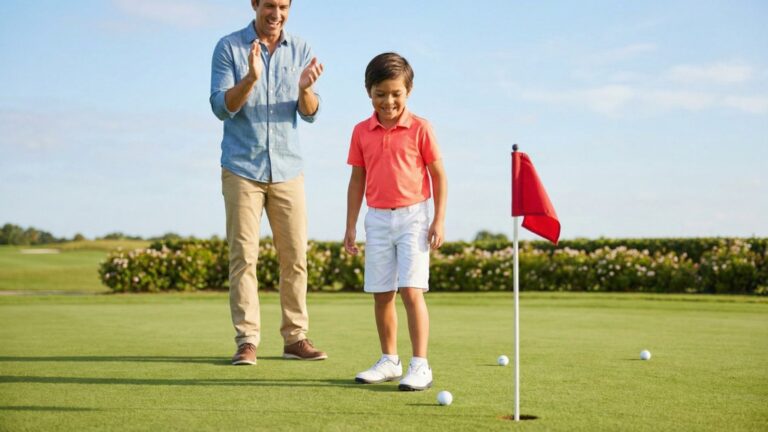
Explaining The Basics Of Golf To Kids In Fun Ways
Golf can seem like a big, grown-up game when you first look at it, but kids usually learn it best when it feels playful,
Read article
Conclusion
A toddler with a golf club in their hands isn't a junior golfer in training — not yet, and that's exactly the point. Get the weight right, keep the ball soft, hold the safe distance without exception, and let the rest be play rather than instruction. Everything else on this list follows from those four things, and none of it needs to happen this year if it doesn't want to.
What actually got your toddler swinging at something — a bucket in the yard, a ball on a tee, or just watching you do it first?
