


There are few moments more exciting for a golf family than watching a junior player develop the kind of game — and the kind of profile — that attracts college coaches. What most parents don’t realize is how much of that development happens off the course: in the careful building of a recruiting portfolio, the navigation of NCAA rules, the preparation of a college application essay, and the financial planning that turns a scholarship opportunity into a reality. The recruiting process is long, nuanced, and far more strategic than it appears from the outside.
My name is Al, and I’ve been following the junior golf world for years — not as a coach or a college administrator, but as a parent and enthusiast who has spent a lot of time sorting through what actually works. I’ve seen families get this right and families get it very wrong, and the difference usually comes down to preparation and staying in the right lane. I’m glad you’re here, because this guide covers everything you need to know to give your junior golfer the best possible chance of landing the right college opportunity. Keep reading — the details matter more than most people think.
⛳🏌️⭐ Our Top Pick — Best College Recruiting Platform for Golf Parents
NCSA College Recruiting
When I first started looking into college golf recruiting for my own kid, I honestly had no idea how early the process needed to start or how structured the outreach to coaches needed to be. NCSA was the resource that finally made it all click. The platform connects families directly with a network of over 40,000 college coaches across more than 30 sports, including golf, and gives junior golfers a structured place to showcase their scores, rankings, highlight videos, and academic profile in one verified location coaches actively search.
- ✅ Golf-specific recruiting tools
- ✅ Connects to 40,000+ college coaches
- ✅ Works across D1, D2, D3, and NAIA programs globally
- ✅ Free profile available; premium tiers for coach messaging and personalized guidance
| Mid-range | Serves families internationally
👉 Join Mens NCSA Golf (opens in a new tab) 👉 Join Womens NCSA Golf (opens in a new tab)Understanding the College Golf Recruiting Landscape
The scale of the opportunity is bigger than most parents imagine: There are more than 820 NCAA golf programs for men (across Division I, II, and III) and more than 720 for women, plus over 160 additional programs in the NAIA, according to NCSA College Recruiting (opens in a new tab). Combined, these programs give junior golfers a remarkably wide net of opportunity — far beyond the small handful of high-profile Division I schools that tend to dominate conversation.

Scholarship structures differ significantly by division: At the NCAA Division I level, beginning with the 2025–26 academic year, the NCAA replaced its old scholarship cap model with roster limits. D1 men’s golf programs can now carry up to nine players and offer scholarships to all of them if the program is fully funded. Prior to this change, D1 men’s programs were limited to 4.5 scholarships per year and women’s programs to 6. Division II programs continue under an equivalency model — up to 3.6 scholarships for men and 5.4 for women — amounts coaches frequently split into partial awards to build larger rosters. Division III schools offer no athletic scholarships, but D3 coaches actively help strong academic-athletic profiles access need-based and merit aid.
What coaches actually evaluate goes well beyond the scoreboard: Parents often focus exclusively on their junior’s scoring average, but college golf coaches assess a much broader profile. Scoring benchmarks matter — for D1 men, the general expectation is a consistent low-70s to under-par average; for D1 women, mid-70s. But coaches also weigh course difficulty, tournament field strength, GHIN handicap, swing video quality, academic record, and the quality of a junior’s communication when reaching out. A consistent 74 at a competitive AJGA or state-level event carries considerably more weight than the same score at a weak local tournament.
🏌️
NCSA is the platform I consistently point parents to first when they ask where to begin. It’s purpose-built for student-athletes: upload your junior’s scoring history, GHIN handicap, ranking results, and swing video, and coaches at programs across every division can find them. The free profile alone is worth setting up well before the formal contact window opens.
- ✅ Golf-specific search | 40,000+ college coaches | D1 through NAIA
- ✅ Free profile | Premium options for coach messaging and guidance
The NAIA and NJCAA open up genuine pathways that families too often overlook: NAIA programs offer up to five scholarships per team for both men and women, with average awards of roughly $7,800 per player per year. The NJCAA, which governs two-year college programs, offers up to eight scholarships per women’s team. For many junior golfers, starting at a community college or NAIA program provides both financial relief and a clear route to four-year programs through transfer. Our full breakdown of junior golf scholarships (opens in a new tab) goes deeper into the specific programs worth targeting at every level.
Families who begin with a clear-eyed view of all available divisions — not just D1 — position their junior for a much better match between athletic level, academic fit, and financial reality. With that bigger picture in place, the next step is building the profile that gets your junior noticed.
Building Your Junior’s Recruiting Profile
An online recruiting profile is the first thing most coaches will look at: Before a coach ever watches your junior play, they will review a digital profile. The AJGA (opens in a new tab) and NCSA both confirm that coaches actively search profiles when building their prospect lists, and a profile with current scores, verified rankings, a clear academic record, and a quality highlight video puts a junior on the radar far earlier than waiting for coaches to notice tournament performance alone.
Tournament selection shapes recruiting visibility in ways parents directly control: Not all tournaments carry equal weight with college coaches. Events sanctioned by the AJGA, US Kids Golf, USGA, PGA Junior League, state golf associations, and similar governing bodies provide verifiable, rankable results. Parents play a key role in helping their junior choose the right competitive calendar — a mix of local events to build confidence and regional or national events where coach exposure is highest. A full schedule of easy local events does nothing for recruiting visibility; targeted appearances at higher-stakes tournaments do. For a comprehensive guide to the top competitive events worth adding to your junior’s schedule, our breakdown of top junior golf tournaments (opens in a new tab) is a good place to start.
Academic preparation is a non-negotiable part of the recruiting equation: NCAA eligibility for D1 and D2 programs requires prospective student-athletes to register with the NCAA Eligibility Center (opens in a new tab) and meet minimum GPA and standardized test score thresholds. As of 2025–26, D1 requires a minimum 2.3 GPA in 16 core courses, with a sliding scale linking GPA to SAT/ACT scores. Parents should treat ACT/SAT preparation with the same seriousness as golf training — not because a 1400 SAT replaces a 72 scoring average, but because academic shortfalls can eliminate programs from consideration entirely, regardless of golf talent. Our balanced schedule guide (opens in a new tab) shows how to fit structured study time and golf training into a single workable week.

Highlight videos don’t need to be professionally produced to be effective: A clear, well-lit swing video — ideally showing a driver, iron, and short-game shot from face-on and down-the-line angles — gives coaches the mechanical baseline they need. Parents can help by organizing a simple video session at the practice facility, ensuring good lighting, a still camera, and a clean background. It doesn’t need cinematic production; it needs clarity and completeness. Building the physical capability that shows up well on those videos is a separate but equally important project — our core workout guide (opens in a new tab) covers the specific training that helps young golfers develop the club speed and consistency coaches want to see.
Once your junior’s profile is strong and their competitive calendar is taking shape, the next challenge is understanding exactly when things are supposed to happen — and what your role looks like at each stage.
Mastering the Recruiting Timeline
The process starts in middle school, even if formal contact cannot: Many parents assume recruiting begins when a coach first reaches out — but by then, the groundwork needs to be laid. Coaches are watching junior tournament results, reviewing state rankings, and building informal prospect lists well before formal contact rules allow outreach. The NCSA recruiting calendar for men’s golf makes this clear: D1 coaches may begin contacting recruits directly — by phone, text, email, or direct message — starting June 15 after the student’s sophomore year of high school. D2 coaches face no such restriction and can reach out at any time.
August 1 before junior year is the single most important date on the recruiting calendar: NCSA’s recruiting calendar (opens in a new tab) identifies August 1 before a student’s junior year as the moment D1 coaches can begin in-person, off-campus contact and recruits can start taking official campus visits. This date does not mean recruiting begins — it means the formal, regulated phase of recruiting accelerates. Parents should plan to have a working college list, a polished recruiting profile, and proactive coach contact already in place well before this milestone arrives.
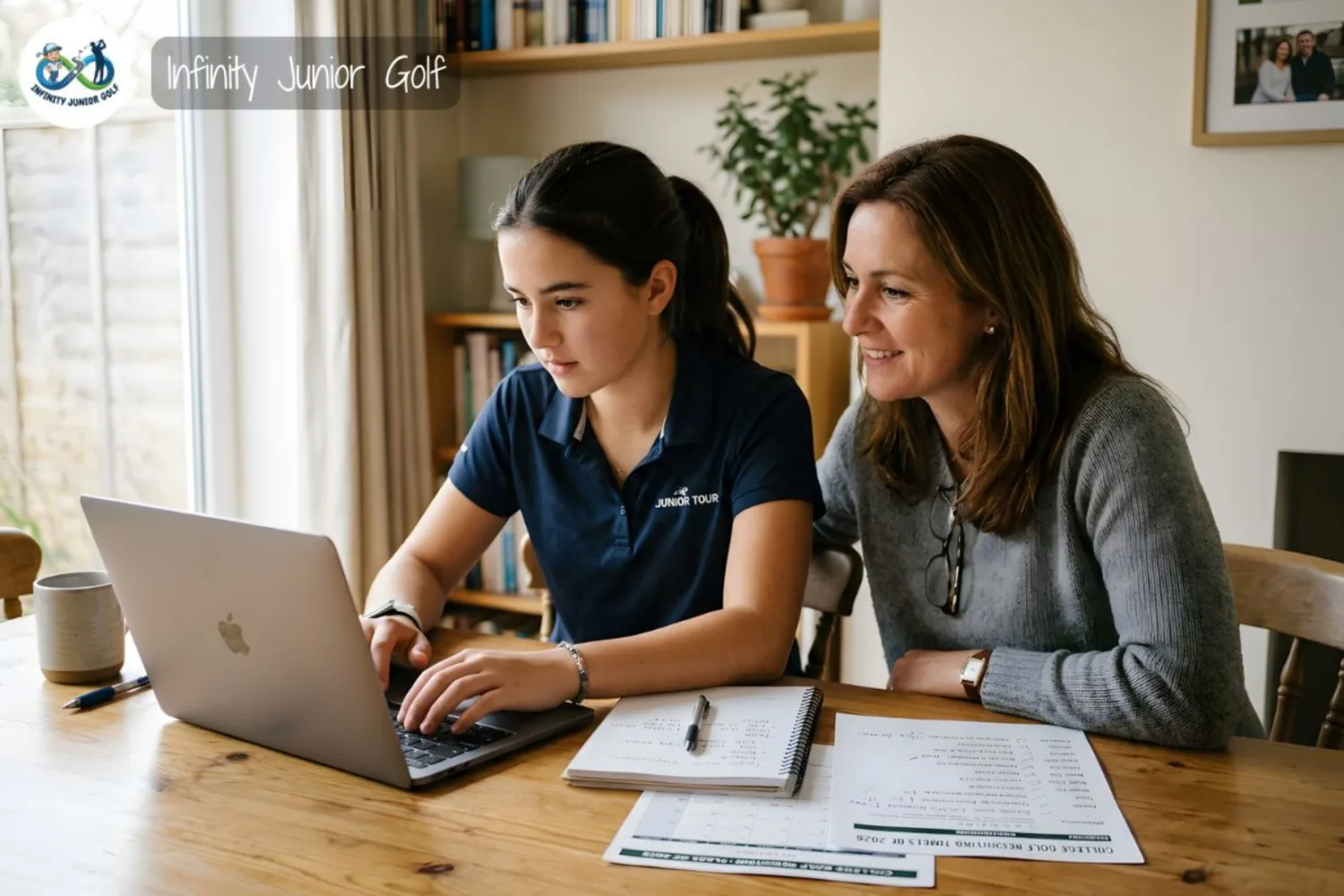
Students — not parents — should be the primary voice in coach communication: One of the most common errors families make is having a parent draft or send emails to coaches on the student’s behalf. College coaches want to recruit the student, not the parent. An email that reads like a student genuinely reaching out — with their own scores, their own words, their own question about the program — lands far more authentically than one that is clearly parent-written. Parents can help by coaching their junior on what to include and proofreading the message, but the sending should belong to the student. The same principle of calibrated parent involvement applies throughout the junior golf journey — our article on coaching your kids (opens in a new tab) covers where the line between helpful and counterproductive tends to fall.
Verbal offers are exciting but carry no binding weight — for either side: Coaches may extend verbal offers at any point during the recruiting process, including before official contact rules allow formal communication. These offers are not enforceable by the NCAA and can be rescinded. The National Letter of Intent (NLI) is the binding agreement, signed during the official signing period — for most D1 and D2 sports excluding football and basketball, the early signing period opens in November. Parents should resist treating a verbal offer as a done deal and should continue working with their junior to keep communication open with multiple programs until a financial aid agreement is actually signed.
Understanding when things happen and what your role is at each stage puts you in a much stronger position — but it’s just as important to have the right tools in your corner. Here’s what I’d recommend.
Brands and Tools That Help Juniors Thrive — Our Recommendations
Supporting a college-bound junior golfer through the recruiting process calls for more than enthusiasm — it calls for the right resources. The services and platforms below are ones I’ve found genuinely useful (or would have found useful) at different stages of the process, from building a recruiting profile to preparing for standardized tests and navigating financial aid.
NCSA College Recruiting
The largest college athletic recruiting platform, NCSA connects junior golfers and their families with over 40,000 college coaches across D1, D2, D3, and NAIA programs. A free profile lets students upload scores, tournament history, and swing video; premium tiers unlock direct messaging with coaches and personalized recruiting guidance. I’d have signed up the moment my junior started competing at regional level — having everything in one verified place that coaches actively search is worth it. Families outside the US can use the platform to connect with American coaches. Visit the men’s golf recruiting hub (opens in a new tab) to get started.
Kaplan Test Prep
NCAA eligibility depends on meeting minimum GPA and standardized test score benchmarks, and Kaplan’s SAT and ACT prep courses are among the most structured ways to help juniors prepare. Their adaptive online courses include full-length practice tests, detailed score analysis, and live instruction options, backed by a score improvement guarantee. What sets Kaplan apart for me is that the same platform that helps your junior hit their eligibility floor can also help them exceed it — opening the door to academic merit aid alongside any athletic scholarship. Online access works globally. Explore the SAT prep course (opens in a new tab) as a starting point.
Grammarly
Every email a junior golfer sends to a college coach is a first impression, and Grammarly Pro makes sure those emails are clear, professional, and error-free. The paid plan goes beyond grammar to flag unclear sentences, weak word choices, and tone issues — exactly the refinement a recruiting email or application essay needs. I recommend parents and juniors both use it when drafting coach outreach. It works on any device and supports writing in English worldwide. See the Grammarly plans page (opens in a new tab) to find the right option.
Road2College
Once offers start coming in, FAFSA and merit scholarship strategy become the most financially consequential part of the process. Road2College publishes detailed, jargon-free guides on FAFSA completion, the CSS Profile, college-specific merit aid strategies, and how to compare financial aid award letters. This is the resource I wish I had found earlier — it’s particularly strong on demystifying merit aid at private colleges. Browse the 2026–27 FAFSA guide (opens in a new tab) for immediate help.
Fastweb
Beyond athletic scholarships, a significant amount of college funding comes from external scholarships that families often don’t know exist. Fastweb is a free scholarship search engine that matches students to awards based on their profile, including athletic involvement, academic achievements, community activities, and background. Setting up a complete profile early — even in freshman year — lets a junior build a running list of scholarships to apply for throughout high school. Visit the sports scholarships section (opens in a new tab) to see relevant opportunities. Fastweb is accessible to students in the US and those applying from abroad to US institutions.
EssayEdge
Whether a junior golfer is entering the recruitment process through athletic channels or relying more heavily on the academic application, the college essay is a critical piece of the puzzle. EssayEdge offers professional editing and proofreading by editors who graduated from Ivy League institutions, with services covering personal statements, supplemental essays, and scholarship essays. I appreciate that they work on your draft rather than writing for you — the essay still sounds like your junior, just polished. Service is available globally. Explore the college essay editing service (opens in a new tab) to see package options.
The tools above cover the key areas where parents make the biggest difference: recruiting visibility, academic eligibility, coach communication, financial aid navigation, and essay support. Together, they give families a structure that reduces the guesswork at every stage. Once you’ve got the right tools in place, the financial side of the decision deserves its own careful attention.
Financial Aid, Scholarships, and Making the Final Call
Athletic scholarships alone rarely cover the full cost of attendance: Even in a fully funded D1 golf program, athletic scholarship dollars are distributed across the roster as partial awards in most cases — the roster limit change in 2025–26 increases the potential pool, but whether a school fully funds its program is a separate institutional decision. Parents should enter offer conversations with a clear understanding of what the scholarship covers — tuition only, or tuition plus room, board, and fees — and compare net cost across all offers received.
The FAFSA is the mandatory starting point for all federal financial aid in the US: The Free Application for Federal Student Aid (FAFSA), which families can open each October 1 for the following academic year, uses prior-prior-year tax information. For the 2026–27 award year, that means 2024 tax data. The new Student Aid Index (SAI) formula, introduced under the FAFSA Simplification Act, replaced the old Expected Family Contribution model and can now produce a negative number (minimum –$1,500) for families with the lowest resources. Submitting early maximizes access to need-based grants and work-study funds distributed on a first-come, first-served basis. The Federal Student Aid office (opens in a new tab) maintains the official FAFSA form and supporting resources.
Private institutions often require the CSS Profile in addition to FAFSA: Many of the colleges with strong golf programs — particularly private liberal arts institutions — use the CSS Profile to award institutional aid. The CSS Profile requests considerably more detailed financial information than the FAFSA, including home equity, business income, and retirement account details. Parents applying to private colleges should prepare both applications and review each school’s net price calculator early in the process to understand what they will actually pay. For a thorough breakdown of what to expect across the full financial aid journey, our guide on finding scholarships for junior golfers covers the funding landscape alongside the athletic scholarship picture.
Comparing offer letters requires a common framework: Financial aid award letters look different at every institution, making direct comparisons difficult without a structured approach. The net price — total cost of attendance minus all grants and scholarships — is the number that matters, not the gross scholarship amount. A $30,000 athletic scholarship at a $70,000-per-year school may be less attractive than a $15,000 merit award at a $35,000 school. Road2College publishes comparison tools and worksheets specifically designed to help families work through this calculation clearly.

Verbal commitment timing pressure is real, and parents should help their junior resist it: Some coaches apply informal pressure for a verbal commitment before a junior has had time to hear from all programs on their list. Parents can help by reminding their junior that no verbal commitment is binding, that coaches genuinely recruiting a student will wait a reasonable amount of time for a thoughtful decision, and that the right college fit — academically, athletically, financially, and culturally — matters more than being the first to say yes. Preparing your junior for that kind of high-stakes pressure is its own skill — the same composure that serves them on the course serves them here too. Our junior tournament packing (opens in a new tab) guide touches on the preparation mindset that carries into every high-stakes moment, on and off the course.
Our Practical Tips For You
Here are ten practical tips for parents supporting their junior golfer through the college recruitment process.
| Tip | How to Implement | How It Helps |
|---|---|---|
| Start the recruiting profile early | Set up a free NCSA profile in freshman or sophomore year. Upload current scores, a basic swing video, and academic information. | Coaches build their prospect lists early. A complete, current profile puts your junior in front of more programs before key contact windows open. |
| Let your junior send the emails | Coach your junior on what to include, proofread together, but have your junior send all coach outreach from their own account. | Coaches recruit students, not parents. A self-written email signals maturity and genuine interest. |
| Build a balanced college list | Aim for a list of 10–15 programs spanning D1, D2, D3, and NAIA options that genuinely fit athletically, academically, and financially. | A broad list protects your junior if top programs don’t materialize and opens doors to programs that may offer better financial packages. |
| Prioritize academic eligibility | Register with the NCAA Eligibility Center at ncaa.org by sophomore year and monitor core course requirements annually. | Eligibility issues discovered late in junior year can eliminate programs entirely. Early registration allows course corrections. |
| Choose tournaments strategically | Select events sanctioned by recognized governing bodies — AJGA, USGA, state associations — where coaches have access to verified results. | Coaches weight competitive context. A strong result at a recognized event carries more credibility than a low score at an unverifiable local tournament. |
| Attend unofficial campus visits | Plan campus visits during the academic year when classes are in session. Have your junior walk parts of the campus independently. | Seeing campus life authentically — not just during a guided tour — gives your junior a real feel for whether the environment suits them. |
| Prepare for the financial conversation | Download the net price calculator for every school on the list before any offer arrives. Build a family budget that accounts for all four years. | Understanding what you can genuinely afford before offers arrive prevents decisions driven by excitement rather than financial reality. |
| File FAFSA on October 1 | As soon as the FAFSA opens each October 1, gather the required tax documents and file immediately. | Earlier FAFSA submissions maximize eligibility for need-based funding distributed on a first-come, first-served basis. |
| Ask coaches the right questions | Prepare a list of questions about playing time expectations, scholarship renewal conditions, team culture, and academic support services. | Asking informed questions demonstrates preparation and gives your family information that should factor into the final decision. |
| Understand the NLI before signing | Read the National Letter of Intent carefully with your junior before signing. Understand what program, scholarship amount, and conditions are included. | The NLI is binding. Understanding every term before signing prevents surprises about scholarship renewal requirements or transfer restrictions. |
FAQs
When should parents start thinking about college golf recruiting? The groundwork — tournaments, academic tracking, building a handicap history — should begin well before freshman year of high school. Formal recruiting activity, like setting up an online profile and beginning coach outreach, works best when started in 8th or 9th grade. By the time D1 coaches can make contact (June 15 after sophomore year), your junior’s profile and competitive résumé should already be in strong shape.
Can parents contact college coaches directly on their junior’s behalf? Parents should generally stay out of coach communication. Coaches are recruiting the student-athlete, and a parent-driven outreach can signal that a recruit lacks independence — a genuine concern, since college athletes need to manage their own academic and athletic lives. The exception is financial aid conversations, where parents are appropriate and expected participants.
What academic standard does a junior golfer need to play in college? This varies by division. NCAA D1 requires a minimum 2.3 GPA in 16 core courses with qualifying SAT or ACT scores. D2 requires a 2.2 GPA in 16 core courses. D3 and NAIA programs set their own academic standards. Parents should monitor core course eligibility requirements from freshman year onward, well ahead of senior year application pressure.
Is a full athletic scholarship realistic for a junior golfer? Full scholarships are rare in college golf. Golf is an equivalency sport, meaning coaches split scholarship dollars across multiple players. The new 2025–26 roster limit model at D1 gives programs more flexibility to offer scholarship money to all rostered players, but whether a school fully funds its program is an institutional decision. Most recruited golfers receive partial athletic scholarships, often combined with academic merit aid and need-based grants to reach an affordable net cost.
Our Related Articles

The Do’s And Don’ts Of Coaching Your Kids In Golf
Getting your child into golf is one thing. Staying in the fairway as their coach, cheerleader, and occasional critic is another thing entirely. The way…
Read More (opens in a new tab)
How To Find Scholarships For Junior Golfers
Golf is one of the few sports where extraordinary talent can open the door to a fully funded college education — but for many families,…
Read More (opens in a new tab)
Top Junior Golf Tournaments In The US
Junior golf tournaments play an essential role in developing young golfers’ skills, competitive mindset, and passion for the game. Across the United States, numerous tournaments…
Read More (opens in a new tab)Conclusion
Supporting your junior golfer through the college recruitment process is one of the most meaningful things you can do as a parent — and one of the most nuanced. The families who do it best are the ones who stay organized, stay informed, and stay deliberately in the background when it matters. The research, the profile-building, the financial planning, the campus visits — those are spaces where your involvement makes a real difference. The coach emails, the application essays, and the final decision? Those belong to your junior.
The process is longer than most families expect, more financially complex than the scholarship headlines suggest, and ultimately more rewarding when a junior commits to a program that genuinely fits — not just the one with the biggest name. Every division level of college golf is genuinely competitive, and a great match at a D2 or D3 school can be a better experience, academically and athletically, than a poor fit at a D1 program.
Have you been through the college golf recruiting process — either recently or years ago? What is the one piece of advice you wish someone had given you before you started? Share it in the comments — other families reading this would genuinely love to hear what worked for you.
