
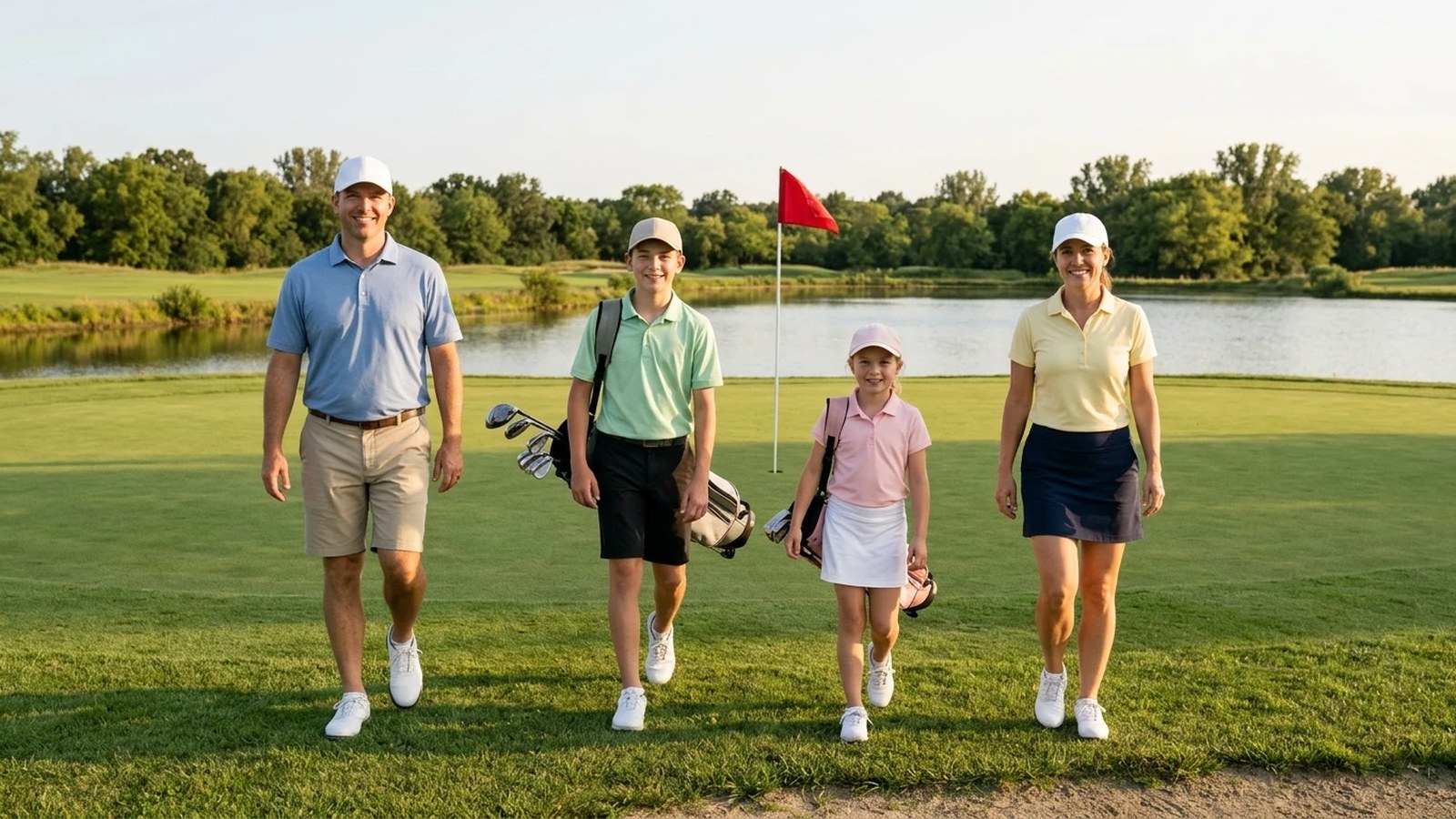

Every golf parent knows the trip that suits one golfer in the family and nobody else: a championship course, a long morning, and a child who has had enough by the turn. The best destinations for golf and family fun work the other way round. The golf is sized for a child, juniors pay little or nothing, and the hours after the round are as good as the round itself. This guide covers eight places around the world that get that balance right.
I’m Al. I trained and taught high school mathematics and science, and these days I’m a stay-at-home dad in Australia to two boys five years apart who have played a decade of junior golf between them. I’m not a travel agent or a golf professional, and this list isn’t drawn from our own family vacations. Every destination here comes from the resorts’, courses’ and tourism boards’ own published details, checked the way I’d check a source in a classroom. What I do bring is knowing what a mixed-age family needs from a round, and that’s the lens for everything below. Read on for the places worth the trip.
⛳🏌️
Bag Boy T-10 Travel Cover
I haven't used this cover myself; I chose it because it sits between a soft cover and a full hard case on protection, price and weight, and it's sold on most continents.
It puts a crush-resistant hard top over the club heads and still rolls through an airport on large wheels.
- Crush-resistant ABS hard top
- Fits up to a 48-inch driver
- 9.6 lb, large in-line skate wheel
What Makes Destinations For Golf And Family Fun Work
Start with a course a child can finish: A full 18 holes from the forward tees is still a long morning for a seven-year-old. Most destinations on this list have something shorter. Pinehurst's The Cradle is nine holes of 45 to 120 yards (opens in a new tab), Big Cedar Lodge's Mountain Top is 13 par-3 holes with an average round of about two hours (opens in a new tab), and Balgove at St Andrews is a nine-hole, par-30 course (opens in a new tab). A round that ends before a child's energy does is the one they'll want to play again tomorrow.

Match the course length to the child's drive: The USGA and the PGA of America's Tee It Forward initiative asks golfers to play a course length that matches their driving distance (opens in a new tab). Its published chart pairs a 100-yard drive with an 18-hole course of 2,100 to 2,300 yards (opens in a new tab), and a 150-yard drive with 3,500 to 3,700 yards. That's why a short course on site matters: for most children it's the closest they'll get to a length that fits their drive. Where a resort does list junior tees, check the number: Disney's Oak Trail lists junior tees (opens in a new tab) at 1,713 yards for its nine holes.
Check what juniors pay before you book: Junior pricing varies far more than adult green fees. Pinehurst lets two kids per paying adult play free (opens in a new tab) on most of its courses, Myrtle Beach runs a summer Kids Play Free (opens in a new tab) program across more than 50 courses, and Youth on Course members in the US, Canada and Australia can play participating courses for $5 USD or less (opens in a new tab) a round. Every one of those offers turns on the details — an age cutoff, a paying adult, a season — so read the terms, not just the headline.
Plan the other half of the day first: The hours after golf decide whether the trip works for everyone. Pinehurst has a lake with sandy beaches and playgrounds (opens in a new tab), Big Cedar lists cave tours and fishing (opens in a new tab) among its activities, and the northern Gold Coast is promoted as Australia's theme park capital (opens in a new tab). Big Cedar even lets non-golfers walk along free (opens in a new tab) at Mountain Top. A destination where the non-golfers have their own plan is one where nobody spends the afternoon waiting at the clubhouse.
Short courses are where new golf is being built: In the US, the National Golf Foundation says par-3 courses make up only about 5 percent (opens in a new tab) of the country's golf supply but almost a third of the limited new development. For families, that's welcome news, because more resorts are building the kind of course a parent and a young child can play together.
The family round is its own kind of round: My two boys are five years apart and have almost never been at the same stage, so a round that suits one rarely suits the other. They still play together happily and often. What makes it work is that nobody is trying to win and the older one isn't treating it as practice. Playing off handicap puts a genuine contest back on the table, and the younger one wins often enough for it to matter. Around the green the gap disappears, because putting and chipping don't depend on being bigger or stronger. So a short course or a putting green suits a mixed-age family better than a famous layout.
Leave the lessons at home: There's a point where being Dad and being the person correcting a grip stop fitting together, and I've had to step back from it more than once. On a family trip the round is the treat, so the usual advice on coaching your own kids applies twice over: keep it short, keep it light and save the technical fixes for a coach back home.
With those tests in mind — a short course, the right length, fair junior pricing and something for everyone afterward — here's how the North American destinations on this list measure up.
Family Golf Destinations In North America
Pinehurst puts its shortest course first: Pinehurst Resort in North Carolina, US, built The Cradle, a nine-hole short course with holes from 45 to 120 yards (opens in a new tab), where kids play free with a paying adult. Two kids per paying adult also play free on Nos. 1, 3, 5, 6, 7, 8 and 9, with an extra per-child fee on Nos. 2, 4 and 10. The resort's page says kids under 17 play free (opens in a new tab) with a parent, while the free room offer covers kids 17 and under, so if you have a 17-year-old, ask whether they golf free too.
A free putting course and a lake for the afternoon: Thistle Dhu, Pinehurst's 18-hole putting course, is free to play (opens in a new tab), and the starter hands out putters and balls. A child who isn't ready for a full hole can still play a real course on a green, and a few simple golf games for kids stretch it into an afternoon. Away from golf, the resort lists Lake Pinehurst's beaches and playgrounds, pools and kids' bikes, and kids 17 and under stay free when sharing a room (opens in a new tab) with a parent.
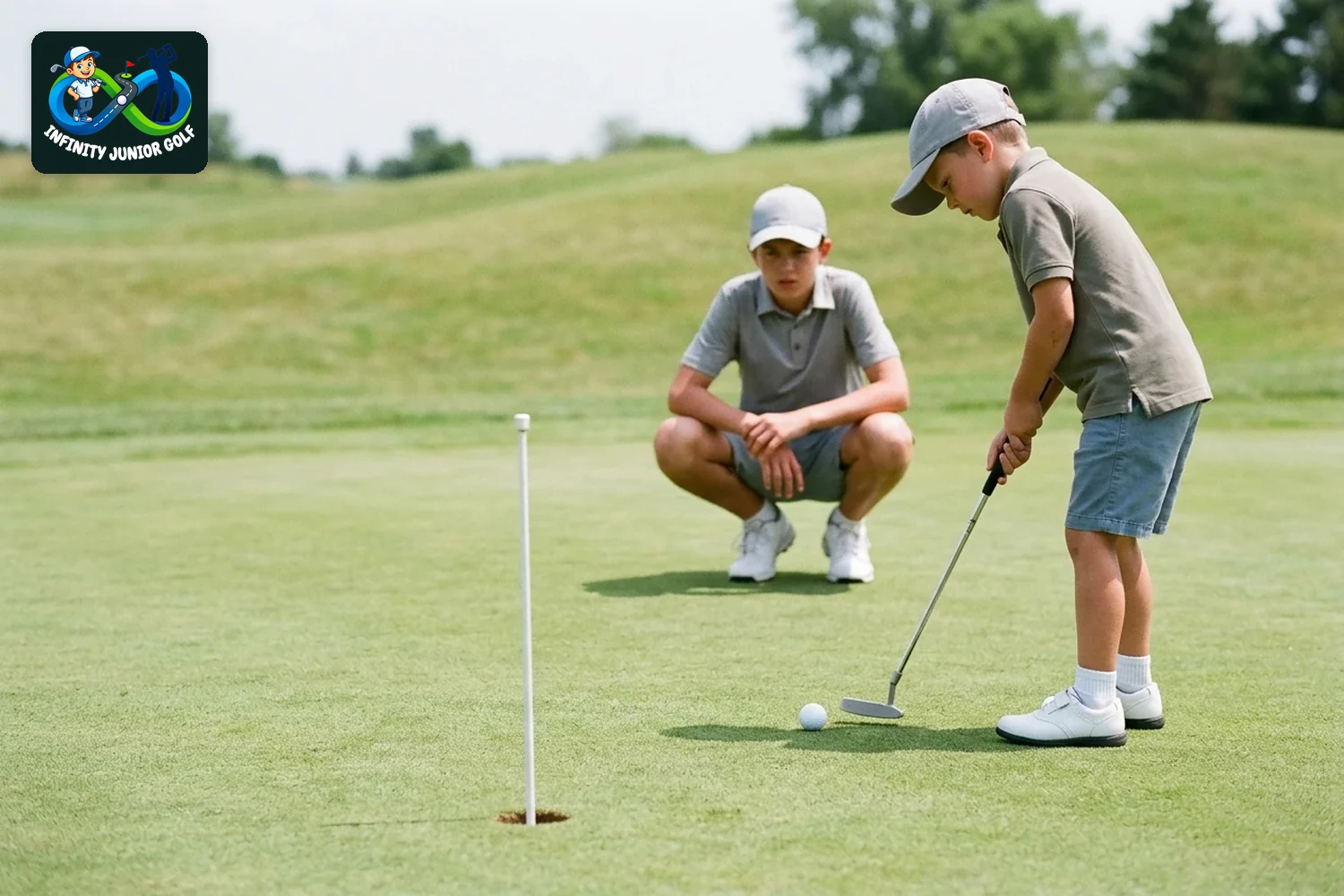
Myrtle Beach makes summer golf free for kids: In South Carolina, US, Play Golf Myrtle Beach brought back its Kids Play Free program for summer 2026 (opens in a new tab), with juniors 16 and under playing more than 50 courses free alongside a paying adult. Most courses run it in June, July and August on a one-to-one basis (opens in a new tab), one child per paying adult, and some limit it to afternoons. The official program page adds that it's available to Youth on Course members (opens in a new tab) and that some courses set the age at 15 and under or 14 and under, so check each course before you assume.
Disney's walking course fits a theme park trip: At Walt Disney World in Orlando, Florida, US, Disney's Oak Trail is a nine-hole walking course (opens in a new tab) that Disney describes as family-friendly, with junior tees at 1,713 yards. Since May 2025, Youth on Course members have been able to play it for $5 a round (opens in a new tab), under what Youth on Course calls a limited-time partnership, so check it's still running before you plan around it. Nine holes on foot slots neatly into a day at the parks.
Big Cedar Lodge builds its golf for families: In Missouri's Ozark Mountains, US, Big Cedar Lodge's Mountain Top is 13 par-3 holes (opens in a new tab) designed by Gary Player and Johnny Morris for families, juniors and newer golfers. It's walking only, the average round takes about two hours and the full loop is under 2 miles, so a lightweight junior bag matters more here than a cart. The resort also has Top of the Rock, a Jack Nicklaus par-3 course (opens in a new tab), and a nine-hole Tom Watson putting course.
Plenty to do once the clubs are put away: PGA.com lists fishing, cave tours (opens in a new tab), hiking, mini golf, bowling, arcade games, bumper cars and a ropes course at Big Cedar. The Mountain Top page lists no junior green fees (opens in a new tab), so ask about children's rates when you book rather than assuming they're free.
North America has the deepest bench of family golf resorts, but it isn't the only place to find them. Across Europe, Australia and New Zealand, the same ingredients turn up in different forms.
Family Golf Destinations In Europe, Australia And New Zealand
Balgove is the gentle side of St Andrews: In Scotland, UK, Balgove is the only nine-hole course (opens in a new tab) at St Andrews Links: par 30, 1,492 yards, and run mainly for families, children and beginners. Green fees for 2026–27 are £15 GBP for adults and £5 GBP for under-16s from late April to mid-October, and £8 GBP and £3 GBP the rest of the year. Visitors can’t book Balgove instantly online. Instead, you fill in the tee time request form (opens in a new tab) and the reservations team gets back to you; for a date within the next two weeks, email or phone them directly.
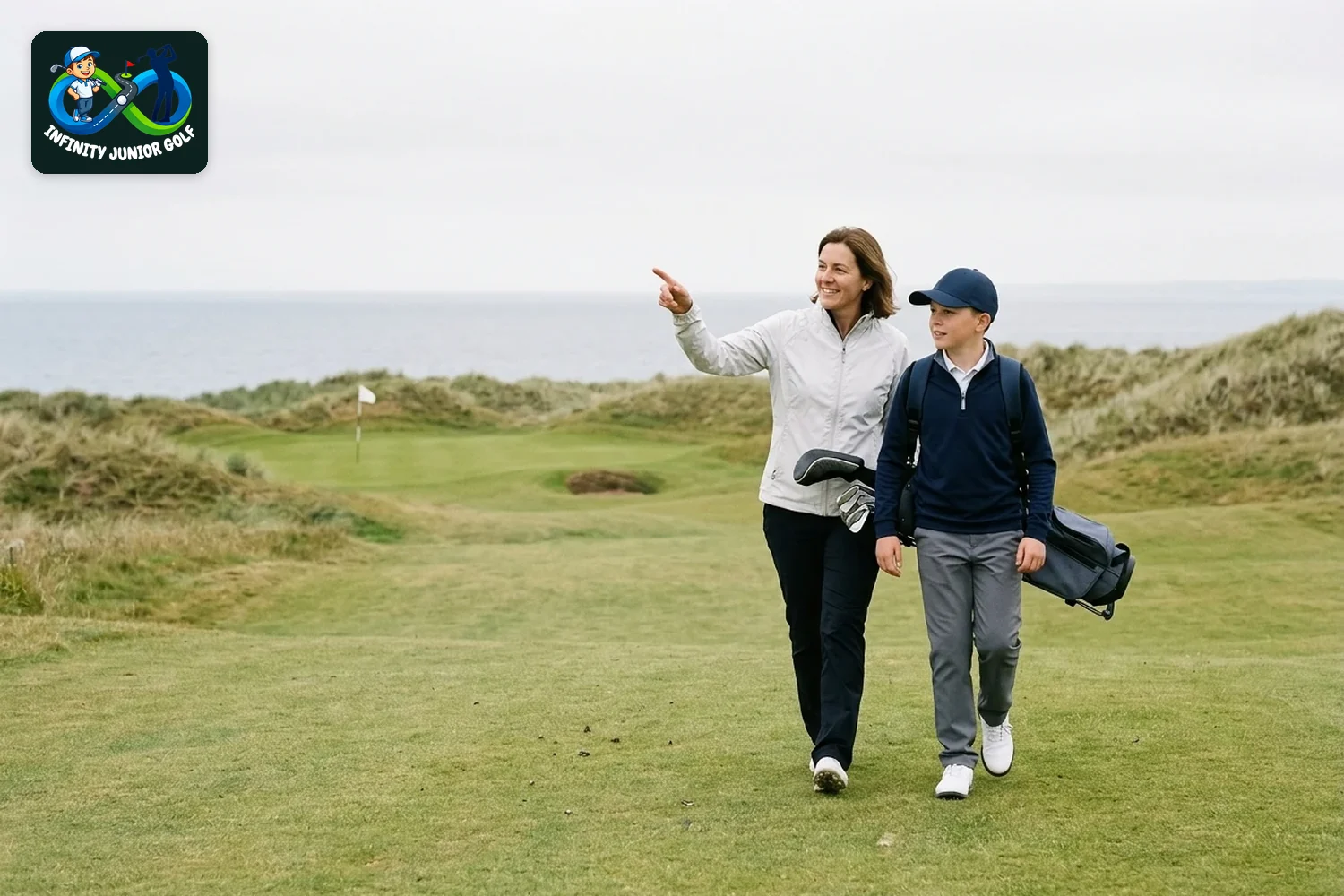
Putting on the Himalayas costs pocket money: Between the Old Course and the West Sands beach, the St Andrews Ladies' Putting Club's Himalayas course is open to the public (opens in a new tab) on weekends in March and daily from April to October. A round costs £4 GBP for adults and £2 GBP for under-16s and seniors, at a club founded in 1867. Scotland has its share of famous family-friendly courses, but for a child under about ten, a putting course and a beach make a full afternoon.
The Algarve pairs a cliff-top nine with a junior program: In Portugal, Pine Cliffs Resort near Albufeira has a nine-hole Martin Hawtree course (opens in a new tab) set 200 feet above the Atlantic, including the par-3 sixth, Devil's Parlour, a 197-meter carry over the cliffs that the adults can attempt while the children watch. Its Golf for Juniors coaching runs on weekday afternoons in July and August and in two October weeks in 2026, and the resort lists Porto Pirata under family and kids alongside an adventure park (opens in a new tab) designed for all ages. Golfbreaks notes a children's village (opens in a new tab), pools and water sports, and puts the resort about 35 minutes from Faro Airport.
The Gold Coast mixes theme parks with short golf: In Queensland, Australia, Experience Gold Coast counts over 35 courses (opens in a new tab) and calls the northern Gold Coast Australia's theme park capital. Parkwood and Emerald Lakes both have mini golf (opens in a new tab), Meadow Park is a nine-hole course from $26 AUD, and Topgolf at Oxenford is pitched at groups who have never swung a club (opens in a new tab). That range, from mini golf to full courses, gives every age in the family something to play.
Queenstown has short golf and a luge: In New Zealand's South Island, The Hills has a nine-hole par-3 farm course (opens in a new tab) designed by Darius Oliver, and Gibbston Valley has a nine-hole course (opens in a new tab) by Greg Turner. Off the course, Skyline Queenstown's luge lets children ride alone from age six and over 110 cm (opens in a new tab) tall, with children from age two riding with an adult.
Southern seasons run the other way: The Gold Coast and Queenstown are in the southern hemisphere, so their summer falls in the northern winter. Queenstown shows why that matters: Jack's Point, one of its championship courses, closes for winter maintenance (opens in a new tab) from early June to mid-August. Living in Australia, we're outdoors while much of North America is not, and a family from the north can use that by heading south for its own winter break.
Wherever you end up, two jobs come before the first tee: getting the clubs there in one piece and, if you'd rather not assemble the trip yourself, booking it. Here's where to find help with both.
Brands and Tools That Help Juniors Thrive — Our Recommendations
Every item below helps with the practical side of a family golf trip, from getting clubs through an airport to booking the trip itself. Prices were checked on each retailer's own site in October 2026, and where a retailer ships within one country, it's noted.
Bag Boy
About
Bag Boy makes push carts, golf bags and travel covers, sold direct in the US and through distributors worldwide (opens in a new tab). Its covers run from budget soft cases to hard-top models, so a family can choose by how often it flies.
Our recommendation
The T-10 Travel Cover (opens in a new tab) has a crush-resistant ABS top, large in-line skate wheels and a 9.6 lb build for $229.95 USD. I haven't used one; I picked it as the middle ground between soft and hard cases, and its limits are the weight and a thin owner-review base. Bag Boy's own store gives US delivery times (opens in a new tab) only.
Golfbreaks
About
Golfbreaks is a golf travel company that packages accommodation and tee times, with listings that include St Andrews' Balgove (opens in a new tab) and Pine Cliffs from this guide. It suits a family that wants someone else to assemble the trip.
Our recommendation
Its Pine Cliffs Resort (opens in a new tab) page lists the nine-hole cliff-top course, a children's village and pools in the Algarve. Packages are priced on request, so it's a service for convenience rather than for hunting the lowest price.
Decathlon
About
Decathlon is a sporting goods retailer that sells its own INESIS golf range through national websites. This listing is from its UK site, and the same cover is on its Irish site (opens in a new tab) at €125 EUR.
Our recommendation
The INESIS rolling cover (opens in a new tab) holds two small golf bags or one large one and costs £99.99 GBP, rated 4.5 from 38 reviews. Two junior bags in one cover can mean one checked item instead of two; it rolls on two wheels rather than four, and readers outside the UK and Ireland should check their own country's Decathlon site.
Worldwide Golf Shops
About
Worldwide Golf Shops is a US golf retailer that ships internationally at a flat $100 USD (opens in a new tab) per order, with duties paid by the buyer. It carries travel covers from budget to premium.
Our recommendation
The Izzo Padded Travel Cover (opens in a new tab) weighs about 2 lb and collapses to 7.5 inches for storage, for $49.99 USD. It's the cheapest option here for a family that flies once a year; no wheels are listed and it offers less protection than a hard top. For a family that flies more often, the ClubGlider Meridian (opens in a new tab) has legs that extend and retract in one motion, pivoting wheels and an 11.3 lb build, for $380.00 USD. A bag that stands and rolls on its own frees a parent's hands for children and suitcases; it's the most expensive cover here. Outside the US, the shipping fee costs more than the Izzo itself.
Golf Galaxy
About
Golf Galaxy is a US golf retailer that sells travel accessories alongside covers. Its site doesn't state international shipping, so treat it as a US option.
Our recommendation
The Bag Boy Backbone (opens in a new tab) is a telescoping support with an oversized top cap that protects club heads inside a soft cover, adjusting up to 54 inches, for $29.99 USD, rated 4.8 from 231 reviews. It adds protection for little money; it's a second Bag Boy product in this table.
A good cover and a booked trip take care of the logistics. What's left is the planning that decides whether the vacation works on the day: flights, seasons, the sun and what the kids' golf actually costs.
Planning A Family Golf Trip That Works
Check the airline before the bag: Airlines handle golf clubs in different ways, so the rules on your ticket are the ones that count. Qantas carries golf bags as checked baggage, exempt from size limits (opens in a new tab) on its own flights, with a 32 kg (70 lb) maximum per piece. British Airways counts golf equipment as one checked item (opens in a new tab) where the ticket includes checked baggage, which its Economy Basic fares don't, and treats it as oversize, so it goes to the out-of-gauge drop at least three hours before a long-haul flight or two hours before a short-haul one.
Protect the club heads, not just the bag: A travel cover's job is to stop a club head or shaft breaking in the hold. A hard-top cover such as the Bag Boy T-10 puts a crush-resistant ABS top (opens in a new tab) over the club heads.
🏌️
Bag Boy T-10 Travel Cover
For a family flying with one or two sets, I'd pick it because the hard top protects the club heads without the bulk of a full hard case.
- Crush-resistant ABS top
- Large in-line skate wheels
- One-year limited warranty
A cheaper fix for a soft cover: A telescoping support such as the Bag Boy Backbone (opens in a new tab) sits in the bag and carries an oversized top cap above the club heads, adjusting up to 54 inches. With a soft cover, it's the inexpensive way to add some of a hard top's protection.
Two small bags can travel as one: Decathlon says its INESIS rolling cover holds two small golf bags (opens in a new tab) or one large one. For a family with two juniors, that can turn two checked items into one, as long as the combined weight stays inside the airline's limit, which on Qantas is 32 kg per piece (opens in a new tab).
Renting works, but ask about junior sizes: Big Cedar rents clubs for $60 USD (opens in a new tab) with two sleeves of balls, but its page doesn't say whether junior sizes are available. Ask before you leave your child's clubs at home, because clubs that are too long or too heavy make a short course harder, not easier.
Seasons decide what's open: Myrtle Beach's free junior golf runs mostly in June, July and August (opens in a new tab), Pine Cliffs' junior coaching runs in July and August (opens in a new tab) and two October weeks, and the Himalayas putting course in St Andrews opens daily from April (opens in a new tab) to October. In the southern hemisphere, Jack's Point in Queenstown closes from early June to mid-August (opens in a new tab). Check those dates against your travel window before you book anything you can't change.
Keep golf out of the midday sun: The American Academy of Pediatrics advises limiting sun exposure (opens in a new tab) between 10 a.m. and 4 p.m., using broad-spectrum sunscreen of SPF 15 to 50, and reapplying every two hours and after sweating. It also suggests a hat with a brim about 3 inches (opens in a new tab) wide all the way around. A short-course round of about two hours (opens in a new tab) fits before or after that window, and the essentials from packing for junior golf — water, sunscreen and a hat — go in the bag on vacation too.
Book the kids' rate, not just the tee time: Free and discounted junior golf almost always depends on a paying adult and on asking for it. Pinehurst's free golf applies per paying adult (opens in a new tab), two kids for each, and Play Golf Myrtle Beach points families to a stay-and-play package (opens in a new tab) for the best value. Youth on Course membership averages $5 to $65 USD (opens in a new tab) a year depending on region, so it's worth checking before a trip with several rounds, and it fits alongside everything else in keeping junior golf affordable.
Give the brother or sister who isn't playing a plan: Junior tournaments here in Australia taught me that nobody warns you about the logistics: travel, accommodation and a whole weekend structured around one child's tee time. Our younger son spent a lot of those weekends at courses he didn't pick, and he genuinely enjoyed being there, which made it far easier than it might have been. Watching his brother compete was part of how he came to the game himself. That isn't guaranteed, so on a family trip it's worth planning something that belongs to the child who isn't on the tee sheet.
Once the flights, the seasons and the gear are sorted, the rest comes down to small decisions on the day. The tips below gather the most useful ones in one place.
Our Practical Tips For You
These ten tips pull the guide together into steps you can use while you plan.
What to do
| Tip | How to do it | Why it matters |
|---|---|---|
| Build the trip around a short course | Choose a destination with a par-3 or nine-hole course on site. Play it before the big course. | A round of about two hours (opens in a new tab) ends before a child's energy does. |
| Ask what juniors pay | Ask about kids-play-free when you book. Confirm the age cutoff. | Pinehurst lets two kids per paying adult play free (opens in a new tab) on most courses. |
| Join Youth on Course if you can | Sign up if you live in the US, Canada or Australia. Carry the membership card. | Members play participating courses for $5 USD or less (opens in a new tab). |
| Pick tees by driving distance | Estimate your child's drive. Use the Tee It Forward chart to choose a length. | A 100-yard drive suits about 2,100 to 2,300 yards (opens in a new tab) over 18 holes. |
| Plan the non-golf half first | Decide the afternoon before booking tee times. Give non-golfers their own plan. | Some resorts let non-golfers walk along free (opens in a new tab). |
| Read your airline's golf rule | Check the sporting equipment page for each airline. Note the bag drop times. | British Airways wants oversize bags dropped three hours before (opens in a new tab) long-haul flights. |
| Share a cover where it fits | Use a large cover for two small junior bags. Stay under the weight limit. | Decathlon's cover holds two small bags (opens in a new tab). |
| Play outside the midday sun | Book early or late tee times. Reapply sunscreen every two hours. | The AAP advises limiting midday sun (opens in a new tab) from 10 a.m. to 4 p.m. |
| Check seasonal dates | Confirm program and opening dates for your travel window. Remember southern seasons run opposite. | Jack's Point closes early June to mid-August (opens in a new tab). |
| Keep the family round friendly | Play off handicap, or don't keep score at all. Leave coaching for later. | It keeps a mixed-age round fair and fun for both players. |
Tips are the quick version. If a particular question is still on your mind, the answers below cover the ones parents ask most.
FAQs
Here are short answers to the questions parents ask most about family golf trips.
Do kids really play golf free at resorts?
Some do, always with conditions. Pinehurst lets two kids per paying adult play free (opens in a new tab) on most of its courses, and Myrtle Beach's Kids Play Free covers juniors 16 and under (opens in a new tab) with a paying adult, mostly in summer.
How young is too young for a vacation short course?
There's no fixed age. A free putting course such as Pinehurst's Thistle Dhu (opens in a new tab) suits the youngest, and the Tee It Forward chart pairs a 100-yard drive with about 2,100 yards (opens in a new tab) over 18 holes, so a short par-3 course suits a child who hits the ball 50 to 100 yards.
Do golf clubs count as checked baggage?
Usually, yes. Qantas carries golf bags as checked baggage (opens in a new tab) and British Airways counts golf equipment as one checked item (opens in a new tab), with relaxed size rules but normal weight limits.
What if one of us doesn't play golf?
Pick a destination where non-golfers have their own day. Big Cedar lets non-golfers walk Mountain Top free (opens in a new tab), and the northern Gold Coast is promoted as Australia's theme park capital (opens in a new tab).
Our Related Articles

Top 10 Golf Courses Perfect For Family Outings
Golf has always been a sport that brings people together, but there’s something truly special about sharing the fairway with your family. Whether you’re
Read article

The Do’s And Don’ts Of Coaching Your Kids In Golf
Getting your child into golf is one thing. Staying in the fairway as their coach, cheerleader, and occasional critic is another thing entirely. The
Read article

How To Make Junior Golf Affordable For Families
Golf has a reputation for being expensive, and I won’t pretend that reputation came from nowhere. By the time you factor in clubs, green
Read article
Conclusion
The best destinations for golf and family fun aren't the ones with the most famous course. They're the ones where a child can play a short round that ends while it's still fun, where juniors pay little or nothing alongside a parent, and where the rest of the family has its own reasons to be there. Pinehurst, Myrtle Beach, Walt Disney World, Big Cedar, St Andrews, the Algarve, the Gold Coast and Queenstown each strike that balance in their own way. Sort out the airline rules, the season and a decent travel cover before you go, and the trip has a good chance of suiting everyone in it.
Where has your family found golf that suits every age — and what made it work for the youngest player?
