
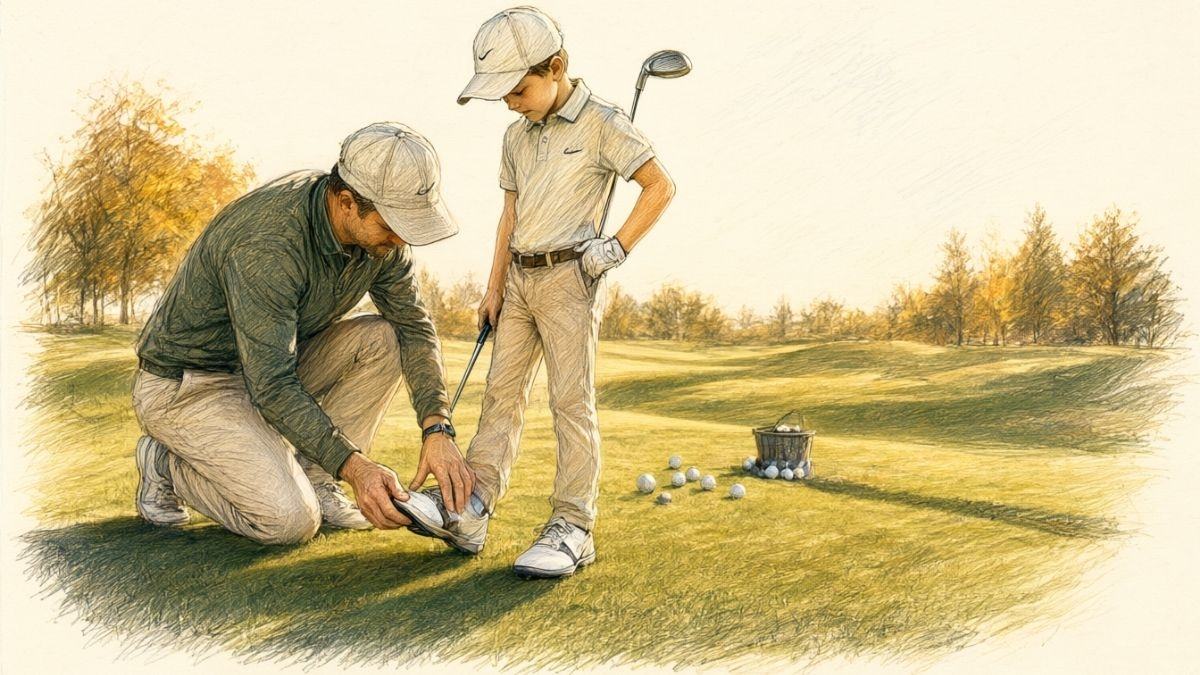

Testing junior golf shoes for comfort and durability is something most parents do by accident — a pair goes on a foot, gets worn for a season, and either holds up or doesn’t. This review runs that process on purpose, using one specific pair, the FootJoy Junior’s Traditions, as the worked example, and it gives you the checks to run yourself on whatever pair you’re actually looking at.
I’m Al — I trained and taught high school math and science, and I’m a stay-at-home dad now, not a club fitter or a touring professional. I’ve bought junior golf equipment for two boys five years apart, and what I bring to a review like this is a teacher’s habit of reading the spec sheet before I read the marketing copy. I haven’t worn this particular pair myself, so what follows is what the manufacturer specifies, what the published research says about junior feet and golf swings, and what a handful of owners report — read on and I’ll show you exactly where each claim comes from.
⛳🏌️
FootJoy Junior’s Traditions Golf Shoes
Best for: roughly ages 6 to 14, beginner to intermediate, playing several rounds a week or competing over consecutive days
I haven’t tested this pair myself, so this rating rests on FootJoy’s own specification sheet, a small base of owner reviews, and how the price stacks up against a shoe a growing foot will likely outgrow before it wears out.
- ✅ Replaceable Fast Twist 3.0 cleats mean the traction element is a consumable part, not the whole shoe’s lifespan
- ✅ A junior-specific last with a molded EVA fitbed, rather than a scaled-down adult shape
- ✅ A stated one-year waterproof warranty, where some cheaper rivals in this category carry none at all
- ✅ One year is the shorter of FootJoy’s two warranty tiers, it covers United States purchases only, and Medium is the only width offered
| ~$84.95 USD | Mid-range
👉 Buy FootJoy TraditionsWhat You’re Getting
FootJoy has been making golf shoes since 1857, when the company began in Brockton, Massachusetts as the Burt and Packard Shoe Company, and the FootJoy name itself dates to 1923, according to FootJoy’s company history. The brand’s junior line sits underneath a much larger adult business — FootJoy states it has held the top spot in FootJoy’s own tour count at PGA Tour events since 1945, and Acushnet Company bought the brand outright in 1985. None of that tour history says anything about how a junior shoe performs, but it explains why the name is the one most parents already recognize at the shop.
The junior range itself is narrower than the adult one. At the time of this review, FootJoy’s FootJoy’s junior shoe page lists a single current model — the Traditions Junior, style 45035 in the United States. A companion spikeless model, the FJ Fuel Junior, still turns up at several retailers but the manufacturer’s own product page for it now returns a “page not found” result, which is a reasonable signal that it’s being phased out. What you get in the box is straightforward: one pair of laced golf shoes, no extra spikes, no travel bag, no accessories.
The shoe itself is built on a junior-specific last — FootJoy’s FootJoy’s product specification page describes a full rounded toe, a standard forefoot and instep fit, a slightly narrow heel and added toe spring for what the company calls an athletic profile. The upper is described as “soft, easy care synthetic,” with a foam Achilles pad, a molded high-density EVA fitbed, and an EVA midsole for cushioning. The outsole is FootJoy’s own Duramax rubber compound, paired with a Fast Twist 3.0 cleat system carrying Softspikes’ Pulsar inserts. FootJoy’s FootJoy’s warranty page states the shoe carries a one-year waterproof warranty for United States purchases, which sits on the shorter of the company’s two warranty tiers.
Pricing runs $84.95 USD at most United States retailers, in youth sizes 1 to 6, Medium width only, in white with a gray or white/gray colorway depending on the retailer. Outside the United States, the same shoe — listed under style 45037 rather than 45035, a discrepancy no retailer page explained — is available in the United Kingdom for £64.99 GBP at Discount Golf Store, and directly from FootJoy’s European store for €110 EUR, though that store currently ships only to the Netherlands and Spain. Whether the two style numbers reflect a genuine specification difference or just a regional SKU wasn’t something any product page settled, so treat the two as the same shoe until a retailer says otherwise.
That’s the shoe on paper. What matters next is how much of that paper actually holds up when a junior wears it into the ground — or, more accurately, outgrows it long before that happens.
Key Features
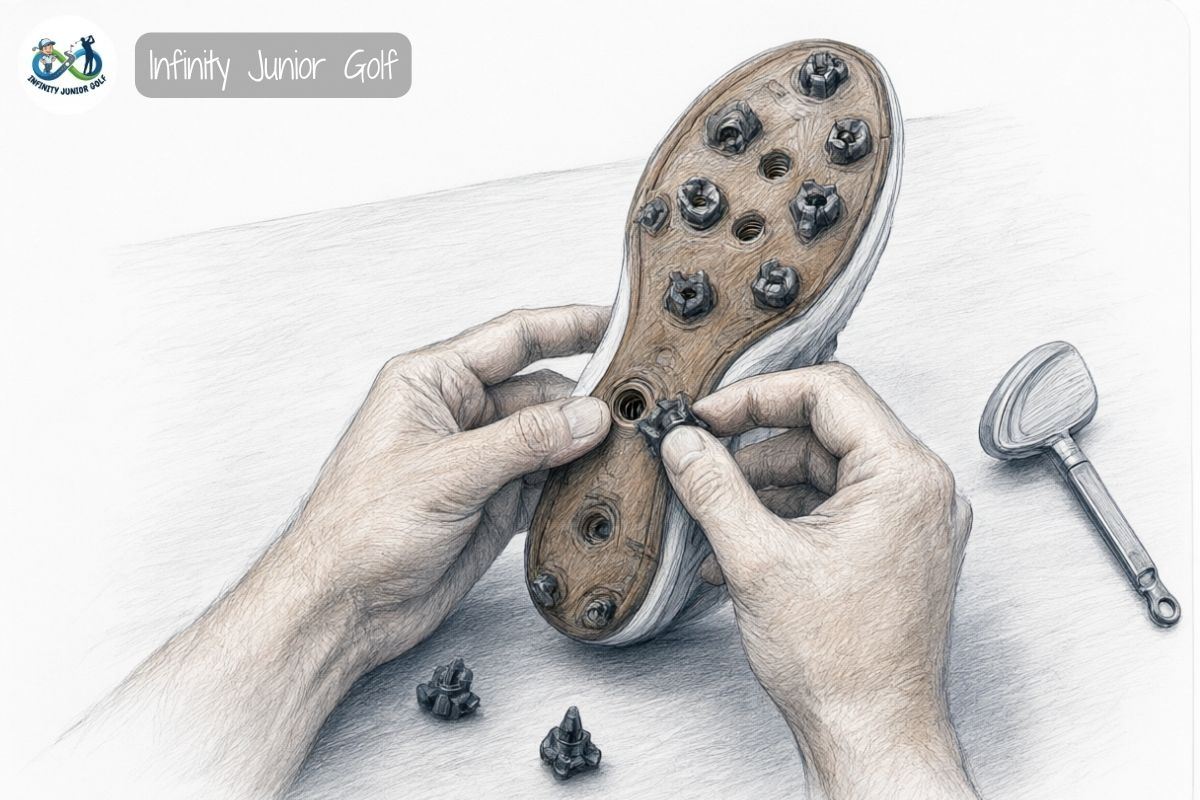
Fast Twist 3.0 cleats turn the traction system into a consumable, not a verdict: The Pulsar spikes on this shoe screw in and out of threaded sockets, which means the part of the shoe doing the most physical work — pushing back against the ground — can be replaced without replacing the shoe. That matters more than it sounds like it should. A ground reaction force study reviewing golf swing biomechanics found that more skilled golfers generate meaningfully higher ground reaction force than less skilled ones, with the trail foot alone bearing roughly 92 percent of body weight during the backswing for skilled players against about 76 percent for less skilled ones. A junior learning to weight shift through impact is, in a very literal sense, learning to load a shoe, and a shoe that can’t hold that load undoes whatever else it does well. Spikes are permitted but not required under the USGA Equipment Rules, so this is a performance choice rather than a compliance one. Softspikes’ own guidance recommends spike changing frequency of roughly every 15 rounds, or about twice a season, and Golf Digest’s reporting on shoe longevity puts the figure at make golf shoes last 15 to 20 rounds, quoting a Softspikes product manager’s comparison: replacing spikes is like changing tires rather than buying a new car. Here’s the honest complication: a junior playing a full competitive season might reach that first cleat change. A junior playing casually almost certainly won’t, which means this shoe’s best durability feature is one a lot of buyers will never actually use.
🏌️
Replaceable cleats and a junior-specific last are the two features that separate this from a generic kids’ sneaker with spikes bolted on.
- ✅ Duramax outsole for durability
- ✅ Fast Twist 3.0 cleats you can actually replace
The Duramax outsole is a named compound, not a measured result: FootJoy’s outsole specification details describe Duramax as providing flexibility and comfort, and retailer listings for the same style add that it offers durability and traction. What none of those sources publish is a wear rating, an abrasion test, or any comparison against a rival compound — for the junior version specifically, this is a brand’s description of what the material is for, not independent evidence of how long it lasts. That’s not a criticism unique to this shoe; almost no junior golf shoe on the market publishes that kind of data. It just means the durability claim here is a specification, and it should be read as one.
A one-year waterproof warranty is real, but read the fine print before you rely on it: FootJoy’s FootJoy’s warranty terms state the company “warrants that certain FootJoy golf shoes purchased in the United States will be waterproof in normal use for two years or one year (depending on the actual style purchased),” and the Traditions Junior sits on the shorter, one-year tier. The warranty applies specifically to shoes purchased in the United States, and it excludes damage described as scuffing from toe drag and cracking caused by lack of maintenance — which is a fair description of how a lot of children actually wear a golf shoe by the end of a season. A wet morning at the range is exactly the situation this feature is built for, and it’s a genuine point in the shoe’s favor against cheaper rivals that carry no waterproof claim at all.
The junior last is a real fit advantage, and the single width is a real limitation on the other side of it: FootJoy specifies a shoe fitting guide recommendation of roughly half an inch of space between the longest toe and the end of the shoe, alongside its own junior-specific last with a rounded toe and added toe spring — a shape built for a child’s foot rather than shrunk down from an adult one, which not every junior shoe bothers with. Set against that: this shoe comes in Medium width only. FootJoy’s own fitting guide states that nearly 40 percent of people are wearing shoes narrower or wider than they actually need, which makes a single-width offering a real constraint for a genuinely narrow or wide-footed junior, not a minor technicality. The same lesson applies to sizing a first set of clubs: get the fit right before you weigh up the brand, because a set — or a shoe — that doesn’t fit undoes whatever else it has going for it.
None of that tells you what this shoe feels like on a foot that’s actually walking eighteen holes, which is the harder and more useful question.
How It Performs in Real Life
Checking the fit is the first test, and it happens before a single hole is played: Rather than take FootJoy’s word for the last shape, the actual test is the one you can run in the shop or at home: stand the child up in the shoes, check for the half-inch of toe room the fitting guide describes, and watch for heel slip when they walk a few steps. A 2025 footwear guidelines review that examined published recommendations for children’s footwear found toe-allowance guidance ranging from 5 to 12 millimeters up to 17 millimeters across different sources, and noted plainly that every one of those figures rests on expert consensus and practical advice rather than controlled evidence. FootJoy’s half-inch, or roughly 12.7 mm, sits comfortably inside that range — but the range itself is opinion, carefully accumulated opinion, not a settled number, and a children’s footwear research review reaches a similar conclusion about how thin the underlying evidence base for children’s shoe fit actually is. That’s worth knowing before you trust any fitting rule, including this one, as though it were exact.
Walking eighteen holes is a longer test than most parents expect it to be: A round of golf played on foot involves steps per round research putting the figure at over 11,000 to 12,000 steps, and separate reporting from the Golf and Health project puts the walking distance at more than 8 kilometers per round without a cart, dropping to 3.86 kilometers where a cart is used. A junior playing a tournament weekend might do that two or three times over. That’s the real test of comfort — not how a shoe feels standing in a shop, but how it feels on the sixteenth hole of the second round.
Shoes were the thing I under-bought for longest. Cheap golf shoes across a full competitive season is a false economy — comfort and grip over four rounds in a weekend are worth paying for, and it took me a while to work that out. The complication is that a growing child almost always outgrows shoes before wearing them out, which makes it hard to justify spending. My answer now is to buy well and accept a short life, because the pair is being outgrown rather than destroyed — which means it still has value to someone else, and the secondhand market for junior golf shoes is better than most people realize for exactly that reason.
That trade-off is exactly the one this shoe puts in front of you: At $84.95, this is not the cheapest junior golf shoe on the market, and the one-year waterproof warranty roughly matches how long the shoe will actually fit a child who’s still growing — which means most buyers will never file a warranty claim, because the shoe will be outgrown before the warranty would matter. What justifies the price is the last, the replaceable cleats, and the stated waterproof performance. What doesn’t fully justify it is a lack of any published durability data beyond the material names themselves. Golf Monthly’s 2026 roundup of kids’ golf shoes doesn’t include the Traditions Junior among its five picks, and the roundup’s overall lean is toward spikeless shoes for juniors — a genuinely different answer to the same problem, and one worth weighing before you commit to a spiked shoe.

Owner feedback is thin, but what exists points the same direction as the specification sheet: Scheels customer reviews for this exact model show four reviews at a five-star average, with buyers describing it as “true to size” and calling out comfort specifically — which is a small sample, not enough to call it aggregated evidence, but it’s consistent with what the specification claims rather than contradicting it.
Fatigue rarely comes from one piece of gear alone: A lightweight junior bags choice solves a related problem from the shoulders down; these shoes solve it from the ground up, and a junior who’s tired from carrying too much bag will judge their shoes unfairly no matter how good those shoes actually are.
Consecutive tournament days are where this shoe’s price tag is easiest to justify: A junior playing one round on a Saturday feels the difference between a good and a mediocre golf shoe far less than one playing two or three rounds back to back, which is exactly the situation packing for a tournament is built around — comfort and grip compound over a weekend in a way they simply don’t over a single nine.
The real cost of outfitting a junior golfer runs well past the price on any one tag: What junior golf costs over a full season is worth weighing alongside this review before deciding whether $84.95 for a pair of shoes a growing foot will outgrow in a year is reasonable — the fuller picture is in what junior golf costs.
A long walk also asks something of the body beyond the feet, and lower-body stability work is a reasonable companion piece for a family thinking about fatigue on the back nine, not just footwear.
Pros and Cons
Pros:
- Replaceable Fast Twist 3.0 cleats mean the traction system can be renewed rather than replacing the whole shoe
- A genuinely junior-specific last, not a scaled-down adult shape — full rounded toe, standard forefoot and instep, added toe spring
- A stated one-year waterproof warranty, where several cheaper rivals in this category carry none
- Foam Achilles pad, molded high-density EVA fitbed and EVA midsole all specified for comfort, not just implied by marketing language
- FootJoy’s junior line is small, so a family sticking with the brand as a child grows should find sizing and successor models easier to track down
Cons:
- Medium width only — FootJoy’s own fitting guide notes that FootJoy’s shoe fitting guide finds nearly 40 percent of people need a different width than they assume, and this shoe doesn’t offer one
- The one-year waterproof warranty is the shorter of FootJoy’s two tiers, and it applies to United States purchases only
- No published wear data, weight figure, or durability test exists for the junior model, from FootJoy or any retailer
- It’s absent from Golf Monthly’s 2026 kids’ golf shoe roundup, whose overall lean favors spikeless models for juniors
This is a shoe with a genuinely strong specification sheet and a genuinely thin evidence trail behind it — both things are true at once, and a buyer should weigh both.
Our Verdict
FootJoy Junior’s Traditions Golf Shoes
The FootJoy Junior’s Traditions earns its price on paper: a junior-specific last, cleats that don’t require replacing the whole shoe when they wear, and a stated waterproof warranty that several cheaper competitors don’t offer at all. What it doesn’t have is any independent evidence — no durability test, no substantial review base, no hands-on account from this site — to confirm that the specification sheet matches the shoe on a foot that’s actually walking a full season.

That leaves the recommendation narrower than the shoe’s own marketing. This is the right buy for a junior playing multiple rounds a week or competing over consecutive tournament days, where the last, the cleats and the waterproofing all get exercised regularly enough to matter. It’s a harder sell for a junior playing occasionally, where a cheaper spikeless shoe will do the same job for less money and get outgrown at the same rate regardless. And it isn’t the shoe for a family with a genuinely narrow- or wide-footed child, since Medium is the only width on offer.
How It Compares
adidas Juniors’ S2G 26 Spikeless
adidas Juniors’ S2G 26 Spikeless is a $64.99 USD spikeless alternative built around a leather-and-synthetic waterproof upper and adidas’s Traxion traction system. It differs from the Traditions in the way that matters most for a growing child: it’s spikeless, so it’s wearable off the course as well as on, and it runs a wider size range at both ends of the scale, from 1.5 up to 6.5. This is the shoe for a junior who plays a few times a month rather than several times a week, or a family who’d rather buy one pair of shoes that works everywhere.
PUMA Junior’s Fusion Crush Sport Spikeless
PUMA Junior’s Fusion Crush Sport Spikeless runs $69.99 USD on a trainer-like chassis, with a removable footbed and PUMA’s FUSIONFOAM cushioning built to feel closer to a sneaker than a traditional golf shoe. It differs from the Traditions on comfort-first construction rather than performance specification — the removable footbed in particular is something the Traditions doesn’t offer at all, which matters for a junior who needs an orthotic or simply prefers a softer step-in feel. This is the shoe for the junior whose complaint has always been comfort rather than grip.
FootJoy Junior’s FJ Fuel Spikeless
FootJoy Junior’s FJ Fuel Spikeless sits at the same $84.95 USD price as the Traditions and shares the same brand, the same junior fit philosophy, and the same one-year waterproof warranty — the difference is spikeless rather than spiked construction. Worth knowing before you buy it: this model appears to be leaving FootJoy’s current lineup. The manufacturer’s own product page for it now returns a “page not found” result, and Worldwide Golf Shops labels its remaining stock “Previous Season Style.” Retailers are still selling it at full price, so this is the shoe for a parent who specifically wants FootJoy’s junior construction without cleats and is comfortable buying a model on its way out.
Set against all three, the Traditions remains the right pick specifically for the junior who plays often enough and competitively enough to use replaceable cleats and a genuine waterproof warranty — everyone else is likely better served by one of the cheaper, more versatile spikeless options above.
FAQs
Here are the questions parents ask most often about junior golf shoes and this category specifically.
Does a junior golfer actually need golf shoes, or will trainers do? Trainers are legal almost everywhere golf is played casually — the USGA Equipment Rules and the R&A equipment rules both permit spikes on the sole without requiring them, subject to a competition’s own conditions. The case for a dedicated golf shoe is traction and comfort over a long walk, not compliance, so trainers are a perfectly reasonable choice for a first few outings. Check the specific rules for any tournament your junior enters, since some events do set their own footwear conditions.
Spiked or spikeless for a junior? Golf Monthly’s 2026 roundup of kids’ golf shoes leans spikeless across its picks, and the practical case is strong for a growing child — a spikeless shoe doubles as an everyday shoe, which spreads the cost of something that will be outgrown within a season. The case for spiked shoes is better grip on wet or sloped ground, and in this specific case, cleats that can be replaced rather than a shoe that has to be. There’s no single right answer; it comes down to how often your junior plays and in what conditions.
How much growing room should I leave when buying junior golf shoes? FootJoy’s FootJoy’s shoe fitting guide recommends about half an inch, roughly 12.7 mm, between the longest toe and the end of the shoe. A 2025 footwear guidelines review found published recommendations ranging from 5 to 12 mm up to 17 mm across different sources, and stated plainly that all of them rest on expert consensus rather than controlled evidence — so FootJoy’s figure sits inside a range that is itself opinion, not a settled standard. Resist the temptation to buy a size up on purpose: the same fitting guide warns that there should be no excess movement in the shoe when a child walks, which is exactly what a deliberately oversized shoe produces.
How long should a pair of junior golf shoes last? For most juniors, the honest answer is that the shoe gets outgrown long before it wears out, so the part actually worth tracking is the cleats rather than the shoe itself. Softspikes recommends spike changing frequency of roughly every 15 rounds, or twice a season, and Golf Digest’s reporting on how to make golf shoes last longer puts it at 15 to 20 rounds for the average golfer. This particular shoe’s one-year waterproof warranty roughly tracks how long it will actually fit a growing child, which is worth knowing going in.
Is it worth buying junior golf shoes secondhand? Across a decade of buying junior golf equipment, the pro shop and the fitter are the two places most people skip, usually on the assumption that they’re for serious adult players — for a junior who’s between sizes or growing quickly, that’s exactly backwards, since those are the places most likely to stop you buying the wrong thing. Secondhand is the answer to the growth problem and it’s badly underused: junior gear gets outgrown, not worn out, so the used market is full of shoes with plenty of life left in them. If you’re buying secondhand or at a distance, check the cleat sockets are undamaged and the inserts still turn, and treat the returns and sizing exchange policy as more important than the price — when you’re buying for a growing child sight unseen, that policy is the feature that actually protects you.
Our Related Articles

How To Make Junior Golf Affordable For Families
Golf has a reputation for being expensive, and I won’t pretend that reputation came from nowhere. By the time you factor in clubs, green fees,…
Read More
What To Pack For A Junior Golf Tournament
Showing up to a junior golf tournament well-prepared can make all the difference between a round filled with frustration and one brimming with confidence. When…
Read More
The Best Lightweight Golf Bags For Junior Players
Getting a young golfer excited about the game is a wonderful thing. But something that doesn’t always get the attention it deserves is the equipment…
Read MoreConclusion
The FootJoy Junior’s Traditions is a well-specified shoe let down slightly by how little independent evidence exists to back that specification up — a strong last, replaceable cleats and a real waterproof warranty, set against no published durability data and a single available width. For a junior playing several rounds a week or competing over consecutive days, it earns its $84.95 price. For a junior playing casually, a cheaper spikeless option will very likely do the same job for less.
Has your junior golfer worn a pair of these, or something similar, and how did they hold up once the season actually got underway?
