



Tiger Woods is widely regarded as the greatest golfer of all time — a 15-time major champion whose dominance reshaped the sport for an entire generation. But the story of how he became that player didn’t start at Augusta National or St Andrews. It started in a garage in Cypress, California, with a toddler, a makeshift net, and a father’s unconditional belief.
Hi, I’m Al — an everyday golfer who fell completely in love with this game and has spent years exploring what makes junior golf development so powerful and so personal. I’m passionate about inspiring young players and the families who support them, and I’m genuinely excited to walk you through Tiger’s incredible early journey. Whether you’re a parent, a young player, or simply a golf enthusiast curious about how the world’s greatest golfer got his start, I invite you to keep reading — because what made Tiger, Tiger, is far more relatable than you might think.
A Club Before He Could Talk
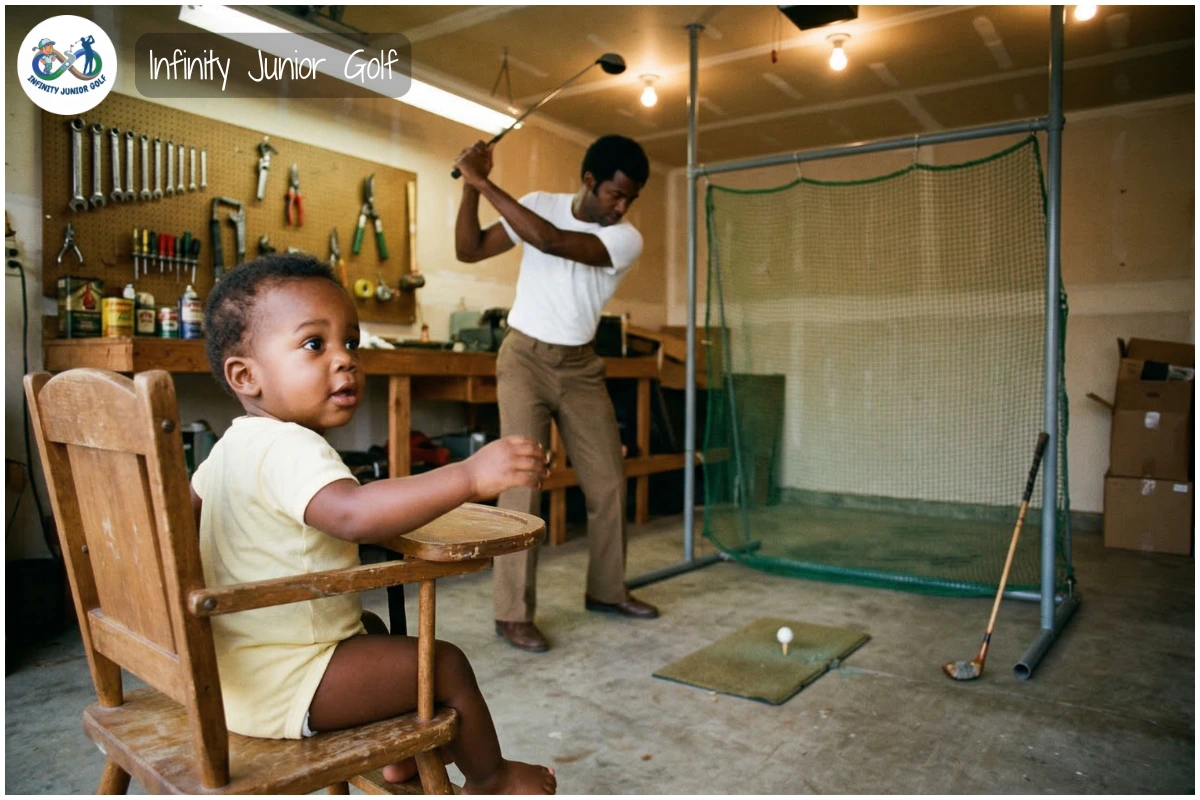
The first swing: Tiger Woods was introduced to golf before most children have formed their first sentence. At just six months old, he sat in his highchair and watched his father Earl practicing his swing in their garage — and one day, Tiger simply reached out and began imitating his father’s motion. Earl, a former Army Lieutenant Colonel and passionate near-scratch amateur, immediately recognized something extraordinary in his son.
The garage net: Earl had set up a makeshift practice net in the family garage to keep his own game sharp — and this simple set-up became Tiger’s first classroom. By 18 months, Earl had taken his son to the Navy Golf Course in Cypress, California, a base course Earl had access to through his military connections. Tiger, using a cut-down iron, emptied an entire bucket of balls on the practice range and even played his first hole — a par-4 of 410 yards — recording an 11.
National exposure at age two: At age two, Tiger made his first TV appearance on The Mike Douglas Show, putting against comedian Bob Hope, with fellow guest Jimmy Stewart looking on. The audience was astonished. Shortly after, at age three, Tiger shot 48 for nine holes at the Navy course — an achievement that would turn heads for a player of any age, let alone a toddler. By age five, he had appeared in Golf Digest magazine and on ABC’s That’s Incredible!
Early recognition: These weren’t publicity stunts — Tiger was genuinely performing at a level that left adults speechless. Earl later recalled that he had begun teaching Tiger to grip a golf club at just ten months old. The recognition Tiger received so early was a testament to just how naturally the game came to him, cultivated by a father who understood that creating the right environment mattered just as much as raw talent.
It’s clear that Tiger’s foundation was laid at home, long before any formal coaching took place. But as Earl recognized, every young talent eventually needs professional guidance — and that’s where the next remarkable chapter of Tiger’s story begins.
The Coach Who Changed Everything
A mother walks in: In 1980, Tiger’s mother Tida walked into the pro shop at Heartwell Golf Park in Long Beach, California, with her four-year-old son in tow. The man behind the counter was Rudy Duran, a PGA golf professional who had built one of the most thriving junior golf programs in the region — over 100 kids had free, unlimited access to the par-3 course. Tiger could barely see over the counter.
Four perfect drives: Duran agreed to take Tiger to the driving range before making any decisions. He teed up four balls. Tiger pulled out his cut-down 2.5-wood and hit four perfect drives — each around 60 yards, each with a slight draw. Duran later recalled his immediate reaction: “Wow, he can play here anytime and I would love to help with his game.” He knew instantly that Tiger was something special — but what he didn’t expect, he admitted, was how much Tiger would end up teaching him in return.
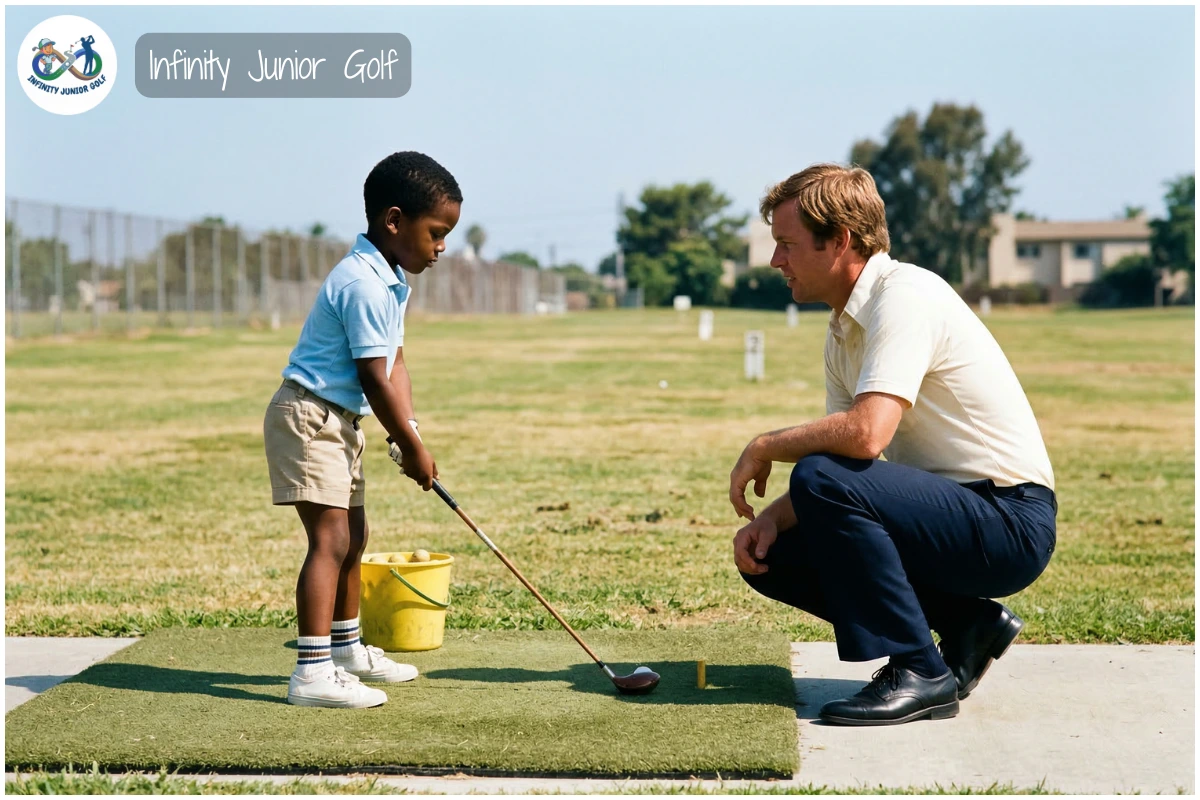
A philosophy built on fun and feel: Duran’s coaching approach was fundamentally different from many instructors of the era. Rather than drilling mechanics and positions, he focused on shot creativity, feel, and joy. He and Tiger would have daily putting and chipping contests and play countless rounds on the little course, exploring high shots, low shots, draws, and fades. Tiger wasn’t learning a golf swing in the traditional sense — he was learning how to play golf, which is an entirely different skill.
Custom fitting and the Tiger par: Duran was ahead of his time in junior equipment, creating his own club-fitting system for young players so Tiger always had properly fitted clubs. He even invented what he called a “Tiger par” — a personalized scoring benchmark based on Tiger’s distances and the 2,143-yard Heartwell layout. That par started at 67; by age five, Tiger shot 59. Around the greens, Duran noted that Tiger could pitch, chip, and putt like a tour professional — a direct product of the feel-based, shot-creative sessions they had built together.
Rudy Duran was more than a coach — he was a mentor and one of the most important early architects of Tiger’s development. The approach he took is one that junior coaches around the world still aspire to today. And as Tiger began entering real competition, it became clear that those formative sessions had laid an unshakeable foundation — one ready to carry him through the demanding world of elite junior tournament golf.
A Junior Tournament Record Like No Other
The Junior World Championships: Tiger won his first major junior title at just eight years old when he claimed the 9–10 boys’ event at the Junior World Golf Championships in 1984 — the youngest age bracket in the competition. He had already broken 80 for the first time that same year, and would break 70 just four years later at age 12. He went on to win the Junior World Championships six times in total — a record never matched — including four consecutive titles from 1988 to 1991.
Competing alongside professionals: At age 13, Tiger entered the Big I (Insurance Youth Classic), his first major national junior event. In the final round he was paired with a then-relatively-unknown professional named John Daly, who birdied three of the last four holes to beat Tiger by just a shot or two. The mere fact that a 13-year-old junior was competing at that level said everything. Tiger had also attended the 1985 PGA Tour’s L.A. Open at Riviera Country Club as Rudy Duran’s nine-year-old caddie, soaking up the professional atmosphere that would one day become his natural habitat.
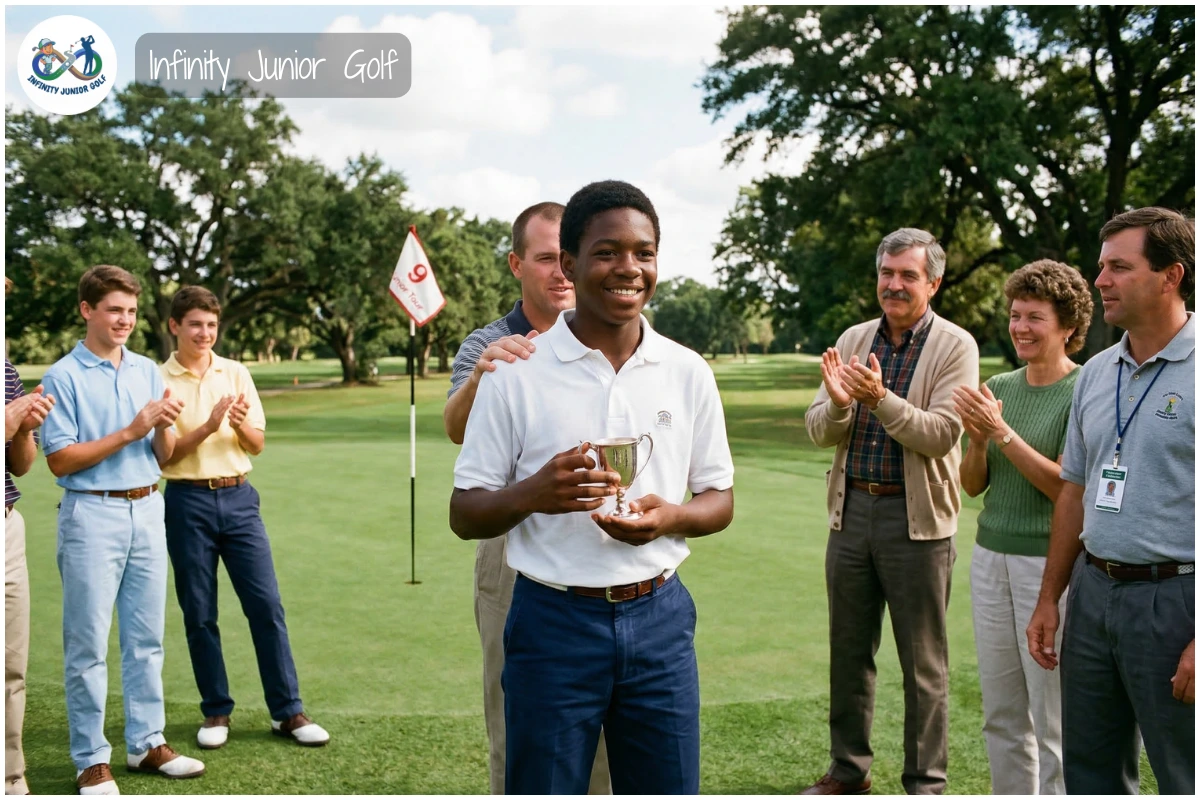
The U.S. Junior Amateur three-peat: At 15, Tiger became the youngest winner in the event’s then-44-year history when he claimed the U.S. Junior Amateur in 1991 at Bay Hill Club and Lodge. He won it again in 1992 at Wollaston Golf Club, coming back from 2-down with five holes to play to win at the last. In 1993 at Waverley Country Club, he completed a historic three-peat — becoming the only player in history to win the U.S. Junior Amateur three consecutive times.
Setting records that still stand: These weren’t lucky wins — Tiger was winning from behind, winning in playoffs, and winning under sustained pressure that would unsettle most experienced adult players. His ability to perform in crunch moments at such a young age was already setting him apart as not just a gifted ball-striker, but a genuine match-play competitor with extraordinary mental resolve.
If the tournament results show us what Tiger could do, they don’t fully explain how he was able to stay so composed under pressure at such a young age. To help any young golfer begin building that same foundation — the right clubs, the right coaching, and the right daily practice tools — here are six retailers whose products directly support junior development at every stage of the journey.
Our Retailer Recommendations
Getting started in junior golf the right way matters enormously. From the moment Rudy Duran insisted on properly fitted clubs for Tiger, to the daily short-game sessions that forged his genius around the greens, every step of Tiger’s early development was underpinned by the right equipment and the right instruction. These six retailers offer junior golfers — from complete beginners to aspiring competitors — the tools to begin building their own story.
Global Golf
GlobalGolf carries the full range of U.S. Kids Golf Ultralight sets — the world’s leading height-fitted junior clubs, available for young players from toddler age through to competitive junior level. Browse their complete junior club sets covering everything from 3-club starter packages — available in red for boys and pink for girls — for the smallest beginners, right through to 7-club sets for developing players aged 10 and above. Their UTry program also lets families trial clubs before committing to a purchase, making it a genuinely low-risk way to get properly fitted equipment into a junior golfer’s hands. Ships to most countries worldwide.
Callaway Golf
One of the world’s most trusted premium golf brands, Callaway offers a dedicated junior golf club range covering ages 5 through 16 with sets engineered for lightweight performance, forgiveness, and proper launch — giving young players the best possible equipment to build their swing from the very first day. Their junior sets come as complete packages with bags included, ideal for parents equipping a young golfer for the first time. Ships worldwide.
TaylorMade Golf
The Team TaylorMade Junior Sets are engineered by the same world-class team that builds major-winning equipment for the world’s top professionals — scaled down specifically for junior players aged 4 to 12 across three precisely sized packages. Each set features ultra-lightweight heads, shafts, and grips designed to help young golfers develop proper fundamentals from the start, with a low-profile driver and irons built for easy launch and genuine confidence at the address. Ships worldwide.
RotarySwing
RotarySwing is an online golf instruction platform focused on biomechanical efficiency. Their flagship program, The GOAT Code, is a step-by-step video-based system covering grip, setup, and full swing sequencing. Three tiered memberships — Basic, Pro, and Elite — make it accessible at every level.
Golf Training Aids
Dedicated to skill development above all else, Golf Training Aids carries a wide range of junior-specific training aids scaled for young players — including putting aids, swing trainers, and alignment tools. Their short game training aids are particularly relevant here, directly supporting the chipping and putting mastery that defined Tiger’s early genius and gave him his first competitive edge. Ships internationally.
Me and My Golf
A world-leading online golf coaching membership platform run by PGA professionals Piers Ward and Andy Proudman, Me and My Golf delivers clear, friendly, and highly structured video coaching lessons for players at every level. In the spirit of Rudy Duran’s feel-first, enjoyment-led approach with young Tiger, their coaching plans make learning the game accessible, enjoyable, and genuinely effective — whether a junior is practising at home or preparing for their first competition. Accessible worldwide.
With the right clubs in hand, the right coaching to guide the journey, and the right training tools to sharpen the short game, every young golfer has a real foundation to build on. But behind all of Tiger’s tournament success was one element that many people overlook entirely: a mental game forged from almost the very beginning, built by his father using methods that were decades ahead of their time.
Earl’s Secret Weapon — The Mental Game
Mental imagery from the start: Earl Woods didn’t just teach Tiger how to swing a club — he trained him how to think. From an early age, Earl used vivid mental imagery to help Tiger grasp complex physical concepts. When teaching shoulder and hip rotation, for example, he would tell Tiger to imagine a door opening and closing. These concrete mental pictures helped a young child understand difficult biomechanics naturally and intuitively — without a single technical drill.
Visualization as a daily discipline: Earl also taught Tiger a powerful putting visualization drill — look at the hole, step into your stance, and when you address the ball, keep the image of the hole alive in your mind. Tiger practiced this so consistently from childhood that visualization became permanently wired into his pre-shot routine. Years later as a professional, Tiger openly credited his mastery of mental imagery as one of his most powerful competitive tools — one that allowed him to simulate shots in his mind before executing them with precision under major championship pressure.

Deliberate distraction training: Perhaps the most unconventional element of Earl’s coaching was his deliberate attempts to disrupt Tiger’s concentration during practice. Earl would deliberately disrupt Tiger’s practice — rattling clubs, dropping bags, coughing, and speaking at the top of his backswing — not to be difficult, but to prepare his son for the unavoidable noise of real tournament environments. Tiger learned to refocus completely after disruption, treating distraction as irrelevant background noise. This kind of psychological resilience training, unusual even by professional coaching standards, gave Tiger a mental edge that far exceeded his years.
Building confidence through progressive challenge: Earl also understood the importance of measured competitive exposure. He paired Tiger’s mental training with constant competitive pressure — entering him in events where Tiger would face players who were older, bigger, and more experienced. The lesson was deliberate: the only way to build genuine confidence is to test yourself repeatedly against real opposition. Tiger learned from an early age that nerves and pressure were simply part of the game — not obstacles, but the very currency of competition.
That mental framework, built brick by brick over years of deliberate practice and thoughtful parenting, became just as important as any golf swing. And when Tiger arrived at Stanford University, he carried all of that inner strength with him — more than ready to dominate at the highest amateur level, before making the final leap to the professional stage.
From Campus Champion to Turning Professional
Stanford and collegiate dominance: Tiger enrolled at Stanford University in 1994, the same year he won his first U.S. Amateur title. In just two years at Stanford, he won 11 collegiate events and claimed the 1996 NCAA Championship. He was named a two-time All-American and won the 1996 Jack Nicklaus Award — the highest individual honor in collegiate golf. Stanford provided a world-class environment, but Tiger’s game was rapidly outgrowing amateur golf altogether.
Three consecutive U.S. Amateur titles: Tiger’s U.S. Amateur record stands alone in modern golf history. Building on his three consecutive U.S. Junior Amateur wins (1991–1993), he added three U.S. Amateur titles in 1994, 1995, and 1996 — the only player ever to accomplish that feat. His 1994 win at TPC Sawgrass was perhaps the most dramatic: 6-down after 13 holes in the final against Trip Kuehne, Tiger rallied to win 2-up in what remains the largest comeback in U.S. Amateur Championship final history.

Turning professional: On August 27, 1996, Tiger officially turned professional — stating that there were simply no challenges left for him at the amateur level. He departed with a record 18 consecutive match-play victories across USGA events, a streak that underlined just how dominant his amateur career had been. He was 20 years old. Within two months, he had won twice on the PGA Tour. Within nine months, he claimed the 1997 Masters by a record margin — the youngest Masters champion in history at the time.
The legacy of a junior career: What Tiger Woods built between the ages of six months and twenty is not just an inspiring golf story — it is a masterclass in long-term player development. Patient early exposure, joyful coaching, progressive competition, rigorous mental conditioning, properly fitted equipment, and unwavering family support all played equal roles. No single ingredient created Tiger Woods. It was the complete recipe — and every element of it translates directly into steps that any junior golfer and their family can take today.
That complete picture — from garage net to the professional tour — is what makes Tiger’s story so practically useful. Here are ten straightforward tips drawn from the principles behind his development, each one designed to be put into action straight away.
Our Practical Tips For You
Inspired by Tiger’s junior journey, here are ten practical steps you or your young golfer can put into action right away — drawn directly from the principles that shaped one of the greatest careers the sport has ever seen.
| Tip | How to Implement It | How It Helps |
|---|---|---|
| Start with the short game | Set up a small chipping and putting area at home or in the garden and practice for a few minutes each day. Keep sessions short and enjoyable rather than forced. | The short game was where Tiger’s genius was first noticed. It’s also the fastest route to lower scores at any level of the game. |
| Use properly fitted junior clubs | Visit a local pro shop or use an online fitting guide to choose clubs matched to your child’s height. Never start with adult clubs that have simply been cut down. | Correct club length and weight builds proper swing habits from day one. Those habits are far easier to maintain than correcting poor technique later. |
| Find a junior golf program | Contact your local golf club or national golf federation to locate structured junior programs in your area. Most clubs offer beginner-friendly options at low cost. | Structured group play builds competitive experience and social confidence. Consistent coaching within a program accelerates skills development measurably. |
| Focus on fun first | Choose courses, games, and drills the young golfer genuinely enjoys and never force a practice session that feels like a chore. | Long-term commitment to the game comes from enjoyment. This was the foundational principle Rudy Duran used with Tiger from day one. |
| Practice shot visualization | Before each shot, look at the target, take a breath, and picture the exact flight of the ball you want to hit. Make this part of every pre-shot routine from the very beginning. | Consistent mental rehearsal before each shot builds focus and routine. Over time, it translates directly into greater accuracy and confidence under pressure. |
| Enter competitions early | Register for local junior or club competitions at the earliest reasonable opportunity, even at beginner level. Don’t wait until the game feels “ready.” | Tournament experience builds composure far faster than practice alone. It also reveals specific areas for improvement that the driving range never will. |
| Practice with distractions | Ask a parent or friend to create background noise during practice putting and chipping sessions. Play music, move around, or drop equipment nearby. | Learning to refocus after distraction — exactly as Earl trained Tiger — builds competitive resilience that pays dividends in every real round played. |
| Watch tournament golf together | Watch major championships as a family and pause to discuss shot choices, course management, and how players respond to pressure. | Observing professional decision-making develops strategic instincts and feeds a young golfer’s sense of aspiration and possibility. |
| Keep a simple golf journal | After every round, write down one thing that went well and one specific area to focus on next time. Keep entries brief and honest. | Regular self-reflection builds self-awareness and turns every round — good or bad — into a useful learning experience. |
| Celebrate small wins consistently | Acknowledge personal bests, solid individual shots, and incremental progress milestones — not just competition results or trophies. | Positive reinforcement builds self-confidence over the long term. Confidence and resilience are the twin foundations of competitive golf at every level. |
These tips are practical, proven, and drawn directly from the principles behind Tiger’s extraordinary journey. If you still have questions about how it all came together — or what Tiger’s path means for a young golfer today — the FAQs below cover the essentials.
FAQs
At what age did Tiger Woods start playing golf?
Tiger was introduced to golf before the age of one — he took an interest in the game at around six months old, sitting in his highchair and watching his father hit golf balls into a net before beginning to imitate his swing.
Who was Tiger Woods’ first professional golf coach?
Tiger’s first professional coach was Rudy Duran, a PGA professional based at Heartwell Golf Park in Long Beach, California. Tiger’s mother Tida brought her four-year-old son to Duran in 1980, and the two worked closely together until 1986.
How many junior titles did Tiger Woods win?
Tiger won the Junior World Golf Championships six times, including four consecutive titles, and won the U.S. Junior Amateur Championship three consecutive times from 1991 to 1993 — making him the only three-time winner in the event’s history. He was also the youngest winner at the time of his first title in 1991, a record that stood until Jim Liu broke it in 2010.
When did Tiger Woods turn professional?
Tiger officially turned professional on August 27, 1996, at the age of 20, following an unmatched amateur career that included six consecutive USGA national titles and an 18-match unbeaten streak in USGA match play competition.
Our Related Articles

Top Junior Golf Tournaments In The US
Junior golf tournaments play an essential role in developing young golfers’ skills, competitive mindset, and passion for the game. Across the United States, numerous tournaments…
Read More
Why Goal Setting Matters For Young Golfers
Goal setting transforms how young golfers approach the game, turning aimless practice sessions into purposeful development opportunities. When junior players establish clear targets, they create…
Read More
How To Teach Toddlers To Swing A Golf Club
Watching a toddler take their first swing at a golf ball is one of those magical moments that parents treasure forever. Those early attempts might…
Read MoreConclusion
Tiger Woods’ junior golf journey is one of the most inspiring origin stories in all of sport — built on a father’s love, a coach’s creativity, fierce competitive hunger, and a mental edge forged from toddler-hood. From a garage in Cypress, California, to six consecutive USGA national titles before his 21st birthday, every step of that journey holds a lesson that is just as relevant for young golfers today as it was in the 1980s and 1990s.
If Tiger’s story has lit a spark in you or someone you care about, the best time to start is right now — whether that means finding a junior program, picking up a properly fitted set of clubs, or simply heading out to a local course and enjoying the game for the pure joy of it. The greatest junior golf career in history began with a six-month-old, a makeshift garage net, and a parent who believed. Yours can begin today too.
What’s your own junior golf story — or what do you hope to build for a young golfer in your life? Drop your thoughts and experiences in the comments below — we’d genuinely love to hear from you.