



Getting a young golfer excited about the game is a wonderful thing. But something that doesn’t always get the attention it deserves is the equipment they’re actually carrying out onto the course. A bag that’s too heavy, poorly fitted, or simply not designed with a child’s body in mind can turn an enjoyable round into a grinding physical experience — and that’s the last thing any junior golfer needs. The right lightweight bag can genuinely change how much a young player enjoys their time on the course.
Hi, I’m Al — a regular golf dad who caught the junior golf bug a few years ago and never quite recovered. I’m not a club fitter or a touring professional; I’m just someone who’s spent a lot of time watching young players grow into this sport and learning what actually makes a difference for them. I’ve seen kids light up when they’re properly set up with gear that actually fits them, and I’ve seen others lose interest because the basics weren’t quite right. If you’re trying to find the best lightweight golf bag for a junior player in your life, welcome — you’re in the right place. Read on, because this one’s worth knowing.
⭐ Our Top Pick — Best Lightweight Junior Stand Bag
PING Prodi G Junior Stand Bag
I chose this bag over the alternatives because no other manufacturer has gone to the same level of engineering detail for junior players — the stand height, strap spacing, and divider sizing are all deliberately designed for a child's body and club set, not simply adapted from an adult version.
This bag gives junior players the freedom to walk and carry independently on any course without fighting the weight at every hole.
- ✅ Purpose-built lightweight construction at 4 lbs | Adjustable padded shoulder straps
- ✅ 4-way top with 4 pockets | Includes two 1-inch risers for height adjustment | Rain hood included
- ✅ Available in 30″ (Black or Green/White) and 34″ (Black or White/Green) sizes to suit every junior golfer
- ✅ Ships globally through PING’s international distribution network
| Mid-range
👉 Shop the 30″ Small 👉 Shop the 34″ LargeWhy Bag Weight Matters for Young Golfers
The developing body isn’t built for adult loads: Children and teenagers are in active phases of musculoskeletal growth, which means their spines, shoulders, and hips are far more susceptible to strain than an adult’s. Carrying a disproportionately heavy bag shifts posture, compresses the spine unevenly, and builds fatigue that bleeds directly into swing mechanics. This isn’t just about comfort — it’s a genuine physical consideration for any young player walking a course.
Energy spent carrying is energy taken away from playing: On a standard 18-hole walking round, a golfer covers 4 to 6 miles. For a child hauling an oversized adult-style bag, that’s a taxing physical challenge before they even think about hitting the ball. Lightweight junior bags — typically under 3 to 4 lbs empty — allow juniors to cover that distance while arriving at each shot with enough energy to focus, swing well, and actually enjoy themselves.

Attitude follows comfort more than most people realize: It’s easy to underestimate how much physical discomfort shapes a young person’s relationship with any sport. The American Academy of Pediatrics recommends that a child’s carried load should not exceed 15% of their body weight — a guideline that applies directly to a loaded golf bag on a long round. A junior who finishes a round exhausted from carrying an oversized bag is less likely to be enthusiastic about the next one. Getting the bag weight right is one of those quiet decisions that pays off in how often your junior asks to go back.
With the “why” clearly in view, let’s turn to the practical side — what you should actually be looking for when you pick up and examine a junior golf bag.
What to Look for in a Junior Golf Bag
Dual padded shoulder straps are the single most important feature: A single-strap carry bag places the entire load asymmetrically on one shoulder, creating an uneven strain pattern through the back and neck across an entire round. Dual padded straps distribute weight across both shoulders, keep posture more neutral, and reduce fatigue significantly. Look for straps with genuine padding depth — thin webbing straps offer very little practical improvement over a single strap.
Club dividers should match the set, not an adult’s bag: Most junior club sets contain between 5 and 9 clubs. A bag with 14 full-length dividers — built around the USGA 14-club rule — leaves those clubs rattling loosely, which causes shaft and grip wear over time and makes club selection slower and more frustrating. Purpose-built junior bags typically feature 3 to 6 dividers sized appropriately for shorter junior shafts and smaller grips.
Pocket design should be minimal and purposeful: Junior bags don’t need a pocket for every conceivable scenario. The practical essentials are a main storage compartment for balls and accessories, a small zippered valuables pocket, and a water bottle holder or sleeve. Bags loaded with unnecessary pockets and hardware just add weight without adding value. Clean, minimal pocket design is almost always the right choice.
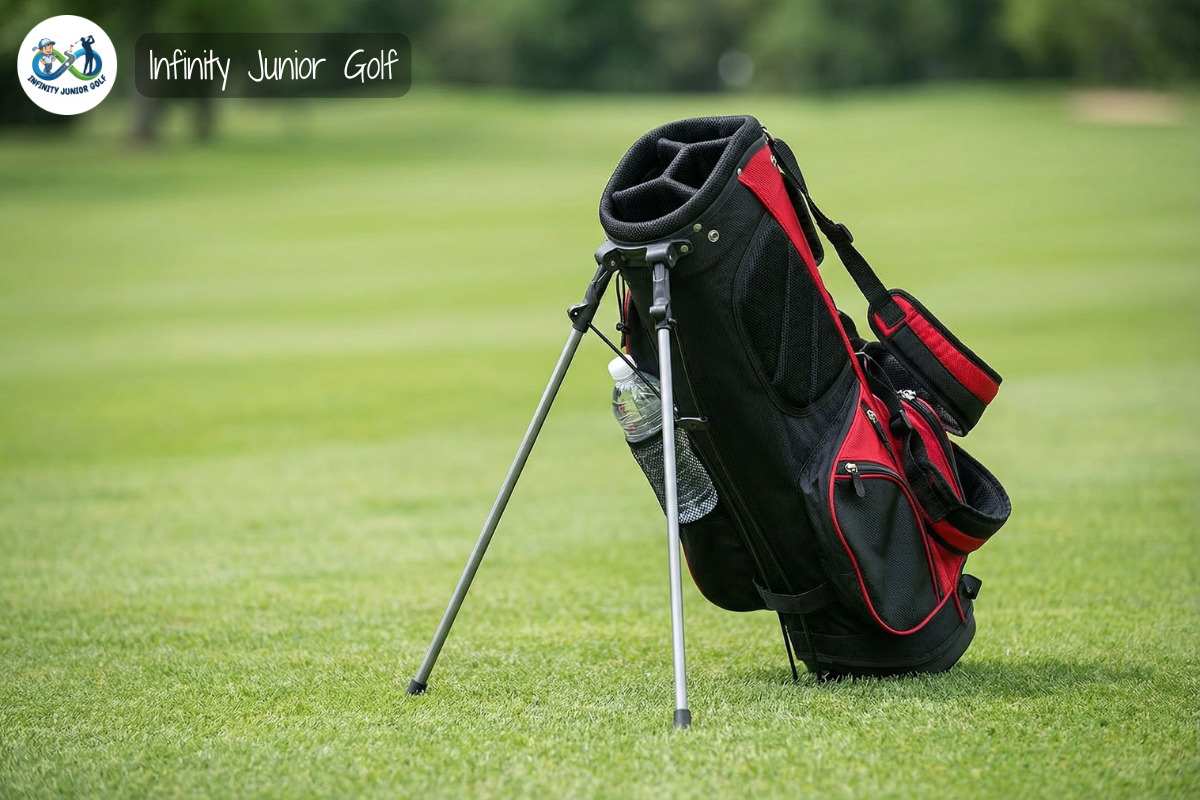
Stand legs should be sturdy enough for real course conditions: If you’re choosing a stand bag, make sure the built-in legs are robust enough to hold the bag upright on uneven terrain — which is most of what a golf course offers. Thin, poorly engineered stand mechanisms collapse unexpectedly and become a frustration for junior players managing their own gear. Well-built stand systems deploy cleanly and hold reliably, which matters when a child is learning to be independent on the course.
Now that you know what to prioritize in terms of features, the next step is understanding which type of bag actually suits your junior’s situation — because not every lightweight option works the same way on the course.
Types of Lightweight Junior Golf Bags
Carry bags — the simplest and lightest starting point: A junior carry bag is a minimal, unstructured design built purely to be light and easy to hold or carry. These are ideal for younger juniors (typically ages 5–8) carrying just a handful of clubs on a par-3 course, driving range, or pitch-and-putt. They’re the most affordable option and make a great first bag for a child just getting introduced to the game.
Stand bags — the most versatile choice for active junior golfers: A stand bag includes built-in fold-out legs that deploy automatically when the bag is set down, keeping clubs off the ground and easily accessible. For juniors playing regular course rounds — typically from around age 9 onward — a stand bag is usually the most practical choice. The PING Prodi G Junior weighs just 4 lbs, features a 4-way top with adjustable padded straps, and comes in two sizes (30″ and 34″ tall) engineered so the stand height suits a child’s reach rather than forcing an awkward bend.
⚙️ Recommended: PING Prodi G Junior Carry Bag
I chose this bag specifically because it’s proportioned for a junior’s body — the straps are correctly spaced for narrower shoulders, the sizing is right for a child’s reach, and the whole thing is genuinely lightweight without sacrificing durability. It comes in two sizes and multiple colorways, including Black and White/Green for the Large, and Black and Green/White for the Small.
- ✅ 4 lbs (both sizes) | Adjustable padded straps | 4-way top | 4 pockets | Rain hood included | Two 1-inch risers included for height adjustment
- ✅ Available in a Large (34″) and a Small (30″) to fit a range of junior heights — both $210.00
- ✅ Available globally through PING’s international retail network
Push cart and trolley options for juniors who ride or roll: For juniors who primarily travel in golf carts or whose parents push a trolley, a lightweight cart-style bag is worth considering. These don’t need stand hardware, which shaves weight, and they often offer more storage for a longer day out. The Bag Boy Quad Junior Push Cart is a smart pairing — specifically engineered for junior-sized bags, it lets young players manage their own equipment on the course without carrying a thing.
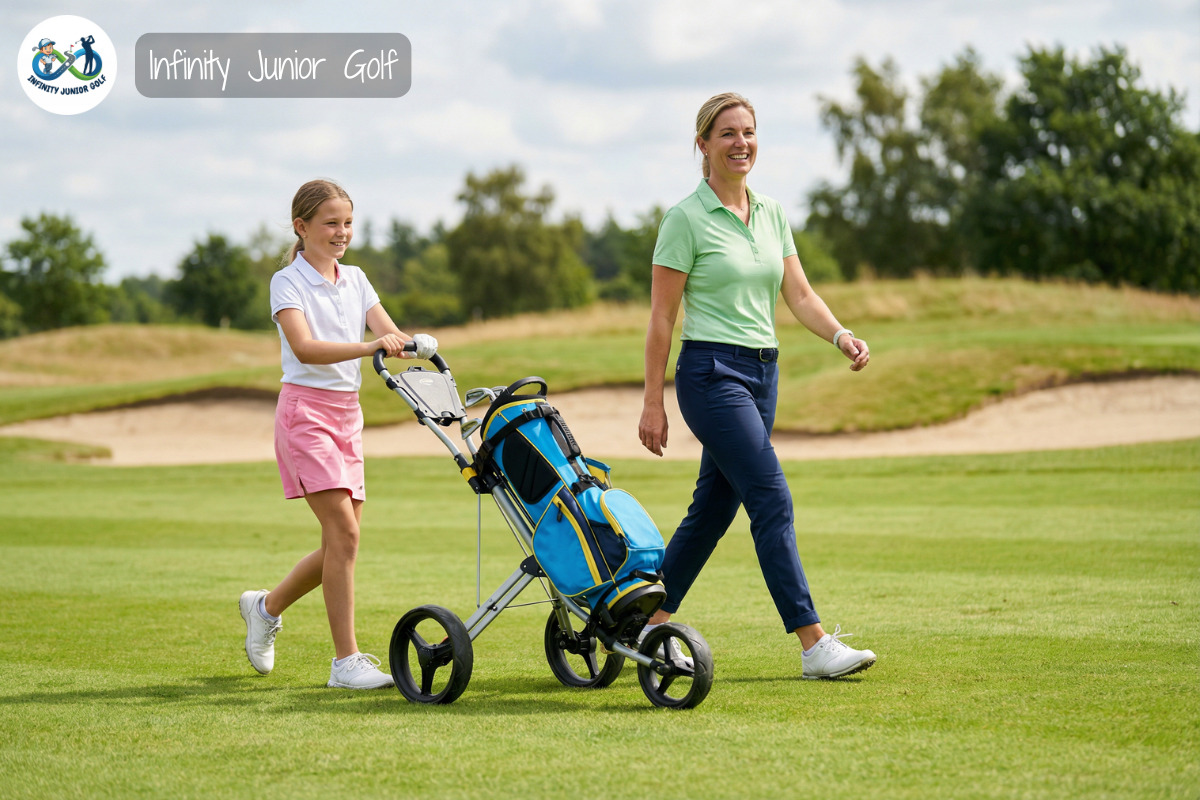
Hybrid designs for more experienced junior players: Some junior bags combine carry and cart compatibility, offering attachable straps alongside cart-compatible bases. For most everyday junior golfers, a clean stand bag or carry bag is still the most practical option. Hybrid or dual-purpose designs are worth exploring once a junior has a clearer sense of how they like to play and what their course routine looks like.
Now that you’re clear on the types available and what to look for in each one, let’s look at the specific brands and retailers that make it easy for parents anywhere in the world to find exactly the right junior golf bag at the right price.
Brands and Tools That Help Juniors Thrive — Our Recommendations
Finding the right lightweight junior golf bag is much easier when you know where to look. The retailers below were chosen because they each offer something specifically relevant to young players at this stage of their game — whether that’s purpose-built junior bags, junior-specific sizing systems, push cart compatibility, or genuine value for fast-growing kids. Every recommendation here ships internationally or has strong regional reach.
Our Retailer Recommendations
PING Golf
PING’s Prodi G Junior Stand Bag is one of the most thoughtfully engineered junior bags available anywhere. Available in a 30″ small size and a 34″ large size — with colorways to suit both boys and girls — each features a 4-way top, padded dual straps, and included risers for a custom fit, making it purpose-built around a child’s body, not scaled down from an adult version. I placed PING first because no other manufacturer applies this level of junior-specific engineering to a bag, and that detail genuinely shows on the course.
US Kids Golf
US Kids Golf has developed one of the most comprehensive junior bag sizing systems in the world, offering stand bags in height-based sizes ranging from 20″ to 32″ tall — each matched precisely to a junior player’s club length and physical proportions. Available for both boys and girls across every size, their lineup includes options like the UL7-42 Stand Bag for the youngest beginners and the UL7-54 Stand Bag for beginner to intermediate players standing 54–57 inches tall — all at accessible price points that make them an excellent choice for parents equipping a beginner or an improving player. What draws me to US Kids Golf specifically is how seriously they take fit as a system — the bag size is designed to match the club set, not just the child’s age.
Sunday Golf
Sunday Golf is a specialist golf bag brand whose Recess kids’ stand bag is purpose-built for young golfers ages 5–12, available in two sizes and in colorways suited for both boys and girls — including Blue/White and Pink/White Checker. Each bag holds up to 8 clubs, features a fully adjustable dual-strap system designed to distribute weight properly for smaller frames, and weighs as little as 3.6 lbs — light enough that kids can carry it comfortably through a full round. For parents looking for a bag-specialist brand that puts kid-specific functionality and fun design front and center, Sunday Golf’s Recess is genuinely hard to look past.
Bag Boy
Bag Boy makes the Quad Junior Push Cart — a push cart specifically engineered for junior-sized lightweight bags, with a frame height and bag attachment system designed to suit a child’s reach and stride. For juniors who prefer to wheel rather than carry, or for families where a trolley is part of the routine, this is one of the few push carts on the market purpose-built for junior use. The proportional design is what separates it from adult trolleys adapted for youth use — the junior doesn’t have to fight the height or geometry of an oversized frame.
2nd Swing Golf
2nd Swing carries both new and certified pre-owned junior golf bags from major brands including PING, Callaway, and TaylorMade — including the lightweight, junior-specific PING Prodi G Stand Bag, which comes in two sizes to fit a range of young players — making it one of the smartest places to shop for parents who want genuine quality without full retail pricing. Junior players grow fast, and a well-maintained pre-owned bag at half the new price is a financially sensible decision that doesn’t compromise the on-course experience. The junior golf section at 2nd Swing remains one of the most underused resources in junior golf.
Callaway Golf
Callaway Golf is one of the world’s most recognized golf brands and offers a purpose-built junior bag that delivers genuine performance at an accessible price point. Their dedicated Fairway J Junior Stand Bag features a 3-way Shaft Shield™ top with full-length dividers, an ANAMATIC™ dual-strap carry system, and a FLEX POD™ stabilizing base — all scaled down to 32 inches and 4 lbs to suit young players on the course. With 6 pockets and a logo-ready design, it’s a clean, practical option for junior golfers, and Callaway’s global retail presence means it can be found in most major markets worldwide through authorized dealers or direct online order.
With those retailers bookmarked, you’re well placed to find the right bag at the right price for your part of the world. Before you head off to shop, though, there’s one more important decision to work through — making sure the bag you choose is the right physical fit for your junior’s current age and size.
Choosing the Right Bag for Your Junior’s Age and Size
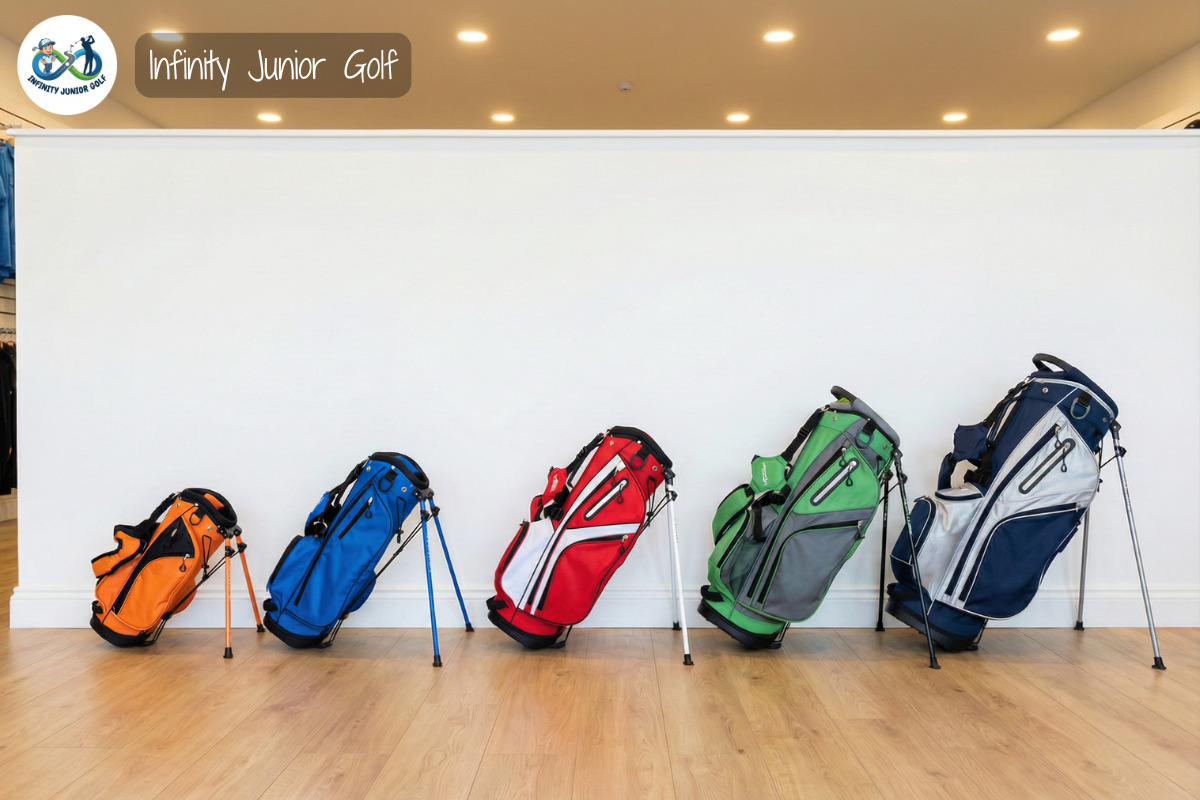
Age ranges are guides, not guarantees: The golf industry typically segments junior equipment by age brackets — under 6, 6–8, 9–12, and 13 and up — but these are starting points, not absolutes. A tall 10-year-old may comfortably use a bag sized for a 12-year-old; a smaller 13-year-old might still be better served staying in a junior-specific bag rather than transitioning to an adult-sized one prematurely. The most reliable test isn’t age — it’s physical: load the bag and put it on your junior’s back. If it hangs below their hips, it’s too large.
Club count should drive bag capacity: A junior just starting out might carry 5–7 clubs. A 14-year-old competing in junior tournaments may carry up to the 14-club limit. A bag designed for 5 clubs is not the right choice for 14 — the dividers will be undersized and the compartment overstuffed. Match the bag’s club capacity to the actual number of clubs your junior uses, with a little room to grow into over the next season or two.
Body weight is the real weight limit: Add up the bag, clubs, water bottle, and all accessories together — that total loaded weight should stay within the 10–15% body weight guideline. For a 70 lb (32 kg) child, that’s a maximum of roughly 7–10 lbs total. Lightweight junior bags in the 3–4 lb empty weight range make staying within that limit genuinely achievable once a full set of clubs and accessories is added.
When to make the transition to an adult bag: Most junior players are physically ready to move to a proper lightweight adult stand bag somewhere between ages 14 and 16, depending on their individual development. The sensible transition point is when they’re carrying a full set of clubs and their height and shoulder width are approaching adult proportions. Rather than making that leap early to save money on equipment, it’s worth keeping a junior in a correctly sized bag for as long as it genuinely fits — it protects posture and swing mechanics through an important developmental window.
Those sizing principles go a long way toward narrowing down your choices. Now let’s pull everything together with some concrete, practical tips you can put into action straight away — whether you’re buying your junior’s first bag or looking to upgrade what they’ve already got.
Our Practical Tips For You
Here are ten practical actions you can take to find, fit, and use the right lightweight junior golf bag.
| Tip | How to Implement It | How It Helps |
|---|---|---|
| Weigh the loaded bag before committing | Put the empty bag on a scale, then add your junior’s clubs, water bottle, and accessories and weigh again. Compare the total to 10–15% of your junior’s body weight. | Gives you the real-world carry weight rather than just the manufacturer’s empty bag figure. Avoids an unpleasant surprise on the first round. |
| Look for junior-specific designs, not scaled-down adult bags | Read product descriptions carefully — look for language like “purpose-built for juniors” rather than just “youth size.” Some youth bags are adult frames with smaller graphics. | Ensures strap spacing, divider sizing, and stand height are actually calibrated for a child’s body. |
| Adjust both shoulder straps to equal length | Set both straps to the same length and check the bag sits centered on the back, not tilting to one side. Re-check each time the bag is put on. | Even weight distribution across both shoulders protects developing spinal alignment during long rounds. |
| Don’t overstuff the bag | Encourage your junior to carry only what they need for the round — extras can stay in the car or at the clubhouse. | Every additional pound adds meaningful fatigue over 4–6 miles of walking an 18-hole course. |
| Match dividers to club count | Count your junior’s clubs before buying and verify the bag’s divider count accommodates them snugly — clubs shouldn’t rattle or be crammed. | Prevents shaft and grip wear and makes club selection quicker and easier during play. |
| Buy one size ahead, not two | If your junior is between size brackets, choose one step up. A bag that’s slightly generous is manageable; two sizes too large creates posture problems. | Balances future-proofing your investment with maintaining a comfortable, safe fit right now. |
| Consider pre-owned for fast-growing juniors | Check retailers like 2nd Swing Golf for quality pre-owned junior bags at significantly reduced prices. Juniors often outgrow bags before they wear them out. | Reduces cost during fast growth phases without sacrificing the quality or fit of the bag. |
| Test the stand mechanism before the first round | Practice deploying and collapsing the stand legs at home before heading to the course. Adjust anything that feels stiff or uneven. | Prevents on-course frustration and ensures the stand performs reliably on uneven grass. |
| Let your junior choose the color | If they’re deciding between two equally good bags, let them pick the one they love visually. Personal connection to gear matters to young players. | Enthusiasm for their own equipment makes carrying feel like something they want to do, not something to resent. |
| Re-evaluate fit at the start of every season | At the beginning of each golf season, check that the straps still fit correctly and the bag sits at the right height for your junior’s current size. | Prevents a bag that fit well last year from causing discomfort or postural strain as your junior grows. |
With those practical tips in hand, let’s close out with answers to a few of the most common questions parents ask when they’re navigating the junior golf bag decision for the first time.
FAQs
Here are the questions I hear most from parents new to the junior golf bag conversation.
What weight should a junior golf bag be?
An empty junior golf bag should ideally weigh between 3 and 4 lbs (approximately 1.4–1.8 kg). When loaded with clubs, a water bottle, and accessories, the total carry weight should stay within 10–15% of your junior’s body weight.
At what age should a junior golfer start using a stand bag?
Most junior golfers transition naturally to a stand bag around ages 9–11, when they begin playing full-length course holes and taking on responsibility for their own equipment during a round. Younger juniors are usually well served by a simple, lightweight carry bag.
Can a junior just use an adult golf bag?
Technically yes, but it’s not a good idea. Adult bags are heavier, have shoulder straps spaced too far apart for a child’s narrower build, and use dividers sized for full-length adult clubs. A junior-specific bag is always the better choice until a young player is physically close to adult proportions — usually mid-to-late teenage years.
How many dividers should a junior golf bag have?
For most junior players carrying 5–9 clubs, a bag with 3 to 6 dividers is ideal. This keeps clubs organized and protected without making the bag unnecessarily bulky or heavy.
Our Related Articles

Best Junior Golf Club Sets For First-Time Players
Getting a young golfer started with the right equipment can be the difference between a lifelong passion for the sport and a set of clubs…
Read More
Top Junior Golf Tournaments In The US
Junior golf tournaments play an essential role in developing young golfers’ skills, competitive mindset, and passion for the game. Across the United States, numerous tournaments…
Read More
Top 5 Junior Golf Club Sets Reviewed
Choosing the right golf clubs can make or break a young player’s journey in this wonderful sport. When junior golfers have equipment that matches their…
Read MoreConclusion
Choosing the right lightweight golf bag for a junior player is one of the most practical, high-impact decisions you can make for their time on the course. The right bag protects their developing body, conserves their energy for the round, and — perhaps most importantly — makes golf feel like fun rather than effort. When junior golf is enjoyable and physically comfortable, young players keep coming back, and that’s the whole point.
Start with the PING Prodi G Junior Stand Bag if you’re looking for a purpose-built option that covers all the bases, and use the retailer recommendations in this article to find the best source for your part of the world. Whether you’re shopping in North America, the UK, Australia, or anywhere else, the right junior golf bag is very much within reach.
Now I’d love to hear from you — has your junior golfer found a lightweight bag that’s made a genuine difference, or are you still working through the options? Share your experience or questions in the comments below — your story might be exactly what another golf parent needs to read today.