



Golf is one of the most accessible and rewarding sports a young person can take up, but it places surprisingly demanding physical requirements on the body — particularly the hips, shoulders, spine, and wrists. While it might not look like a high-intensity sport from the outside, the golf swing is a powerful, coordinated full-body movement that can cause real injury when a young golfer’s muscles aren’t properly prepared. Building a consistent stretching routine from the very beginning isn’t just good practice; it’s one of the most valuable investments any junior golfer can make in their long-term performance and health.
Hi, I’m Al — and if I’m honest, I’m just a passionate golf parent who got completely swept up in the junior golf world the moment my child picked up a club for the first time. I’m not a physiotherapist or a professional coach, but I’ve spent a good chunk of time learning from those who are, reading the evidence, and figuring out what genuinely makes a difference for young players. I’m thrilled you’ve found this guide, and I hope it becomes something you and your junior golfer come back to time and again. If you want to give your young golfer the best possible physical foundation — one that keeps them healthy, flexible, and playing confidently — then read on, because what follows could genuinely change how they approach every round.
Dynamic Warm-Up Stretches to Start Every Session
Why the body needs warming up before any club is touched: Junior golfers — particularly those between the ages of 8 and 16 — are in the middle of active physical development, meaning their muscles, tendons, and joints respond very differently to sudden physical demands than an adult’s would. A published study from the University of Essex found that youth golfers who completed a dynamic exercise warm-up experienced statistically significant improvements in both clubhead speed and self-reported shot quality — with shot quality improving by 40% compared to those who used no warm-up at all. The same research confirmed that a club-only warm-up, without any prior dynamic movement, produced no significant improvement in either measure — making a structured physical warm-up non-negotiable for any junior golfer serious about performance and safety.
Stretch 1 — Torso Twists: This is the gold-standard opening move for any young golfer’s pre-round routine. Stand with feet shoulder-width apart, arms crossed over the chest, and slowly rotate the torso left and right, letting the hips follow naturally through the movement. Aim for 10 smooth, controlled rotations in each direction. Torso twists loosen the spine and the deep rotational muscles of the back — the exact muscles that power the backswing and follow-through — making this stretch directly transferable to swing performance.
Stretch 2 — Arm Circles and Shoulder Rolls: The shoulders are among the most active and vulnerable joints in the golf swing, and preparing them properly before play is essential. Begin with large, slow arm circles — 10 forward, then 10 backward — followed immediately by shoulder rolls, lifting the shoulders up, rolling them back, and releasing them down. This sequence improves shoulder range of motion and loosens the rotator cuff muscles that stabilise the joint throughout the swing. Junior golfers who practise frequently at the driving range are particularly prone to shoulder tightness, making this stretch especially important for regular players.
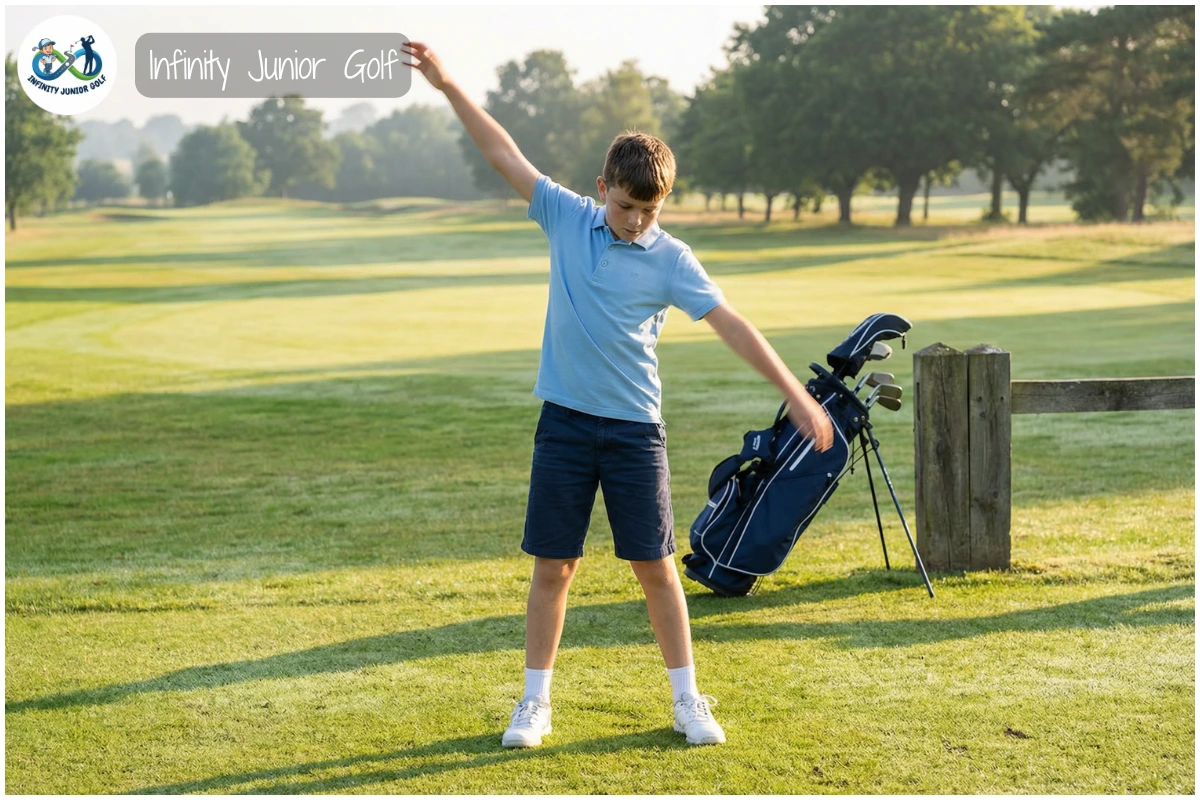
Stretch 3 — Leg Swings: Leg swings are a highly effective dynamic stretch that activates the hip flexors, hamstrings, and glutes simultaneously — three muscle groups central to generating rotational power in the golf swing. Stand tall and hold onto a fence or golf bag for balance. Swing one leg forward and back in a controlled, pendulum motion for 10 repetitions, then switch to a side-to-side motion to open the inner thighs and hip external rotators. Repeat on the other leg. The goal is smooth, progressive movement that tells the body it’s about to get to work — not a competition to see how high the leg can go.
Now that the whole body is moving and warm, it’s time to focus on one of the most frequently overlooked areas for young golfers — the upper body, where grip, swing control, and rotational power all converge.
Upper Body Stretches for Power and Protection
Why the upper body deserves its own focus: The arms, shoulders, and wrists absorb a significant amount of force with every golf swing, and in junior players whose grip strength and joint stability are still developing, this load accumulates quickly — especially over an 18-hole round or a long session at the range. Rush University orthopaedic specialists note that all five phases of the golf swing place direct, measurable stress on the shoulders, wrists, and elbows, making targeted upper body stretching essential for long-term health in the sport. A published case study from Kyungnam University found that a structured upper-body flexibility program significantly increased spinal rotation range and clubhead speed — improving carry distance by 26% over just six sessions — demonstrating how directly upper-body mobility translates to swing performance.

Stretch 4 — Cross-Arm Shoulder Stretch: This requires no equipment and can be done anywhere — on the first tee, at the range, or in the car park before a lesson. Extend one arm horizontally across the chest and use the opposite hand to gently press the elbow toward the body. Hold for 20–30 seconds on each side. This targets the rear deltoid and the posterior shoulder capsule — areas that tighten progressively with repetitive swinging and that, when left unaddressed, can begin to restrict backswing depth and increase the risk of shoulder strain over time.
Stretch 5 — Wrist Flexor and Extensor Stretch: Young golfers who spend meaningful time at the practice range often develop unexpected tightness in the forearm muscles, which can lead to wrist and elbow discomfort if left unaddressed. For the wrist flexor stretch, extend one arm forward with the palm facing up and use the opposite hand to gently pull the fingers back toward the body. For the extensor stretch, flip the palm downward, make a loose fist, and gently guide the knuckles down. Hold each position for 20 seconds per side. As Rush University’s orthopaedic guidance confirms, upper body stretches targeting the shoulder and forearm are specifically recommended for all golfers to address the repetitive strain risk that the swing creates in these structures.
The upper body is mobile and primed — but the real engine of a powerful, consistent golf swing lives in the lower body. Let’s work through the stretches that build that foundation.
Lower Body Stretches for Stability and Swing Power
Why the lower body drives the swing: A powerful, consistent golf swing is built from the ground up, with the hips, hamstrings, quadriceps, and calves all engaged from address through to follow-through. A 2022 meta-analysis published in Sports Medicine Open, drawing on data from 1,936 young participants across 28 controlled studies, found that flexibility levels tend to plateau or even decrease during the adolescent growth spurt — particularly in boys — making this a critical period for maintaining a consistent lower body stretching routine. The same analysis confirmed that systematic stretching training measurably increases joint range of motion in both children and adolescents when applied consistently over time.
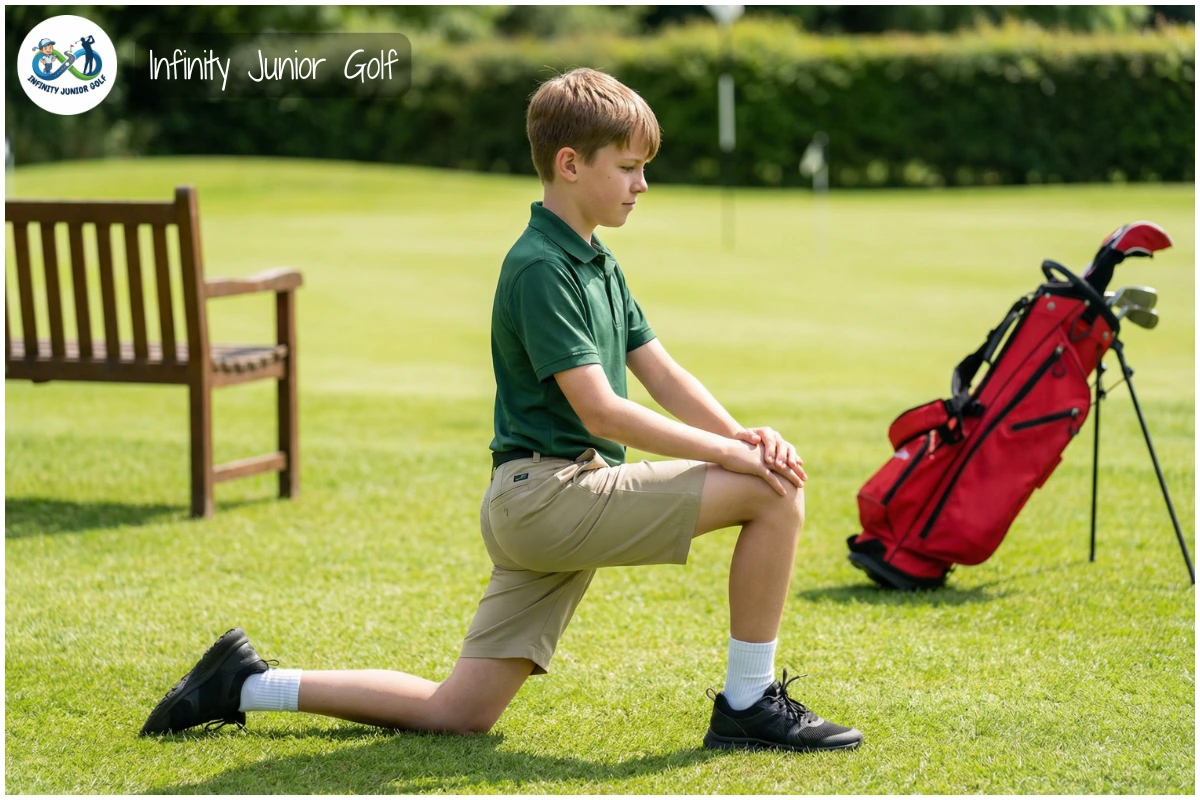
Stretch 6 — Hip Flexor Lunge Stretch: Rush University’s orthopaedic team specifically recommends hip flexibility work as a priority for all golfers, noting that exercises focused on low back and hip flexibility are among the most important for improving spine mobility and reducing injury risk. Step forward into a lunge and lower the back knee gently to the ground. Keep the chest upright and push the hips slightly forward until a deep stretch is felt at the front of the rear leg. Hold for 20–30 seconds on each side. Because hip flexibility directly influences how much rotational range a golfer can access during the backswing, improving it is one of the highest-return stretching investments a junior golfer can make.
Stretch 7 — Standing Hamstring Stretch: Tight hamstrings affect golf posture more than almost any other muscle group — they tilt the pelvis in a way that forces the lower back to compensate throughout the entire swing. Stand and extend one leg slightly forward with the heel on the ground, then hinge gently at the hips while keeping the spine long and flat. Hold for 20–30 seconds per side. For younger players especially, the goal is never to touch the toes — it is to feel a genuine stretch in the back of the thigh while the back remains straight. Rush University includes hamstring stretching explicitly in its recommended safe golf conditioning program for exactly this reason.
Stretch 8 — Standing Quad and IT Band Stretch: The quadriceps and IT band (the iliotibial band, running along the outer thigh from hip to knee) play an important role in the knee stability that underpins a solid, grounded golf stance. Stand tall and hold a steady surface for balance if needed, then pull one foot up toward the glutes and hold for 20–30 seconds each side. For the IT band, cross one foot behind the other and lean gently toward the opposite side to feel the stretch along the outer thigh. Rush University’s orthopaedic team specifically lists quadriceps, hamstring, calf, and IT band stretches as the recommended lower body preparation for golfers looking to stay healthy throughout the season.
With all the major muscle groups addressed through the warm-up and mid-session stretches, having the right recovery tools and flexibility resources to support the routine at home can make the difference between something you do once and a habit that genuinely sticks. Here are the retailers worth knowing about.
Our Retailer Recommendations
The right tools and programs can take a young golfer’s flexibility journey to the next level. From compact foam rollers that fit in a golf bag to guided yoga programs created specifically for children, the retailers below offer products and resources that directly support the stretching and recovery principles covered in this article. Here are six we recommend exploring.
Our Retailer Recommendations
Therabody
Therabody produces some of the world’s most trusted percussion massage devices, including the Theragun Relief and Theragun Mini — compact, user-friendly tools that help release muscle tension in the hamstrings, glutes, shoulders, and upper back after a round of golf. Applying percussive therapy to the areas targeted in this article’s cool-down stretches significantly enhances muscle recovery and prepares the body more effectively for the next session. Therabody ships internationally and its products are used by elite sporting organisations worldwide.
Hyperice
Hyperice offers a range of vibration and recovery technology, including the Vyper foam roller and the Venom heated wrap — both of which are used widely by professional athletes to accelerate warm-up and post-activity recovery. Running the Vyper over the quads, hamstrings, and upper back before beginning the dynamic stretches in this article measurably improves muscle activation and range of motion from the very first move. Hyperice products are available globally through their website and international retail partners.
Travel Roller
Since 2007, Travel Roller has produced high-performance, portable foam rollers designed specifically to travel with athletes — their compact size makes them ideal for a junior golfer’s bag. The Travel Roller® 4.3 and ALL IN Recovery Transformation Kit both include free access to a Recovery & Wellness App with guided rolling routines, giving young golfers and their parents a structured pre-stretch preparation program that complements every exercise in this article. They ship internationally and offer foam balls and mobility tools suitable for all ages.
GoGo Yoga Kids
GoGo Yoga Kids is a dedicated children’s flexibility and mindfulness platform offering yoga books, activity guides, and lesson plans for children aged 3–14. Their approach to teaching body awareness and movement — building flexibility through fun, game-based practice — aligns directly with the principles in this article, and their resources work as an excellent structured supplement to a junior golfer’s daily stretching routine. GoGo Yoga Kids resources are available digitally worldwide and as physical books through major retailers.
Active Kids
Active Kids connects families with youth sports and fitness registrations, including yoga, movement, and flexibility programs for young athletes. For parents who want to build on this article’s stretching routine with structured, in-person or virtual flexibility classes — taught by qualified children’s movement professionals — Active Kids is one of the best starting points for finding age-appropriate programs in your area. Their platform covers locations across North America, Europe, and beyond.
Recovery For Athletes
Recovery For Athletes stocks a comprehensive range of sports recovery equipment used by athletes training at a high level, including the Normatec 3 Leg System for dynamic compression recovery, the Theragun PRO Plus for percussion therapy, and the Game Ready GRPro 2.1 for cold and compression therapy. For junior golfers competing in tournaments or practising regularly throughout the week, these tools provide everything needed to support the cool-down and recovery stretches in this article and keep the body performing at its best between sessions.
Now that you’ve got the tools to support the journey, let’s complete the full stretching routine with the two cool-down stretches that tie everything together — and where the real long-term flexibility gains are made.
Cool-Down Stretches for Recovery and Longevity
Why the cool-down is the most skipped — and most valuable — phase: Most young golfers are comparing scorecards before their muscles have had any chance to recover from the session — but the cool-down phase is where genuine, lasting flexibility gains accumulate. A 2022 meta-analysis published in Sports Medicine Open, drawing on data from 1,936 young participants across 28 controlled trials, confirmed that systematic stretching training measurably increases joint range of motion in both children and adolescents. The research also found no significant difference in flexibility improvements between those who stretched during warm-up and those who stretched during cool-down — meaning both windows deliver real results, and neither should be skipped.
Stretch 9 — Child’s Pose: Borrowed from yoga, child’s pose is one of the most effective full-body cool-down stretches available, targeting the lower back, hips, inner thighs, and the full length of the spine in a single, gentle movement. Kneel on the ground, sit back onto the heels, and walk both arms forward along the floor until the forehead is close to the ground. Hold for 20–30 seconds, breathing slowly and deeply. To add a lateral element, walk both hands gently to one side to feel the stretch through the muscles of the back and ribcage. Junior golfers who carry any lower back stiffness from the day’s round will find this stretch particularly rewarding.
Stretch 10 — Supine Spinal Twist: The supine spinal twist is the ideal finishing stretch for any junior golfer’s session because it gently decompresses the spine and releases the deep muscles of the lower back and glutes that work hard throughout every round. Lie flat on the back with arms extended at shoulder height. Bend one knee and slowly guide it across the body toward the floor on the opposite side, keeping both shoulders pressed flat to the ground throughout. Hold for 20–30 seconds, then repeat on the other side. This stretch directly counteracts the one-sided rotational loading of the golf swing and helps the spine reset before the next session.

By ending every practice or round with these two stretches, junior golfers are actively building the flexibility and recovery habits that will serve their bodies well for years to come. To help make every stretch as effective as possible, the table below brings all 10 together in one place — with a video demonstration from a golf fitness expert for each one, so you can check your technique any time you need to.
Practical Daily Tips You Can Action Today
All 10 Stretches — Watch the Experts
Seeing a stretch performed correctly by a qualified professional makes a genuine difference to how well you execute it yourself. Each video below has been selected for its direct relevance to the golf swing, and each presenter is either a TPI-certified golf fitness coach, a golf physical therapist, or a qualified tour fitness trainer.
| Stretch | Key Technique Reminder | Expert Video |
|---|---|---|
| Torso Twists | Feet shoulder-width apart, arms crossed on chest, rotate left and right with hips following naturally — 10 reps each side. | Watch Torso Rotation |
| Arm Circles and Shoulder Rolls | Perform large, slow forward and backward arm circles — 10 each direction — then follow with shoulder rolls. | Watch Arm Circles Watch Shoulder Rolls |
| Leg Swings | Hold something stable for balance, swing one leg forward and back 10 times, then side to side — repeat on both legs. | Watch Leg Swings |
| Cross-Arm Shoulder Stretch | Extend one arm across the chest and press gently at the elbow with the opposite hand — hold 20–30 seconds each side. | Watch Shoulder Stretch |
| Wrist Flexor and Extensor Stretch | Palm up, pull fingers back toward the body — then flip palm down and guide knuckles downward. Hold 20 seconds each side. | Watch Wrist Stretch |
| Hip Flexor Lunge Stretch | Step into a lunge with the back knee on the ground, chest upright, hips gently pushed forward — hold 20–30 seconds each side. | Watch Hip Flexor Stretch |
| Standing Hamstring Stretch | Extend one leg forward with heel on the ground, hinge at the hips with a flat back — hold 20–30 seconds per side. | Watch Hamstring Stretch |
| Standing Quad and IT Band Stretch | Pull one foot up toward the glutes and hold 20–30 seconds. For the IT band, cross one foot behind the other and lean gently to the side. | Watch Quad Stretch Watch IT Band Stretch |
| Child’s Pose | Kneel, sit back on heels, and walk arms forward along the ground until forehead is near the floor — hold 20–30 seconds. | Watch Child’s Pose |
| Supine Spinal Twist | Lie on your back, bend one knee and guide it across the body while keeping both shoulders pressed flat — hold 20–30 seconds each side. | Watch Spinal Twist |
Bookmark this table and return to it whenever a technique check is needed — getting the form right on each stretch is what makes the routine both effective and safe. Before we wrap up, let’s tackle the most common questions we hear from parents and junior golfers about stretching routines.
FAQs
How old does a junior golfer need to be before starting a stretching routine?
There is no minimum age — even children aged 6 or 7 who play golf can benefit from gentle, age-appropriate movement and mobility work. For very young players, keep it playful, free of forced holds, and focused on fun movement rather than perfect technique.
Should my child stretch before or after playing golf?
Both — but differently. Dynamic stretches like torso twists and leg swings should happen before play to activate muscles and joints, while static stretches like child’s pose and the supine spinal twist are best saved for after the round, when muscles are fully warm and most receptive to lengthening.
How long does a proper warm-up stretching routine take?
The complete pre-round dynamic warm-up in this article takes approximately 8–10 minutes. The post-round cool-down can be completed in 5–8 minutes — both very achievable even at the busiest junior golf events or coaching sessions.
Can stretching actually improve a junior golfer’s swing?
Absolutely. Flexibility directly influences the range of motion available during the swing — particularly in the hips, shoulders, and thoracic spine. A fuller backswing rotation, more powerful hip drive, and a freer follow-through all flow from a well-stretched, mobile body.
Our Related Articles

Why Goal Setting Matters For Young Golfers
Goal setting transforms how young golfers approach the game, turning aimless practice sessions into purposeful development opportunities. When junior players establish clear targets, they create…
Read More
Top 5 Junior Golf Club Sets Reviewed
Choosing the right golf clubs can make or break a young player’s journey in this wonderful sport. When junior golfers have equipment that matches their…
Read More
How To Teach Toddlers To Swing A Golf Club
Watching a toddler take their first swing at a golf ball is one of those magical moments that parents treasure forever. Those early attempts might…
Read MoreConclusion
The 10 stretches in this guide cover every major area of the body involved in the golf swing — from the dynamic warm-up moves that activate muscles before the first tee shot, to the upper and lower body stretches that protect growing joints, to the restorative cool-down stretches that build lasting flexibility after the final hole. Whether your young golfer is 8 or 18, just starting out or already competing in tournaments, beginning this routine now builds the physical habits that prevent injury, improve performance, and keep the joy of the game alive for the long haul. Share this guide with every golf parent and junior golfer you know — and try the routine before their very next round.
Here’s a question for you: does your young golfer currently have a stretching routine, and if so, which of these stretches has made the biggest difference for them? Drop your answer in the comments below — I’d genuinely love to hear from you.