



For any family with a junior golfer in the house, the weekly juggle is very real. School homework sits on one side of the table, golf gear leans against the other wall, and somewhere in the middle is a young person trying to navigate it all — usually with far more enthusiasm than free time. Getting the balance right matters enormously, not just for scores and grades, but for the long-term wellbeing and love of the game that makes all the effort worthwhile.
Hi, I’m Al — just a regular golf dad who got completely swept up in the world of junior golf and genuinely never looked back. I’ve spent years watching how different families find their rhythm, some nailing the balance beautifully and others burning out before their kid ever reaches their potential. I’m not a coach or a sports scientist, but I’ve been around enough fairways and school gates to know what works and what quietly doesn’t. If you’re trying to figure out how to structure a schedule that keeps your junior golfer thriving both on the course and in the classroom, you’re in exactly the right place — read on.
⭐ Our Top Pick — Best Junior Golf Performance Tracker
Arccos Golf Smart Sensors & App
“I chose Arccos for this article specifically because it solves the exact problem the article is about: knowing where to focus limited practice time. When you only have 45 minutes on a Tuesday evening, you need to know whether your junior should be working on driving accuracy or short-game consistency — and Arccos tells you that with pinpoint precision, automatically, every round.“
When practice time is tight, every session has to count. Arccos uses AI-powered analytics to automatically track every shot, identify the weakest areas of a junior's game, and direct focused practice toward the improvements that will deliver the biggest results — turning even short sessions into genuinely productive ones.
- ✅ AI-powered automatic shot tracking | No manual input required during the round
- ✅ Identifies strengths and weaknesses broken down by course zone
- ✅ Available globally — US, AU, UK, CA, EU and JP regional storefronts
★★★★★ | Mid-range
👉 Shop Arccos Golf Smart Sensors
The Real Cost of Getting the Schedule Wrong
More isn’t always better: It’s tempting, when you have a talented young golfer, to stack the week as high as possible — extra range sessions, weekend tournaments, school holiday clinics, and private coaching on top. Youth sports development professionals consistently flag overloading as one of the fastest routes to burnout, as AAP research confirms. When a child’s entire week is structured around performance demands, the intrinsic joy of golf — the very thing that made them pick up a club in the first place — can quietly disappear before anyone notices.
Burnout has a very real face: The warning signs are easy to miss at first because they often look like something else entirely. A junior heading toward burnout frequently becomes irritable after rounds, starts finding reasons to avoid practice, and gradually loses the spark that once lit up their face after a good hole. Clinicians at Lurie Children’s Hospital document athlete burnout as producing a recognisable cluster of signs — personality and mood changes, decreased sports performance, fatigue, sleep disturbances, and declining school results — that are regularly misread as a performance slump rather than a systemic problem with the schedule itself.
The academic side is non-negotiable: Golf talent opens doors — but only if the academic foundation is solid enough to walk through them. Scholarship pathways, school team selections, and long-term development opportunities all require consistent academic performance running alongside athletic development. Student-athletes who fall behind at school often find that pressure compounds quickly, affecting both their grades and their game simultaneously. A well-structured schedule treats school as the non-negotiable anchor around which golf fits, not the other way around.

The good news is that finding the right balance doesn’t require a sports science degree or a spreadsheet the size of a tournament draw. It starts with a clear, honest look at the week ahead — and that’s exactly what we’re going to build together in the next section.
Designing a Weekly Schedule That Actually Works
Start with the fixed blocks first: Before a single round of golf goes onto the calendar, map out the non-negotiables — school hours, homework time, meal times, and sleep. Sleep is particularly critical for junior athletes: peer-reviewed research available through the National Institutes of Health confirms that sleep restriction negatively impacts both physical performance and academic outcomes in student-athletes, with sleep-deprived athletes showing measurably reduced muscle glycogen stores, slower reaction times, and significantly impaired recall — all of which affect both exam performance and in-round decision-making. A tired junior golfer will consistently get less from a practice session than a rested one, regardless of how talented they are.
How much golf is actually enough: For juniors under twelve, two to three sessions per week of no more than 60 to 90 minutes each is generally considered a solid foundation — enough to build consistent habits without crowding out free play and social time that are genuinely important at that age. For teenagers with serious competitive ambitions, four structured sessions per week — combining technical work, short game, on-course play, and a review or recovery day — reflects what experienced coaches recommend as the upper boundary before diminishing returns set in. The key principle in both cases is that sessions must be purposeful, not simply time-filling.
Tournament scheduling deserves its own dedicated plan: Competitive play is one of the most powerful accelerators of junior development, but tournaments disrupt school weeks, require travel, and carry emotional weight that needs genuine recovery time on either side. Most juniors aiming for ranked development benefit from a schedule balanced deliberately across demanding, moderate, and accessible events — rather than chasing every available opportunity. Younger juniors especially benefit from a local-first approach that keeps travel disruption to school routines to an absolute minimum.
Involve your junior in building the schedule: When a child has genuine input into their own weekly plan — even just choosing the time of a practice session or helping select which tournaments to enter — their sense of ownership and sustained motivation noticeably increases. This isn’t about letting them opt out of practice whenever they feel like it; it’s about giving them agency within a structure that you, as the parent or coach, have already defined and are responsible for maintaining.
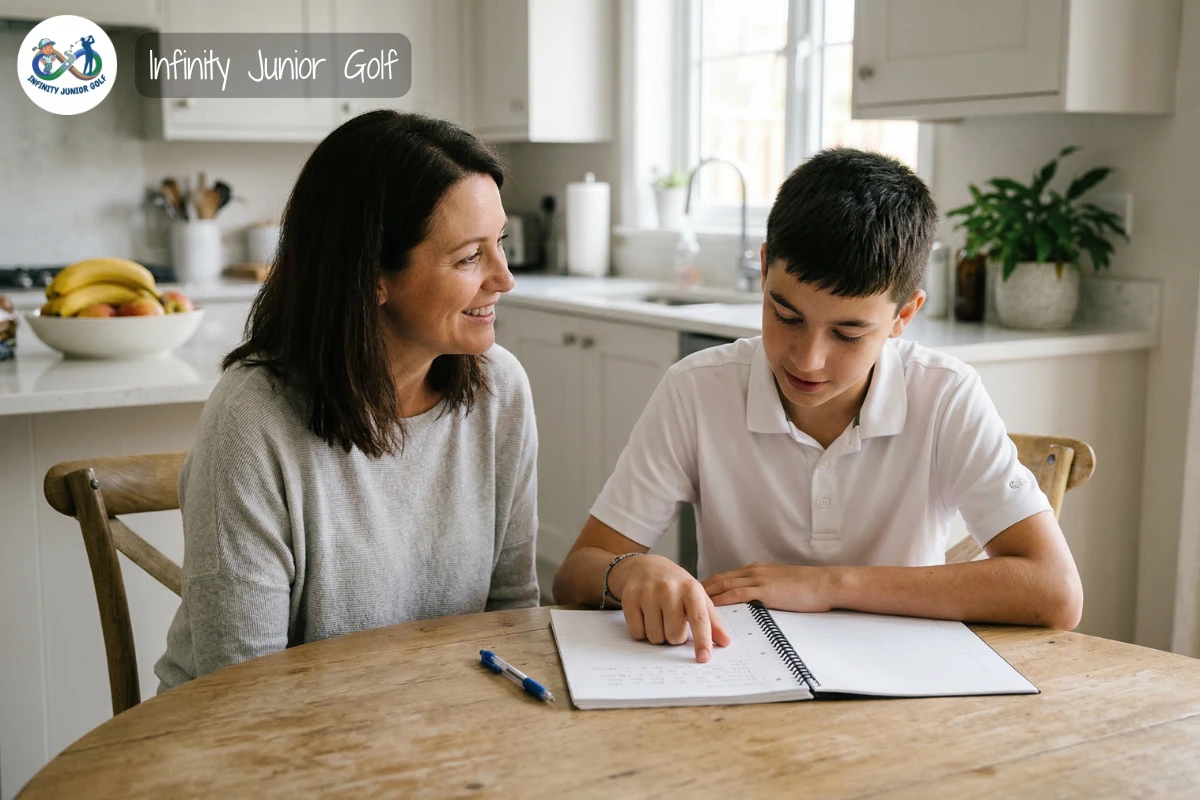
With the weekly framework in place, the next and arguably most important step is making sure the time actually spent at the course or driving range is as valuable as it possibly can be. That’s where a huge amount of junior development is either gained or quietly wasted — and it’s what we’re covering next.
Structuring Practice Sessions for Maximum Progress
Quality beats quantity every single time: The most common waste of practice time in junior golf is the aimless range session — a bucket of balls hit without a specific goal, in no particular sequence, with no feedback loop at the end of it. Effective junior practice follows a structured three-part model built around form, skill, and testing. The form component checks technical fundamentals; the skill component trains those fundamentals under varied conditions; the testing component finishes with a measurable challenge that genuinely reflects in-round performance. This structure applies whether a session runs for 45 minutes or two hours.
Short and focused sessions outperform long and unfocused ones: A 45-minute session with a clear structure consistently produces better development outcomes than a two-hour session without any. Short, focused sessions help juniors maintain concentration throughout, avoiding the attention drift that sets in — and produces very little improvement — when a young golfer is simply going through the motions. For families managing school nights and homework deadlines, this is genuinely encouraging: a well-structured 45-minute session on a Wednesday evening is meaningful, measurable golf development.
Track performance data to guide where the schedule focuses: One of the most practical tools available to modern junior golfers and their coaches is real performance data. When you can see exactly which parts of the game are costing the most shots — driving accuracy, approach distance control, short-game performance, or putting — you can allocate the limited practice time available each week with precision rather than guesswork. Arccos, golf’s number one game tracker, uses AI-powered smart sensors to automatically record every shot and deliver detailed Strokes Gained analytics showing precisely where a junior’s game is strongest and where it needs work — removing the guesswork from every practice plan.
⚙️ Recommended: Arccos Golf Smart Sensors
“I chose Arccos specifically for this use case because it answers the question that should shape every practice session: “Where does my junior actually lose shots?” Rather than guessing, Arccos gives you the data to build the whole practice plan around real weaknesses — not perceived ones.“
- ✅ Automatic shot tracking — no manual entry needed during play
- ✅ AI-powered analytics broken down by course zone and skill category
- ✅ Global storefronts — valid across US, AU, UK, CA, EU, JP
Journaling adds a layer that data alone can’t provide: Beyond digital tracking tools, encouraging a junior golfer to keep a simple practice journal — noting what they worked on, how it felt, and what they’d like to try next session — builds a level of self-awareness that accelerates improvement significantly. This habit of planning, reflecting, and reviewing transfers directly and usefully into academic work, making it one of the rare practices that genuinely develops both the golfer and the student at the same time.

With a well-structured practice plan sorted, the practical next question is where to find the right equipment and tools to support it all — both at the course and at home on school nights. The following section covers our top retailer picks, chosen specifically for how directly they serve the themes of this article.
Brands and Tools That Help Juniors Thrive — Our Recommendations
Every brand and tool in this list was chosen for one reason: it directly supports the kind of structured, balanced junior golf development this article is about. Whether you’re looking for a properly fitted set of clubs to match your junior’s current stage, a performance tracker that takes the guesswork out of practice planning, or home practice gear that makes a 30-minute school-night session genuinely worthwhile — these are the products and platforms worth knowing about. Each one has been selected because it solves a real problem that junior golfers and their families face, not simply because of brand recognition.
Our Retailer Recommendations
PING Prodi G
PING’s Prodi G junior clubs are purpose-engineered for young golfers at different growth stages, built using the same precision process as their adult clubs and supported by the WebFit Junior fitting app that helps match the right set to the right stage of development. No other major manufacturer has invested as deliberately in the reality that kids outgrow their equipment faster than their game — and that’s why PING leads this list for junior equipment.
Where to Buy This Set
| North America: Visit PING Golf |
| UK/Europe: Visit PING Golf |
| Rest of World: Visit PING Golf |
Arccos Golf
Arccos is the official game tracker of the PGA TOUR, using AI-powered smart sensors that automatically record every shot and deliver detailed analytics showing exactly where a junior’s game is strongest and where it’s leaking shots. For a junior golfer working within limited weekly practice time, that data is the difference between guessing and planning.
Where to Buy This Set
| North America: Visit Arccos Golf |
| UK/Europe: Visit Arccos Golf |
| Asia Pacific: Visit Arccos Golf |
| Rest of World: Visit Arccos Golf |
GlobalGolf
A leading online golf retailer covering clubs, apparel, accessories, and pre-owned junior equipment at all price point — with a PGA professional recommendation tool to help match gear to your junior’s playing style. GlobalGolf’s pre-owned junior club selection is what stands out specifically for this article: it’s one of the most practical options for families who don’t want to invest in brand-new equipment every time their junior has a growth spurt.
The Golfer’s Pick
A specialist retailer of home practice equipment — hitting nets, practice mats, and putting greens. For families building short evening sessions into a school-week schedule, having the right equipment at home removes the “we don’t have time to drive to the range” barrier completely. Their range is built specifically around home practice, which is the most accessible option for busy families.
Me and My Golf
One of the world’s most-watched online instruction platforms, co-founded by PGA professionals Piers Ward and Andy Proudman, offering coaching plans for all skill levels. Critically for this article, their content works on any device at any time — meaning a junior can access a focused technique session at 8pm on a school night without going anywhere. Their lessons are genuinely structured around long-term development, not just quick tip videos.
Mental Golf Type
Mental Golf Type delivers mental performance programs designed specifically for golfers, covering focus, pressure management, and the ability to perform consistently when it matters most — with resources including Lv1 Core Concepts and the Shot Process Formula, both available to male and female players. Mental skills are systematically underinvested in most junior development programs — and for a junior managing a full school schedule alongside competitive golf, the ability to compartmentalize pressure is useful in both environments.
With the right tools and resources in hand, there’s one dimension of the schedule that parents and coaches most often overlook — and it may be the single factor that holds everything else together over the long run. That’s the joy of the game itself, and protecting it deliberately is what we’re turning to now.
Protecting the Love of the Game
Fun is a performance strategy, not a luxury: It’s easy, particularly when a junior golfer starts to show genuine talent, for the atmosphere around their game to gradually shift from playful to pressured. The most respected junior development frameworks consistently identify enjoyment and intrinsic motivation as the actual foundations of long-term success. Johns Hopkins Medicine, citing AAP guidelines on youth sport specialization, notes that by sampling multiple sports and activities at early ages rather than specializing too soon, children have a greater chance of lifetime sports involvement,
lifetime physical fitness, and ultimately of accomplishing their long-term athletic goals. Young athletes who play because they genuinely love it are more resilient, more coachable, and far more willing to invest in the sustained deliberate practice that real improvement requires.
Unstructured play belongs deliberately in the schedule: Not every hour on a golf course needs to be a structured session with a measurable outcome. Scrambles with friends, casual nine-hole rounds where the scorecard barely matters, short-game competitions in the backyard — these unstructured moments are often where some of the deepest learning happens, because the junior is experimenting freely without a coach watching and without a result on the line. Building genuine free time and unstructured golf into the weekly plan isn’t a compromise on development; it’s a genuine part of it.
Communication is the foundation the whole schedule rests on: A schedule only works if the junior golfer is genuinely on board with it. Regular, relaxed conversations about how they’re feeling — not just about scores or technique, but about whether they’re enjoying it, whether they’re tired, whether any part of the schedule has started to feel like too much — give you the early signal you need to adjust course before exhaustion or quiet resentment sets in. Giving juniors a real voice in shaping their own schedule creates a sense of ownership that consistently proves to be one of the strongest protective factors against burnout.

The structure, the tools, the data, and the motivation to keep going are all now on the table. To bring everything together into something you can act on straight away, the next section distils the key takeaways from this entire article into ten clear, practical tips that parents and coaches can put to work this week.
Our Practical Tips For You
Getting the balance right is easier when the big ideas translate into small, specific actions. Here are ten tips — drawn from everything covered in this article — that parents and coaches can put into practice immediately.
| Tip | How to Implement It | How It Helps |
|---|---|---|
| Map the school week before adding golf | Lay out all school hours, homework, meals, and sleep as fixed blocks first. Golf slots fill what remains. | Ensures golf fits around academic demands rather than competing with them. Reduces weekly friction and stress for the whole family. |
| Set practice frequency by school term | Agree on a set number of sessions per week for the current school term. Review and adjust at each term break. | Creates consistency without rigidity. Gives the schedule room to flex around exams or heavy assignment periods. |
| Use a shared digital calendar | Tools like Google Calendar or TimeTree allow parents, coaches, and juniors to view the same schedule in real time. | Eliminates last-minute confusion and missed sessions. Keeps all parties aligned without repeated check-in conversations. |
| Structure every session in three parts | Divide each session into a form check (10 min), skill practice (25 min), and a measurable test or game (10 min). | Short structured sessions produce significantly better focus and retention. Works equally well at the range or at home. |
| Track round performance with data | Use a shot-tracking tool to log rounds and identify the specific areas costing the most shots each week. | Removes guesswork from practice planning. Directs limited time to the skills that will produce the biggest improvement. |
| Plan the tournament calendar at term start | Map all upcoming events at the beginning of each school term and build study schedules around them in advance. | Prevents last-minute academic pressure before tournament weekends. Avoids travel disrupting key school deadlines. |
| Give your junior a genuine voice | Sit down together each week and let them flag anything that isn’t working or that they’d like to change. | Builds real ownership and long-term motivation. Surfaces early warning signs before burnout has a chance to develop. |
| Protect at least one full rest day per week | Choose one day — often a Sunday or a lighter school evening — as a complete rest day from all structured golf activity. | Physical and mental recovery is when improvement from practice consolidates. Rest is development, not a gap in it. |
| Invest in basic home practice gear | A practice net, putting mat, or chipping target at home makes short school-night sessions possible without travel. | Maintains habit and momentum on evenings when the range isn’t practical. Even 20 focused minutes at home counts. |
| Review and reset the schedule each term | At the start of every new school term, sit down as a family and assess what’s working, what isn’t, and what to change. | Junior golfers’ needs evolve constantly. A schedule built for a twelve-year-old will not serve a fifteen-year-old. |
These tips work best applied together rather than in isolation, and even putting three or four of them into consistent practice will produce a noticeable shift — both in how your junior performs and in how they actually feel about the whole experience. Before we wrap up, here are a few of the questions that come up most often from parents who are working through this for the first time.
FAQs
How many days a week should a junior golfer practise?
For juniors under twelve, two to three purposeful sessions per week is a strong foundation. Older teens with serious competitive goals typically benefit from three to four structured sessions. Quality and intent consistently matter more than sheer volume.
Should golf always take a back seat to school commitments?
In general, yes — and especially during exam periods and significant assignment deadlines. A junior who stays on top of schoolwork experiences far less scheduling conflict overall and tends to be a calmer, more focused golfer as a result.
What’s the single biggest scheduling mistake parents make?
Overloading the calendar — particularly early in a junior’s competitive journey. Enthusiasm is a wonderful thing, but cramming in too many sessions and too many tournaments too soon is the most common and most preventable path to burnout.
How do I know if my junior’s schedule has become too full?
Watch for a combination of signals: declining enthusiasm for practice, fatigue that carries into the school week, emotional volatility around rounds, or a simultaneous drop in both academic and golf performance. Any two of these together is a clear prompt to ease back and reassess.
Our Related Articles

10 Essential Stretches For Young Golfers
Golf is one of the most accessible and rewarding sports a young person can take up, but it places surprisingly demanding physical requirements on the…
Read More
Top Junior Golf Tournaments In The US
Junior golf tournaments play an essential role in developing young golfers’ skills, competitive mindset, and passion for the game. Across the United States, numerous tournaments…
Read More
Why Goal Setting Matters For Young Golfers
Goal setting transforms how young golfers approach the game, turning aimless practice sessions into purposeful development opportunities. When junior players establish clear targets, they create…
Read MoreConclusion
Building a balanced schedule for a junior golfer isn’t about finding a perfect formula and locking it in forever — it’s about creating a structure that’s flexible enough to grow with your child, firm enough to protect their academics and their health, and honest enough to keep the love of the game right at its centre. The families who get this right over the long term don’t necessarily have the most detailed spreadsheets or the most coaching hours; they have open communication, a genuine willingness to adjust when something isn’t working, and a clear-eyed understanding that a happy junior golfer is almost always a better junior golfer.
The schedule should serve your junior — not the other way around. Start with the school week, build the golf around it, protect the rest days, track the performance, and keep checking in. When all of those pieces are working together, the results on the course tend to take care of themselves.
What does the balance look like in your household right now — and what’s the one scheduling change that made the biggest difference for your junior golfer? Share your experience in the comments below; your insight might be exactly what another golf family needs to hear today.